
Australia versus New Zealand: Count the Stars Before Comparing the Flags
Australia’s and New Zealand’s national flags share a blue field and the Union Jack in the upper hoist area. Those familiar features are not enough to distinguish the two. A more useful check separates the stars into groups, then looks at their colours and points. The first question is whether you are counting the entire flag or only the Southern Cross.
This guide compares the current national designs. It is not a guide to other ensigns, historical versions, official-use eligibility or flag manufacturing. The accompanying graphics are explanatory counting keys, not reproductions of either flag’s official geometry.
Ask which count you mean
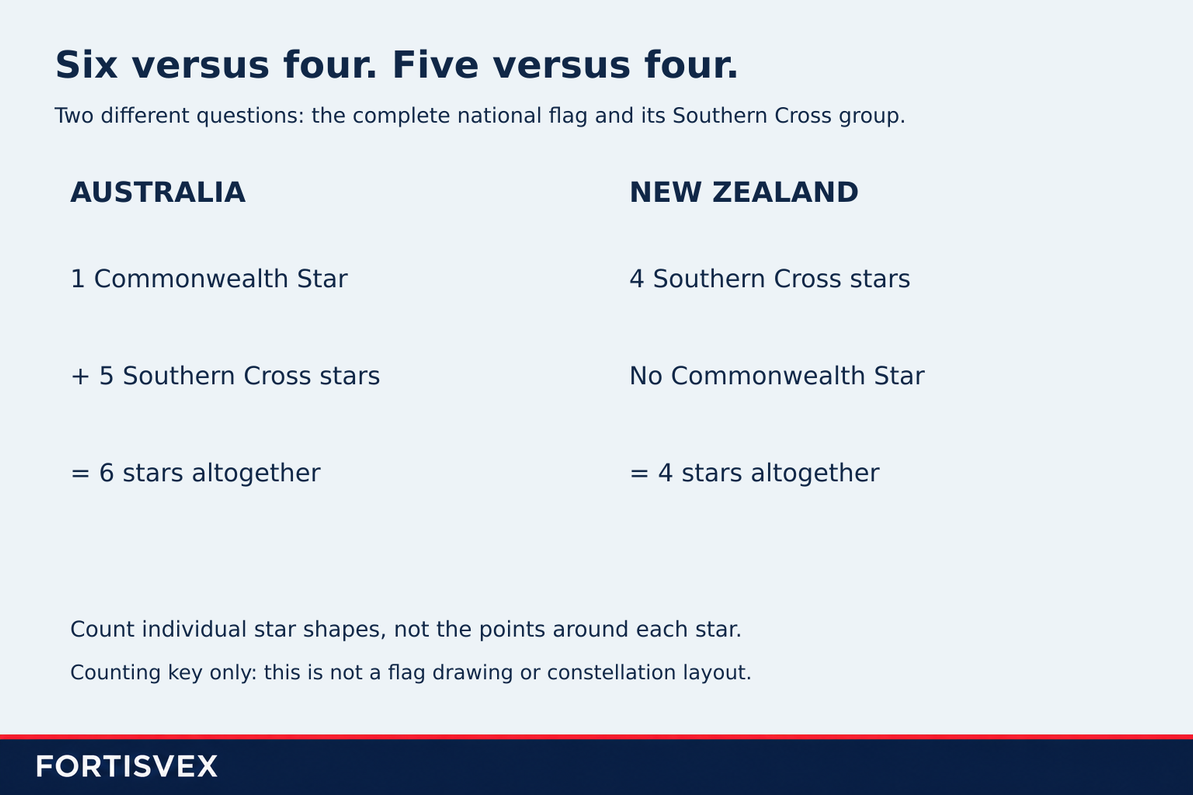
The Australian Government’s national-flag explanation identifies a Commonwealth Star below the Union Jack and a separate five-star Southern Cross on the fly, the part away from the hoist. Adding those groups gives six stars across the complete design.
The New Zealand Ministry for Culture and Heritage’s design account describes four stars on the fly. New Zealand’s national design does not include Australia’s separate Commonwealth Star. Its whole-flag star count is therefore four.
That gives two valid comparisons: six versus four for the whole flag, or five versus four for the Southern Cross group. Mixing those questions produces an unhelpful shorthand. A caption that says “Australia has five stars” needs to specify the group, because it has left out the separate star beneath the Union Jack.
Look below the Union Jack, then across the fly
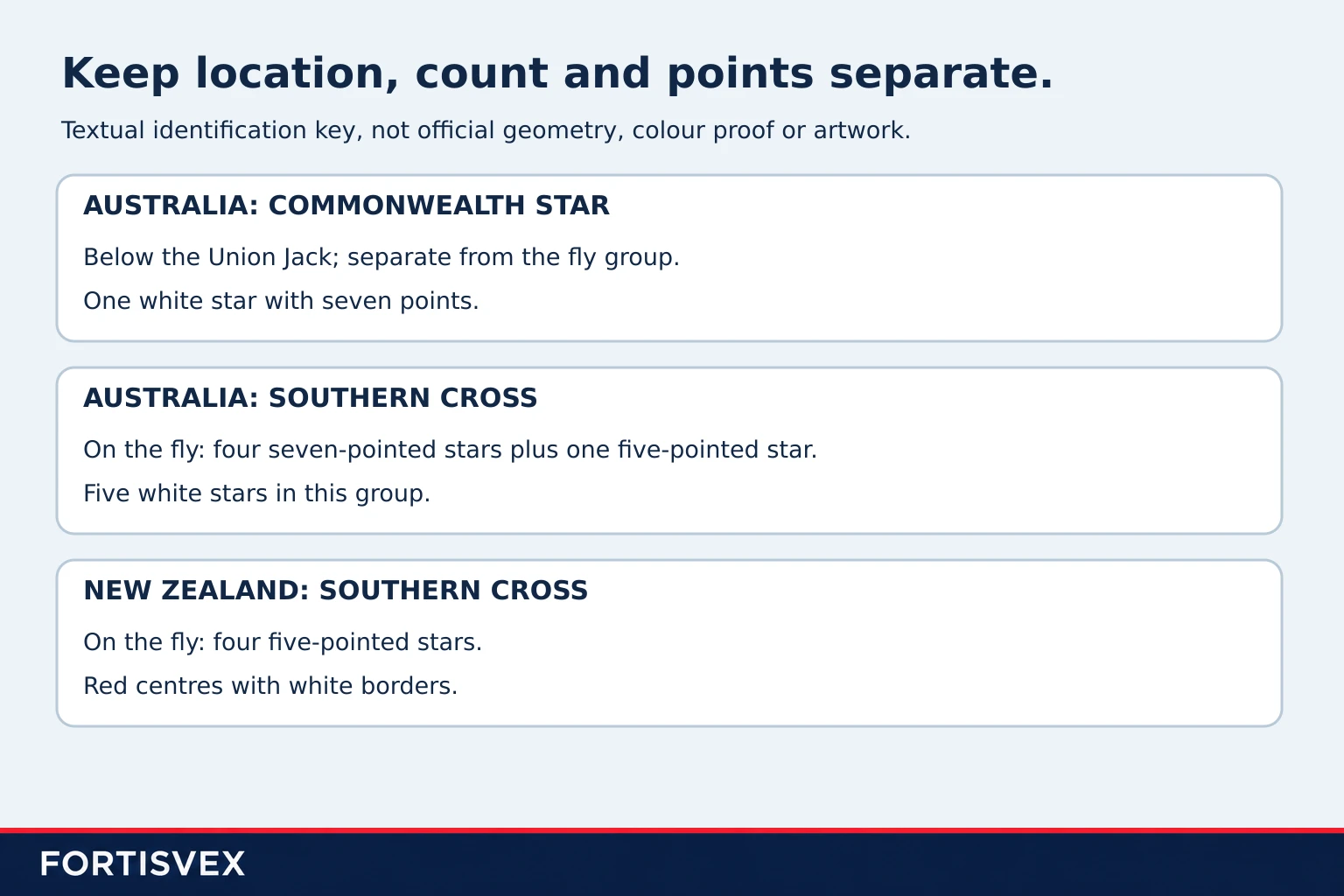
Start with a complete, flat reference image. Locate the Union Jack, then examine the area below it. On Australia’s flag, this is where the Commonwealth Star appears. Next look at the group on the fly. Do not treat the isolated star and the constellation group as one continuous arrangement.
Our article on Australia’s two different star stories explains their symbolism and design history. Here, their separate locations serve a narrower purpose: they help a reader identify which group is being counted without importing that history into New Zealand’s design.
Count stars, not their points
A star is one shape even when it has several points. Australia’s Commonwealth Star has seven points. Within its Southern Cross, four stars have seven points and the smaller star has five. New Zealand’s four stars each have five points. These details help confirm an identification, but a small photograph may not resolve every point.
The distinction between counting objects and reading their arrangement also matters in our U.S. star-field counting guide. That is a separate design with its own row pattern. It is useful as a counting exercise, not evidence that the stars on these three countries’ flags carry interchangeable meanings.
Use colour as a second check
Australia’s stars are white. New Zealand’s stars have red centres and white borders. Check the star shapes themselves rather than relying on the blue background, which both national designs share. If glare or a low-resolution image obscures the red centres, return to a clearer reference instead of guessing.
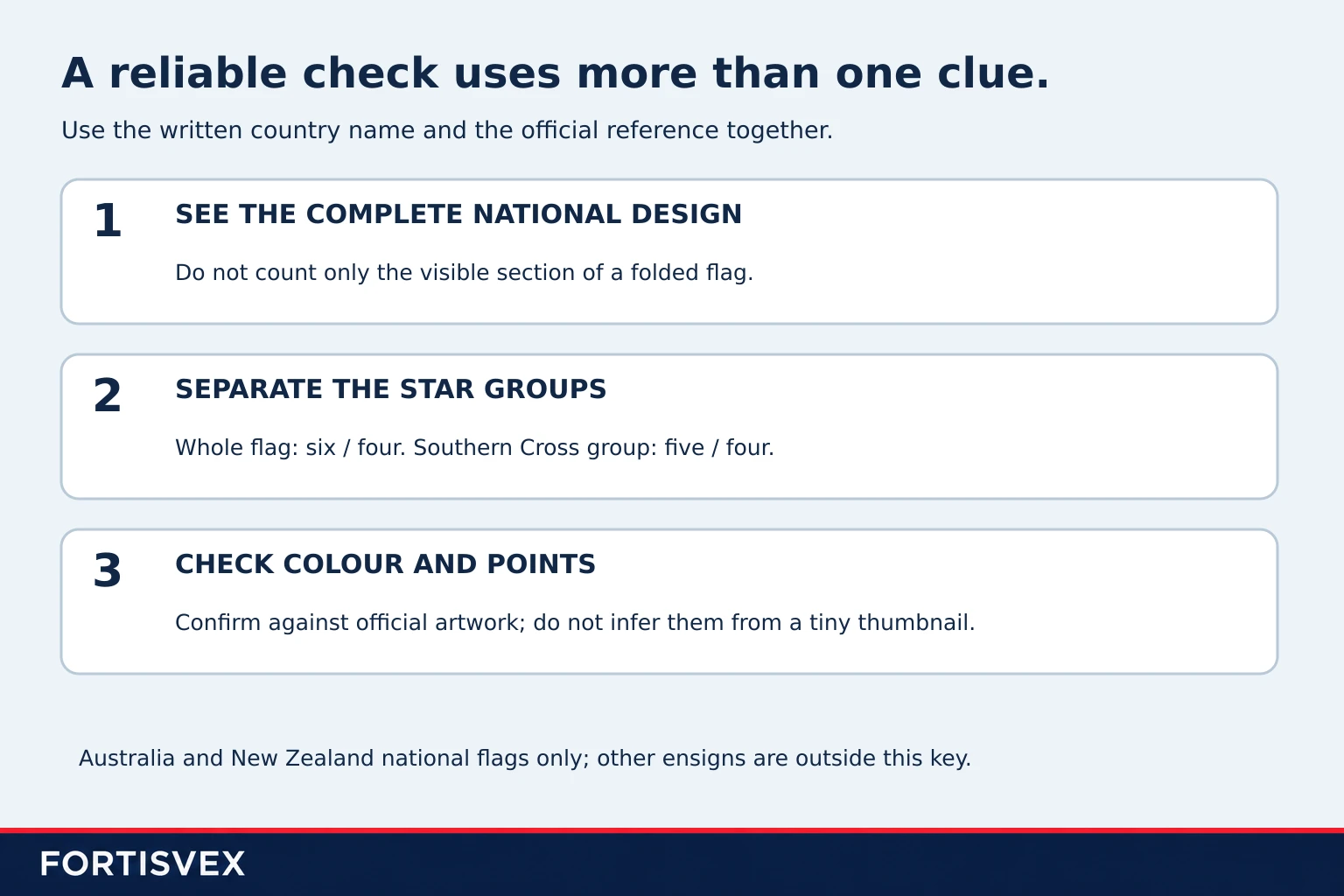
A white outline is not an extra star, just as seven points do not make seven stars. For a worksheet or display caption, record the observations in separate fields: whole-design count, fly-group count, star colour and point pattern. Keeping those fields separate makes an error easier to spot than a single vague description such as “blue flag with white stars.”
Keep identification separate from historical dating
A present-day visual key cannot establish when a particular flag, photograph or drawing was made. For the earlier maritime and legal milestones of New Zealand’s flag, see our 1869-to-1902 history. That chronology is a different reader task from distinguishing two current designs.
Likewise, an educational key is not a production proof. Use the official artwork for exact layout and reproduce neither flag by rearranging this article’s text boxes. Before approving a caption, ask: did I name the national design, state which group I counted, and check the colour and points in a complete reference? Those three checks keep a quick comparison precise without turning it into an unsupported specification.
Recent Posts
-
Czechia’s Flag: The Blue Wedge Reaches Halfway Along the Fly
Czechia’s flag is not fully identified by a glimpse of white above red. The blue wedge at the attach …Nov 18th 2026 -

A Capitol-Flown Flag: What Its Certificate Can Tell You
A flag described as “flown over the Capitol” carries a claim about an event, not simply a descriptio …Nov 18th 2026 -
The Olympic Flag: Why Ring Colours Are Not a Continent Key
A colour-coded continent legend can make an Olympic flag display look easy to explain. It also gives …Nov 18th 2026