
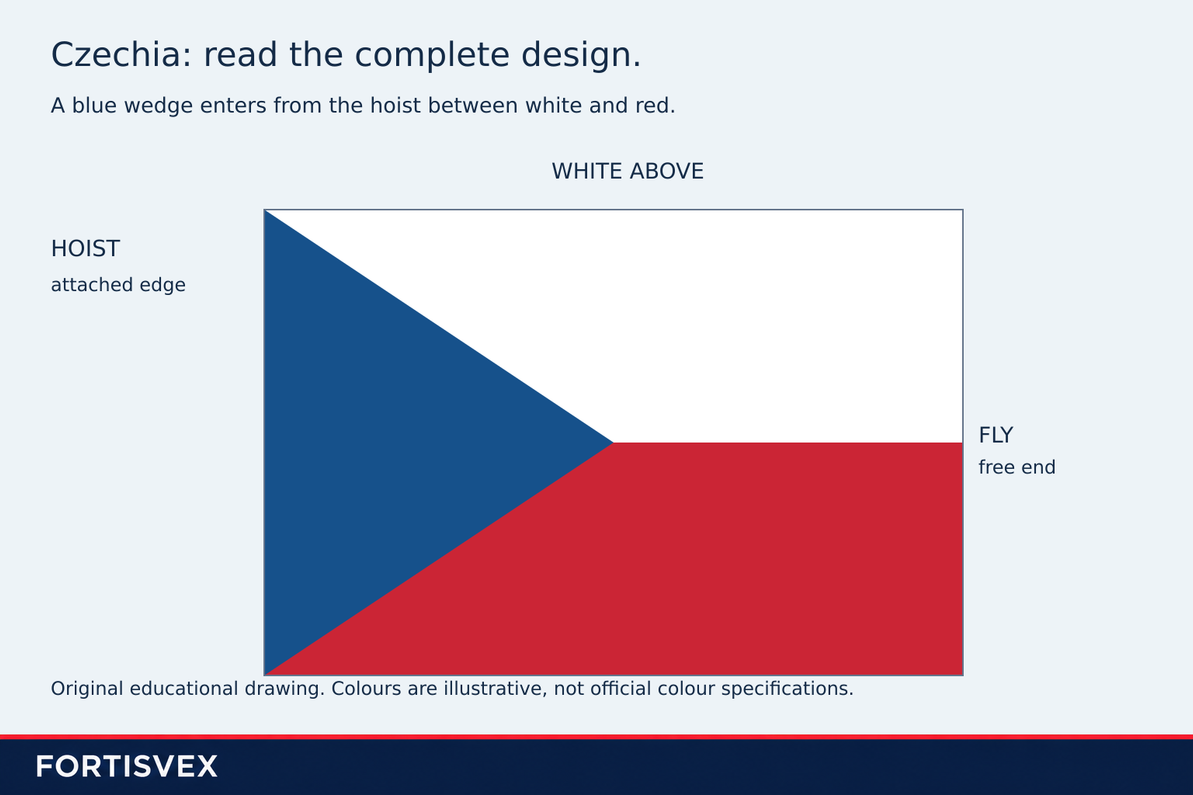
Czechia’s Flag: The Blue Wedge Reaches Halfway Along the Fly
Czechia’s flag is not fully identified by a glimpse of white above red. The blue wedge at the attached edge is an essential part of the design, and its tip has a defined position: halfway along the flag’s length.
For a classroom reference, a display label or an artwork check, start with the whole rectangle. A folded flag or a close crop may hide the very feature that distinguishes this design.
Find the hoist before following the wedge
The Prague Castle description of Czech state symbols, under “Státní vlajka,” places white above red and describes a blue wedge entering from the hoist to half the flag’s length. The hoist is the attached edge; the fly extends away from it. The wedge’s base runs along the hoist, while its point meets the boundary between the white and red fields.
That complete arrangement matters more than a two-colour glimpse. Our Poland–Indonesia top-band comparison deals with plain two-band flags. Czechia adds the blue hoist wedge, so a cropped white-over-red section is not enough to identify the flag.
Keep height and length separate
Prague Castle gives the flag’s height-to-length relationship as 2:3. In a simple educational drawing, a height of two units therefore pairs with a length of three units. Half of that three-unit length is 1.5 units: that is the distance from the hoist to the wedge tip.
The 1.5-unit figure is arithmetic based on the source’s half-length description, not an additional official measurement or a product size. For a larger drawing, a height of 20 units gives a length of 30 and a wedge depth of 15. Scaling all three together keeps the same geometry.
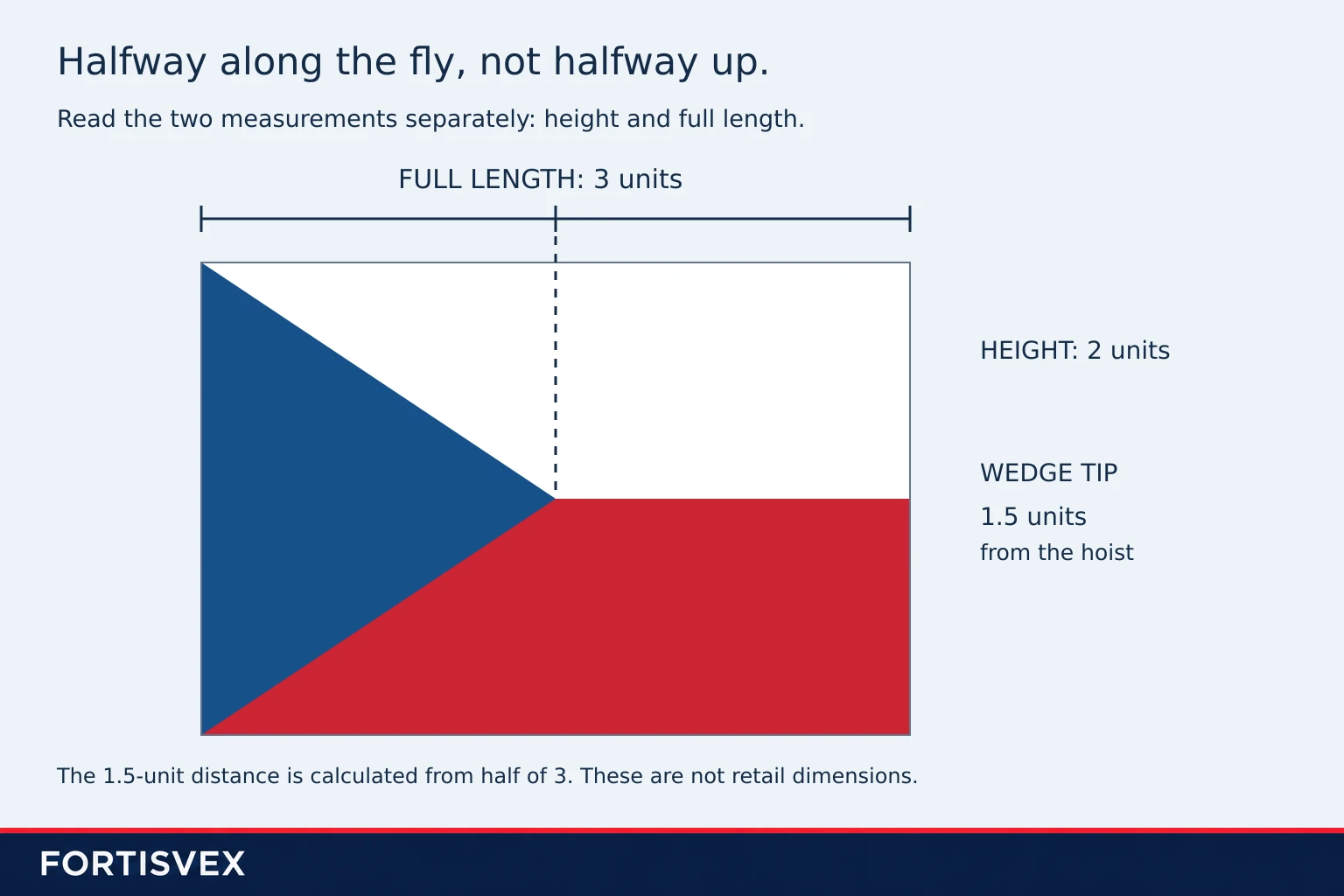
Our hoist-and-fly proportions guide explains why a ratio describes shape rather than a particular offered size. Here, the useful check is whether the wedge and the rectangle were scaled together. Stretching only the background or moving the point by eye changes the relationship.
Use the country’s own vertical reference
The same Prague Castle page also describes the vertically hanging flag from the viewer’s position: white is on the left, red on the right, and the blue wedge is at the top pointing downward. That is the reference used in the vertical educational key below.
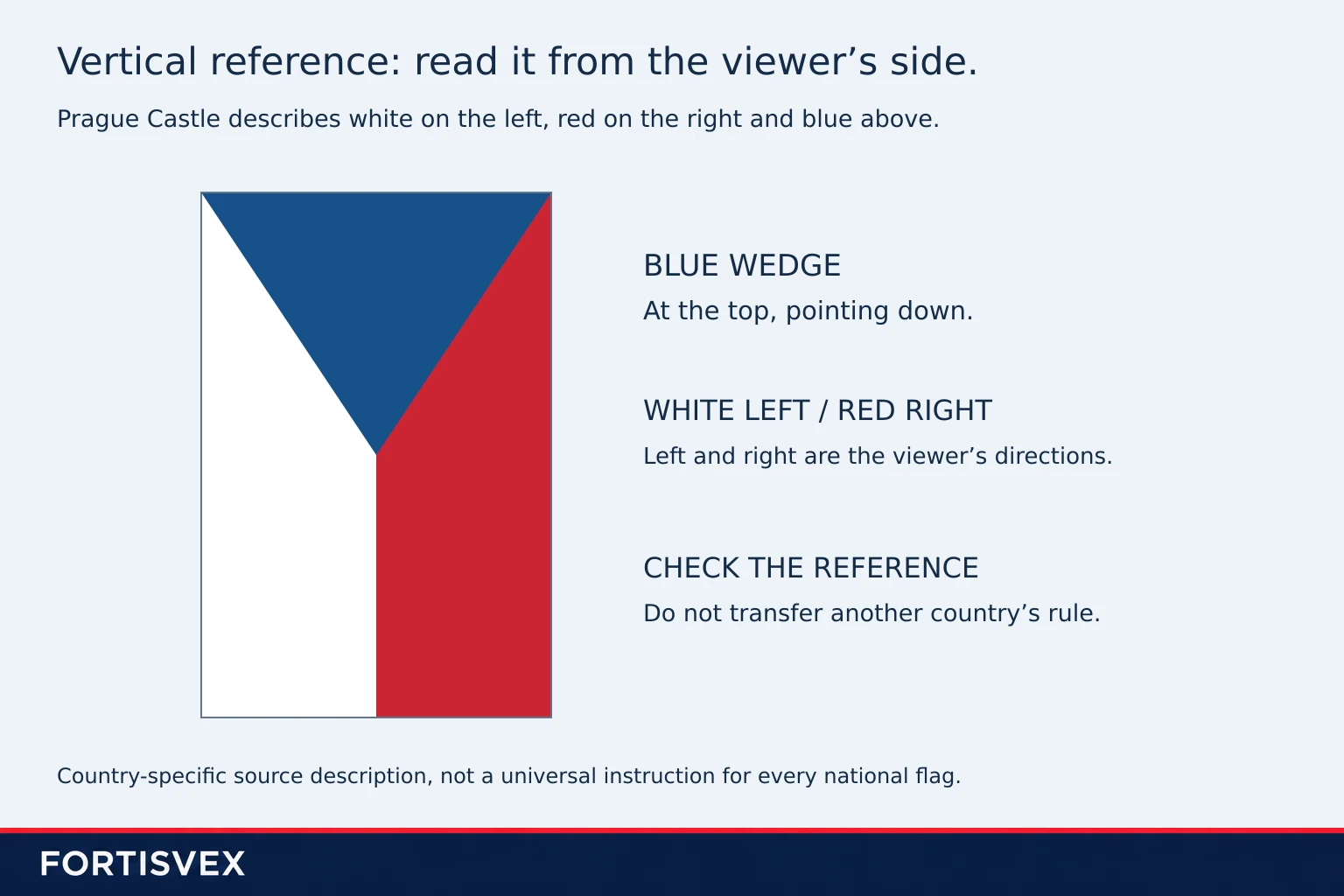
Do not replace that description with a rule remembered from another flag. Our Philippine flag article shows why display position can depend on a country’s particular source and circumstances. Its peace-and-war distinctions do not apply to the Czech design.
A short, useful identification note
A reference card can record four things: Czechia; white above red in the horizontal view; blue wedge at the hoist; and wedge tip halfway along a 2:3 rectangle. If the reference shows a vertical display, add the viewer’s position and the source’s white-left, red-right description instead of leaving orientation implicit.
These original diagrams explain the geometry and orientation described by Prague Castle. Their screen colours are illustrative, not official colour references, sewing templates or photographs of a physical FORTISVEX product. They do not establish manufacturing tolerances, hardware compatibility or permission for every use of a national symbol.
For further source context, the Czech Government’s historical account of the national flag also describes the 2:3 rectangle and half-length wedge. Its account discusses more than one historical flag; do not detach a description of an earlier plain bicolour from its date and treat it as the current design.
Recent Posts
-
Czechia’s Flag: The Blue Wedge Reaches Halfway Along the Fly
Czechia’s flag is not fully identified by a glimpse of white above red. The blue wedge at the attach …Nov 18th 2026 -

A Capitol-Flown Flag: What Its Certificate Can Tell You
A flag described as “flown over the Capitol” carries a claim about an event, not simply a descriptio …Nov 18th 2026 -
The Olympic Flag: Why Ring Colours Are Not a Continent Key
A colour-coded continent legend can make an Olympic flag display look easy to explain. It also gives …Nov 18th 2026