
The Olympic Flag: Why Ring Colours Are Not a Continent Key
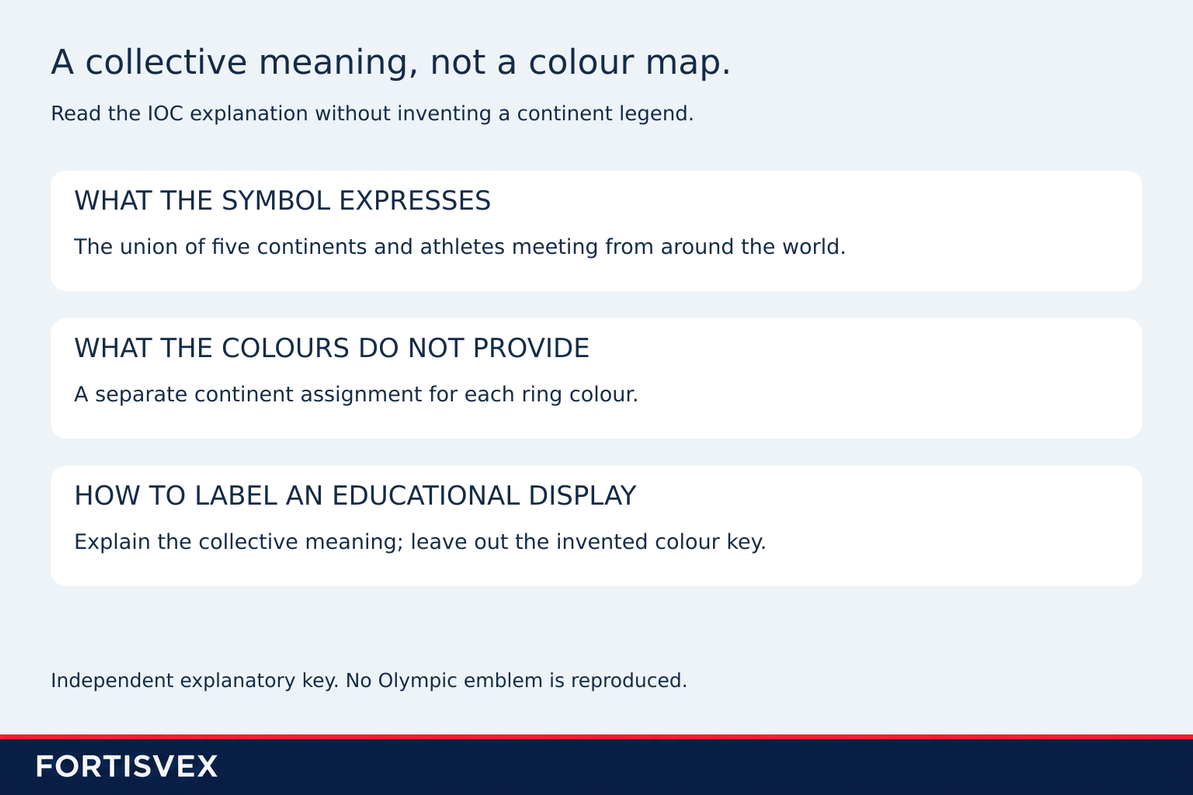
A colour-coded continent legend can make an Olympic flag display look easy to explain. It also gives the reader the wrong key. The International Olympic Committee explicitly rejects assigning a particular continent to each ring colour.
The useful question is not “Which continent is the blue ring?” It is “What does the symbol express as a whole?” Keeping those questions separate makes a classroom caption or exhibit label more accurate.
Explain the whole symbol
The IOC’s explanation of the Olympic rings describes their collective meaning as the union of five continents and athletes from across the world meeting at the Games. It does not provide a continent-by-colour legend.
For a display label, a concise paraphrase would be: “The rings express the coming together of continents and athletes, rather than assigning a continent to each colour.” Attribute that explanation to the IOC. This is a suggested educational caption, not an official quotation.
Keep 1913 in the colour explanation
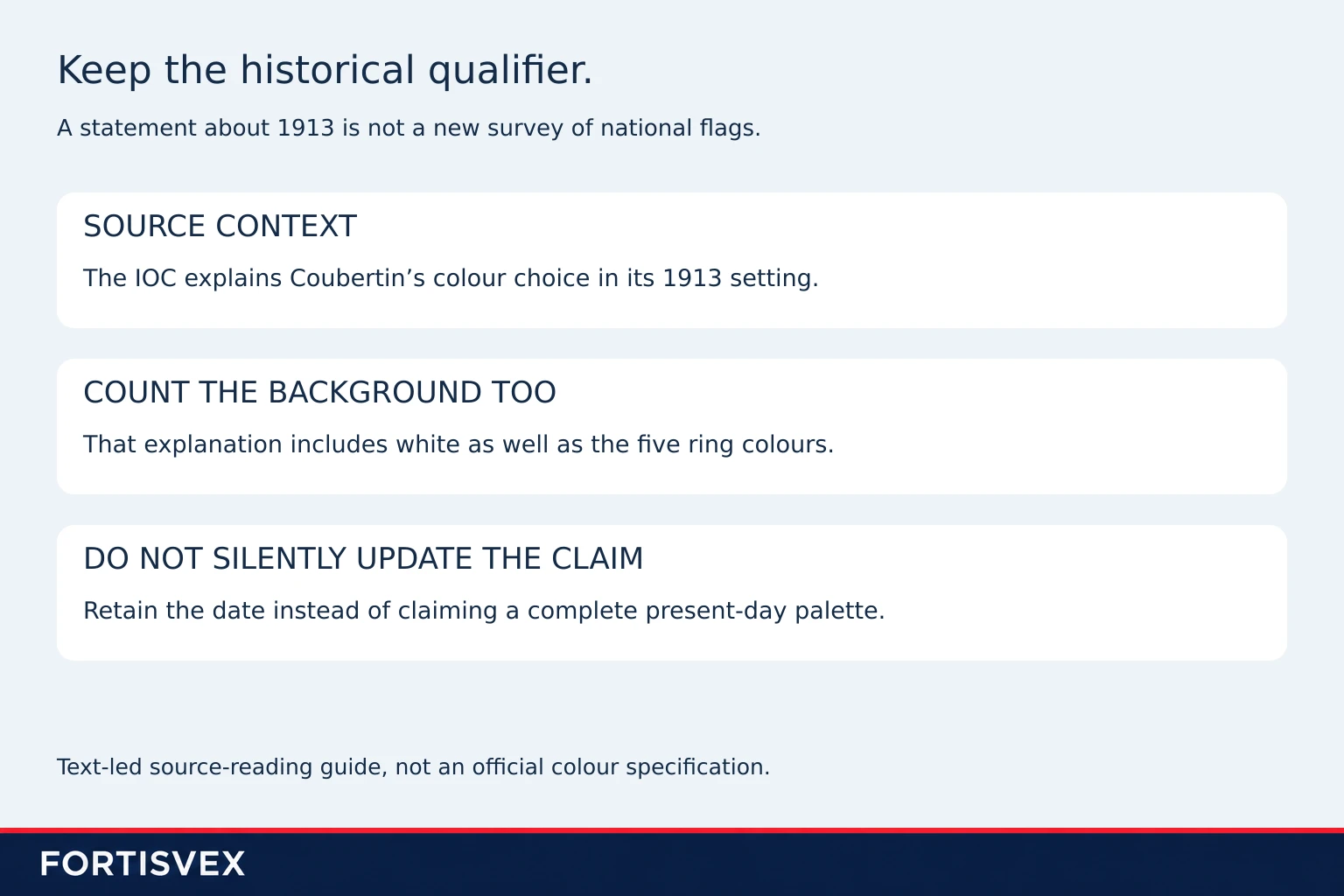
The same FAQ places Pierre de Coubertin’s colour choice in 1913. It explains the five ring colours together with the white background in relation to national flags at that time. Keep that historical setting; do not rewrite it as a newly checked claim about every national flag today.
A better classroom activity
Instead of asking students to connect each colour to a continent, give them two statements to assess: a collective explanation attributed to the IOC, and a colour-by-continent legend without a supporting source. Ask which statement the source actually supports. The exercise becomes one of reading evidence rather than memorizing an invented map.
That distinction has useful parallels. The European flag’s twelve stars are not a membership count, and Canada’s maple-leaf points should not be assigned to provinces. These are separate designs with separate documented explanations, not a universal rule that numbers never have meaning.
Keep interpretation separate from affiliation
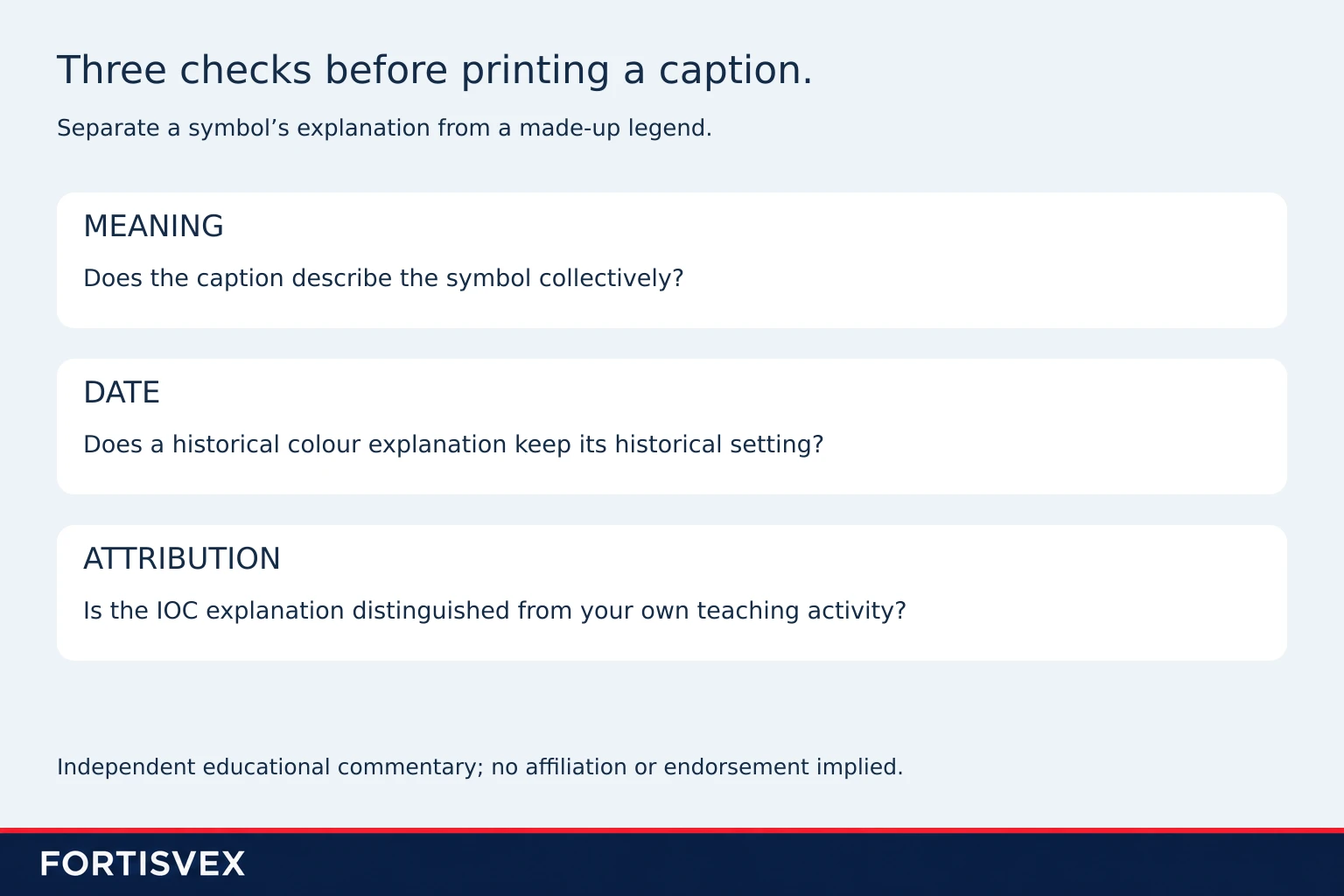
A clear explanation of a flag does not make a school, business or publisher an official partner of the institution behind it. Our guide to reading the United Nations flag makes a similar distinction between understanding an emblem and permission to use it as an organization’s identity.
This is independent FORTISVEX educational commentary. The original text-led keys do not reproduce the Olympic rings, supply official artwork or colour specifications, or imply IOC affiliation or endorsement. Olympic symbols and related rights remain separate from this explanation.
Recent Posts
-

Czechia’s Flag: The Blue Wedge Reaches Halfway Along the Fly
Czechia’s flag is not fully identified by a glimpse of white above red. The blue wedge at the attach …Nov 18th 2026 -

A Capitol-Flown Flag: What Its Certificate Can Tell You
A flag described as “flown over the Capitol” carries a claim about an event, not simply a descriptio …Nov 18th 2026 -

The Olympic Flag: Why Ring Colours Are Not a Continent Key
A colour-coded continent legend can make an Olympic flag display look easy to explain. It also gives …Nov 18th 2026