
Why the European Flag Keeps Twelve Stars
Twelve gold stars form a circle on a blue field. The European flag is easy to recognize, but its number invites a persistent misunderstanding: the stars are not a running count of countries. You cannot work out an institution’s membership by counting them, and a change in membership does not require another star.
Why twelve stays twelve
The Council of Europe’s account of the flag describes twelve as a symbol of perfection and completeness. The EU’s official explanation of the European flag emphasizes unity, solidarity and harmony, and explicitly separates the star count from the number of EU countries.
Those explanations give you a better caption than a list of twelve supposed member states. The circle communicates an idea about Europe; it does not function as a membership chart. If a classroom activity asks students to label each star with a country, change the exercise. Put the institutional membership information on a separate, dated map or list, where it can be checked and updated without rewriting the meaning of the flag.
The flag began with the Council of Europe
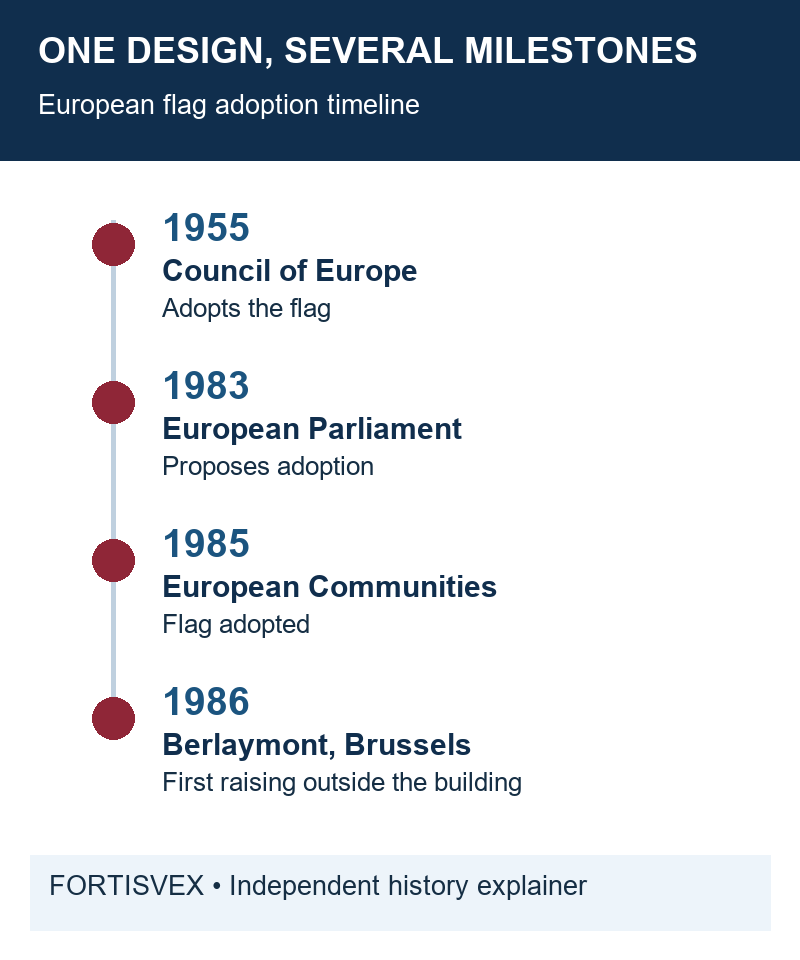
The Council of Europe’s Parliamentary Assembly approved the star-circle emblem on October 25, 1955. Its Committee of Ministers adopted the flag on December 9, and the official launch took place in Paris on December 13. These dates describe different stages of a decision, not competing answers to the same question. The Council’s history records that sequence.
How it became associated with the EU
The EU’s chronology places the European Parliament’s proposal in April 1983, adoption by European leaders in June 1985, and the flag’s first raising outside the Berlaymont building in Brussels in May 1986. At the adoption stage, the institution was the European Communities, which later became the EU. That is why an account that jumps straight from “1955” to “EU flag” leaves out an important part of the story. Read the EU’s timeline.
For an exhibit label, keep the sequence compact but explicit: Council of Europe origins, followed by European Communities adoption. There is no need to turn the caption into a list of every later European event. The useful information is the relationship between the design and the institutions that adopted it.
Similar names, different organizations
The Council of Europe is separate from the EU. Based in Strasbourg, it was created in 1949 to promote democracy, human rights and the rule of law. Its own guide to commonly confused European institutions is a helpful reference when a photograph, building sign or caption leaves you unsure which body is involved.
Do not use the flag alone to identify the institution in an image. Read the building name, event description and original caption. A photograph may show the familiar design clearly while offering little evidence about the occasion. This is especially important when preparing educational material: an accurate flag image can still acquire an inaccurate caption.
Three checks for a clearer display
- Meaning: Explain the fixed symbolic count rather than assigning a country to each star.
- History: Name the institution and describe what happened on the date you give.
- Context: Separate an educational illustration from a claim of institutional support or endorsement.
When comparing this design with other international flags at FORTISVEX, begin with what the symbol represents. Then consider the physical display separately: size, attachment and setting are practical choices, not facts you can deduce from twelve stars. This is an independent FORTISVEX explanation, with no institutional affiliation implied.
Recent Posts
-

Rupert, Idaho: Read the History Around the Town Square
Rupert’s historic square rewards a closer look than a quick photograph. Its buildings record change …Oct 29th 2026 -
Reading the Swiss Flag: Shape, Cross and Context
The Swiss flag is easy to recognize, but its simplicity rewards a closer look. Its ordinary national …Oct 29th 2026 -
Why the European Flag Keeps Twelve Stars
Twelve gold stars form a circle on a blue field. The European flag is easy to recognize, but its nu …Oct 29th 2026