
Reading a U.S. Flag’s Star Field: Count the Alternating Rows
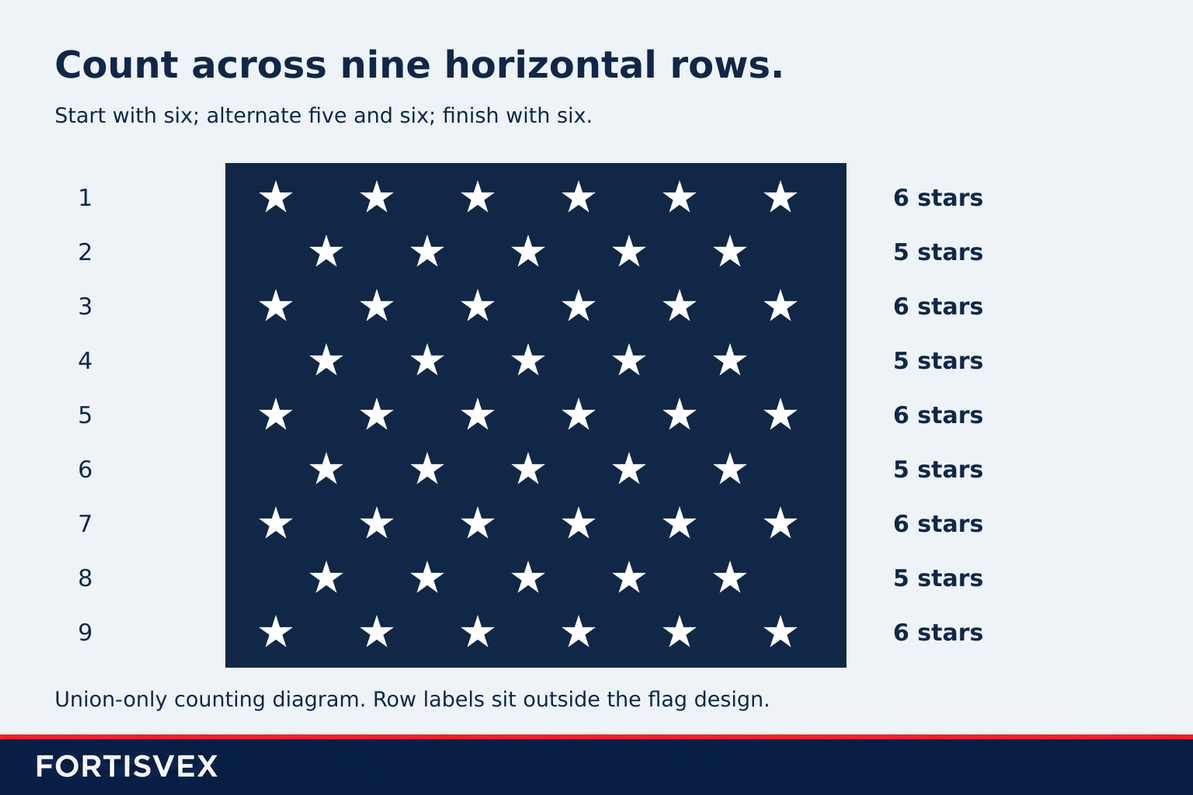
The current U.S. flag’s star field is easier to read as a pattern than as fifty separate objects. Look across the blue union one horizontal row at a time: six stars, then five, then six again. Continue that alternation through nine rows, ending with six.
The arrangement is not a rectangular grid with the same number of stars in every row. The shorter rows are offset between the positions in the longer rows. Recognizing those two features gives you a practical way to check a clear illustration without losing your place.
Start with the official arrangement
Part I of Executive Order 10834, as transcribed by the National Archives, refers the positions of the stars to the order’s attached diagram. That diagram appears on page 6865 of the August 25, 1959 Federal Register. It shows the staggered nine-row arrangement used here.
Our diagrams isolate the counting pattern. They are educational illustrations, not photographs of a flag for sale, complete production artwork or dimensional inspection templates. The official drawing includes proportional information that is outside this counting guide’s scope.
Count the rows before adding the stars
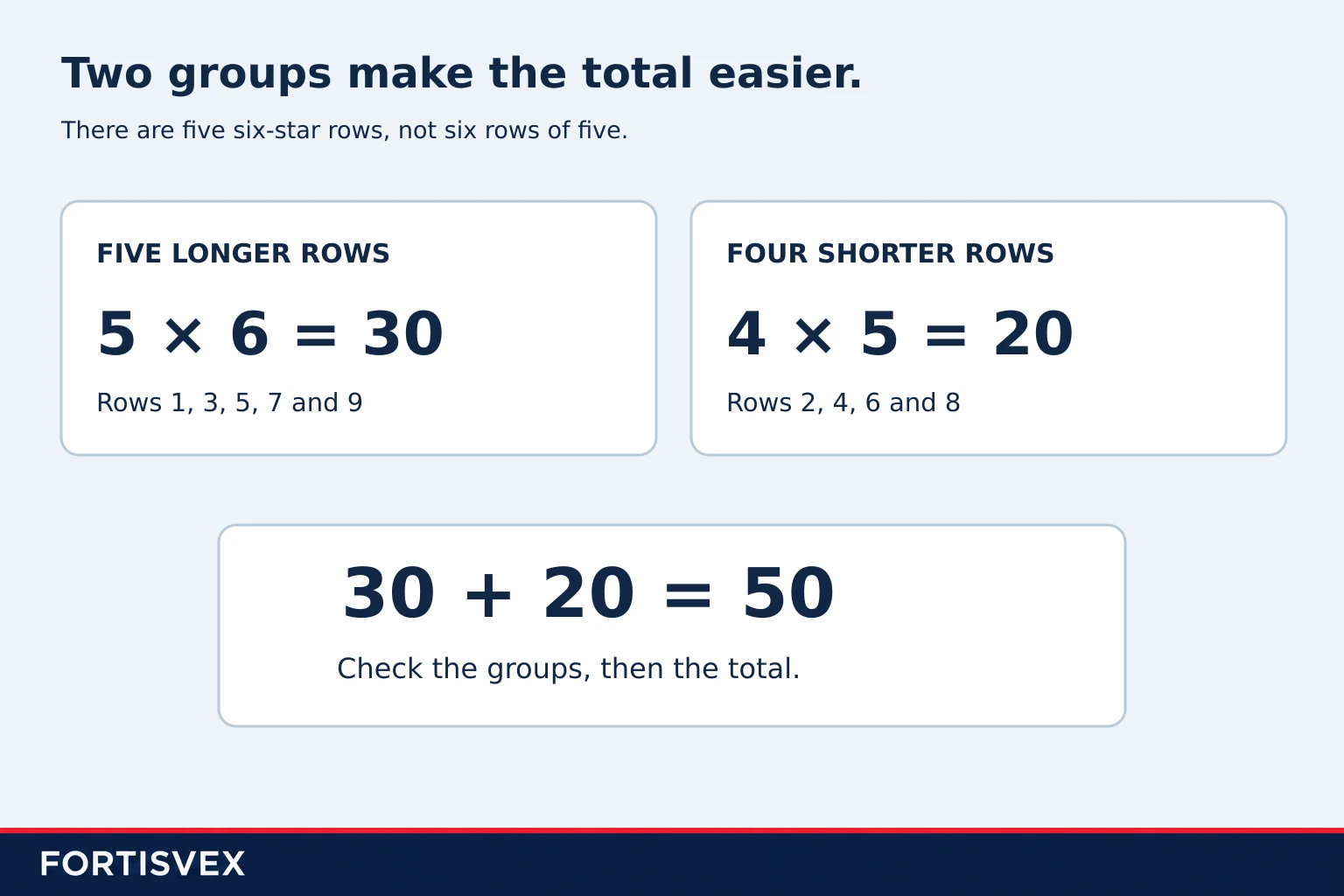
Begin at the top of the union and count downward. There are nine horizontal rows. Rows 1, 3, 5, 7 and 9 each contain six stars; rows 2, 4, 6 and 8 each contain five. That leaves five longer rows and four shorter ones.
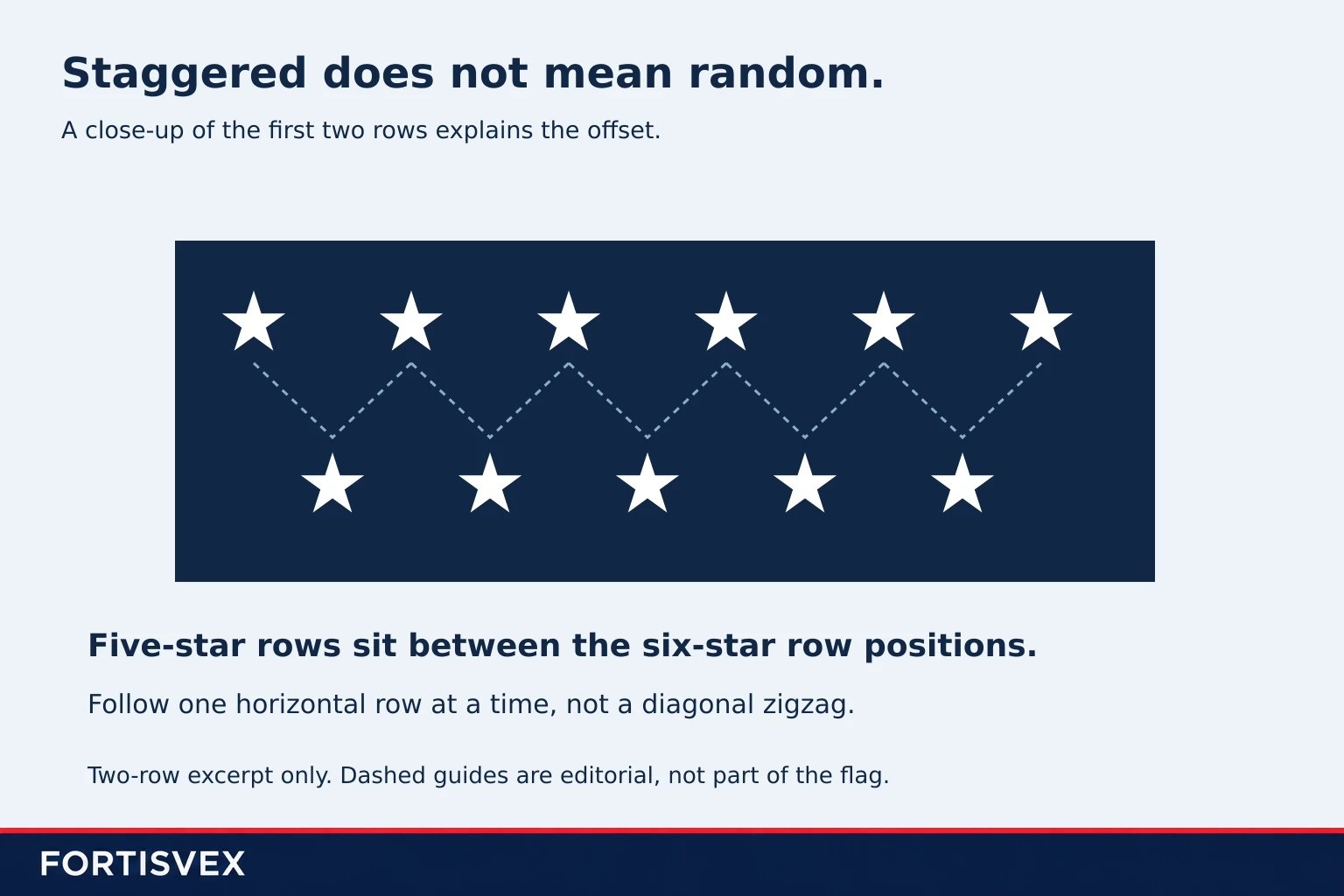
Check one row across before moving to the next. If you follow the diagonal pattern instead, it is easy to jump between rows and count a star twice. When working from a photograph, enlarge the image enough to distinguish neighboring stars rather than guessing at white marks in a small thumbnail.
Use the arithmetic as a second check
Five rows of six produce 30 stars. Four rows of five produce 20 more. Add those groups to reach 50. This is a quick check on a row-by-row count, not a substitute for looking at the arrangement itself.
A drawing can contain fifty stars yet place them differently. Confirm both the total and the alternating layout when the illustration is meant to depict the current design. Do not treat a different historical arrangement as an automatic mistake: our guide to the 49-star U.S. flag explains a separate official design from an earlier period.
See how the rows are staggered
Compare the first two rows. The five stars in the second row sit horizontally between neighboring stars in the six-star row above. The third row returns to the six-star positions. This repeating offset is what creates the diagonal lines you notice when looking at the union as a whole.
If the fabric is folded, curled around a pole or partly outside the photograph, some stars may be hidden. Record that as an incomplete view rather than declaring the flag short of stars. A full, clear view of the union is the right starting point for a count.
Know what a count does not establish
Counting stars does not tell you the fabric, stitching method, finished dimensions or country of manufacture. Nor does a mirrored-looking view by itself establish a printing error. Our explanation of single-reverse and double-sided flag printing addresses why the back can look different from the front.
For an older flag or reproduction, first establish which design the item is intended to represent. Our historical flag reproduction guide separates the evidence for a design from a modern product description. The fifty-star counting pattern is useful for the current design, not a universal test for every American flag from every period.
For a clear current-design image, keep the check simple: nine rows, alternating six and five, with six at both the top and bottom. Then confirm the two groups add to fifty.
Read the primary diagram
The official source below is page 6865, the first page of this three-page Federal Register excerpt. It includes the flag diagram and the beginning of Executive Order 10834.
Open the official diagram and order or download the official PDF excerpt if the embedded viewer is unavailable.
Recent Posts
-

Czechia’s Flag: The Blue Wedge Reaches Halfway Along the Fly
Czechia’s flag is not fully identified by a glimpse of white above red. The blue wedge at the attach …Nov 18th 2026 -

A Capitol-Flown Flag: What Its Certificate Can Tell You
A flag described as “flown over the Capitol” carries a claim about an event, not simply a descriptio …Nov 18th 2026 -
The Olympic Flag: Why Ring Colours Are Not a Continent Key
A colour-coded continent legend can make an Olympic flag display look easy to explain. It also gives …Nov 18th 2026