
Choosing a Historical Flag Reproduction: More Than Counting Stars
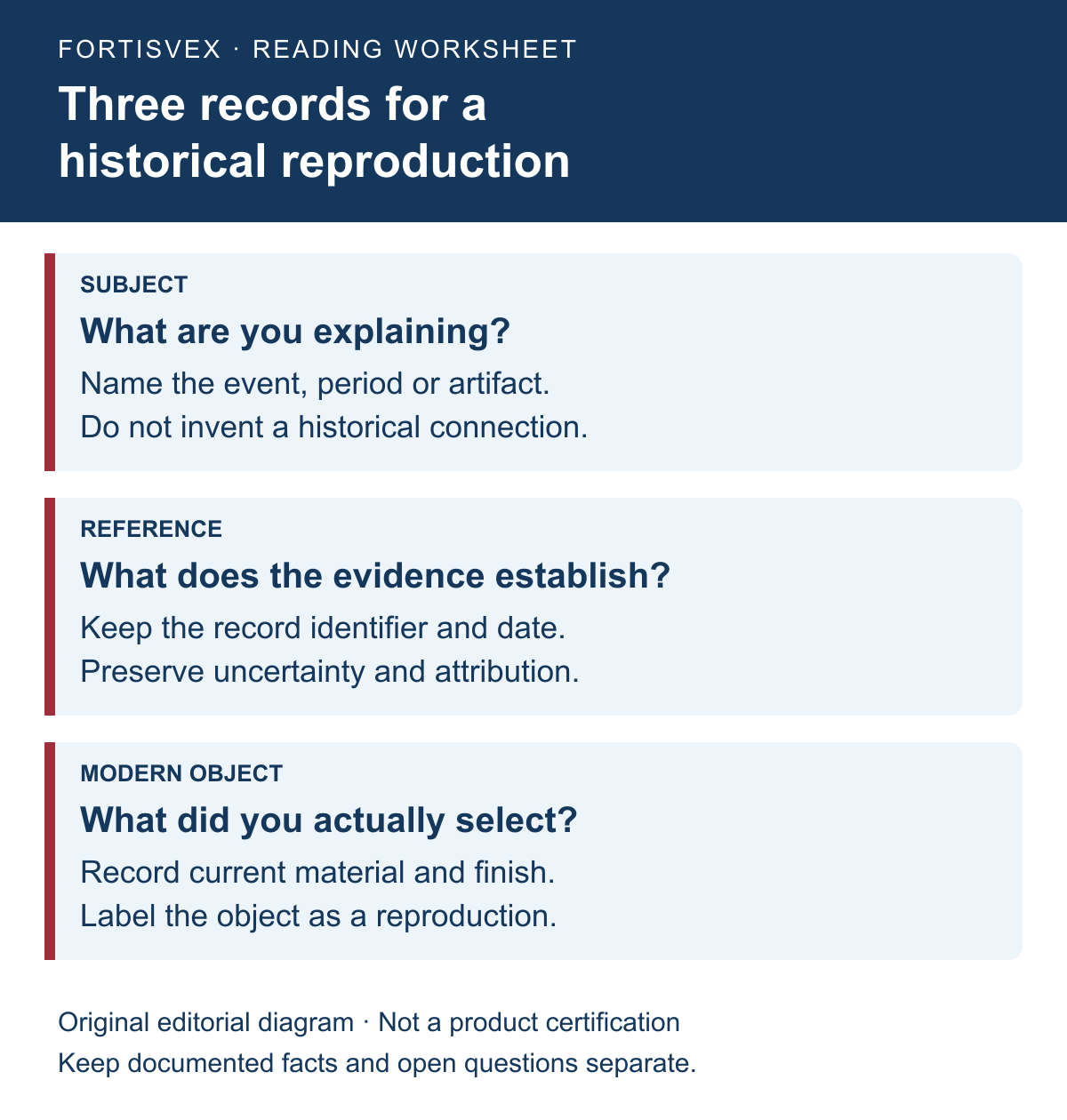
Before choosing a historical flag for a classroom or display, finish this sentence: “This flag will help explain…” A particular event, an era, an artifact and a later commemoration are different subjects. Choosing the subject first makes it easier to decide which details matter and which claims the display should avoid.
Why a star count cannot do all the work
The Smithsonian’s online abstract for Grace Rogers Cooper’s 1973 Thirteen-Star Flags: Keys to Identification describes a thirteen-star flag whose machine stitching ruled out an eighteenth-century date. It also discusses later use of thirteen-star boat flags. These examples support a limited but important lesson for a reproduction buyer: an appearance associated with an early period does not, by itself, date the object in front of you. Read the Smithsonian’s published abstract and bibliographic record.
This is not a home authentication test. A buyer should not use one stitch, a faded color or an apparently old attachment to declare an object genuine. For an educational reproduction, the more useful question is whether the object’s documented design and its description support the lesson you intend to teach.
Choose a reference before choosing a resemblance
Start a reference card with a collection record or a documented historical source. Record its title, institution, identifier, stated date or date range, and link. Preserve words such as “attributed,” “circa” or “possibly.” Those qualifiers are part of the evidence, not clutter to remove from a display label.
Then list what the reference actually shows or describes: arrangement, proportions, colors, inscriptions, material and attachment. Mark each entry as observed, stated in the record, or unknown. A photograph may support an observation about the visible arrangement while leaving reverse-side construction unresolved. Do not fill an unseen side from imagination.
A reference card also makes a purchase discussion more precise. Instead of asking for something that “looks old,” you can identify the documented pattern and say which details you need reproduced. If the chosen item is a general interpretive design rather than a copy of one artifact, describe it that way.
Separate historical resemblance from modern construction
A modern reproduction can be useful without duplicating every physical feature of a reference object. The essential requirement is an honest description of what it represents. Record the selected item’s stated material and finish separately from the historical reference’s material and finish. Do not merge the two into a sentence that makes modern construction sound like a documented historical fact.
For a classroom comparison, this separation can become part of the lesson. Students can identify which details are supported by the historical record, which belong to the newly made object, and which remain uncertain. That is more informative than presenting a purchase as an original artifact.
Match the purchase to the actual display
Write down whether the item is intended for a wall display, a supervised teaching activity or use on an existing flagpole. Check the product’s exact dimensions and attachment description against the equipment and instructions for that setting. Do not choose attachments only because they resemble the reference photograph.
This worksheet does not establish structural capacity or wind limits. Those questions belong to the documented system requirements. If the historical appearance you want conflicts with the available mounting arrangement, resolve that conflict before ordering rather than improvising a connection.
For a display that also compares historical designs with today’s flag, the FORTISVEX American flag collection provides a place to examine current product descriptions. Keep the modern comparison object clearly identified; its presence does not authenticate the historical reproduction or imply that every item in the collection represents the same period.
A label that does not overclaim
Use a short label with separate fields: “Modern reproduction”; “Design or period represented”; “Reference used”; and “Known differences or uncertainties.” Add a production date only when it is actually known. Use a date range when that is what the historical evidence supports.
For example, a blank planning label might read: “Modern reproduction of [documented design]. Based on [collection record and identifier]. This display explains [specific subject]. Modern material or finish differences: [verified details].” Fill the brackets from evidence before printing it. This is a writing template, not a description of any product offered here.
If the item was selected only as a broad illustration of a period, say so. Do not add an association with a named battle, ship, person or building because the connection would make a more memorable story. A modest, accurate label gives the reader a reliable starting point for further research.
Keep the evidence with the object
Save the reference URL, access date, product description and final caption together. Note any later changes to the display label. If the reference record is revised, you will be able to distinguish a new historical finding from a change to the object you purchased.
The finished selection should answer four practical questions: what subject it represents, which evidence supports that choice, how the modern object differs, and how it will be displayed. Counting stars remains one observation within that record. It does not replace the rest of it.
Recent Posts
-

Rupert, Idaho: Read the History Around the Town Square
Rupert’s historic square rewards a closer look than a quick photograph. Its buildings record change …Oct 29th 2026 -
Reading the Swiss Flag: Shape, Cross and Context
The Swiss flag is easy to recognize, but its simplicity rewards a closer look. Its ordinary national …Oct 29th 2026 -
Why the European Flag Keeps Twelve Stars
Twelve gold stars form a circle on a blue field. The European flag is easy to recognize, but its nu …Oct 29th 2026