
Ireland and Côte d’Ivoire: Read the Outer Bands in Context
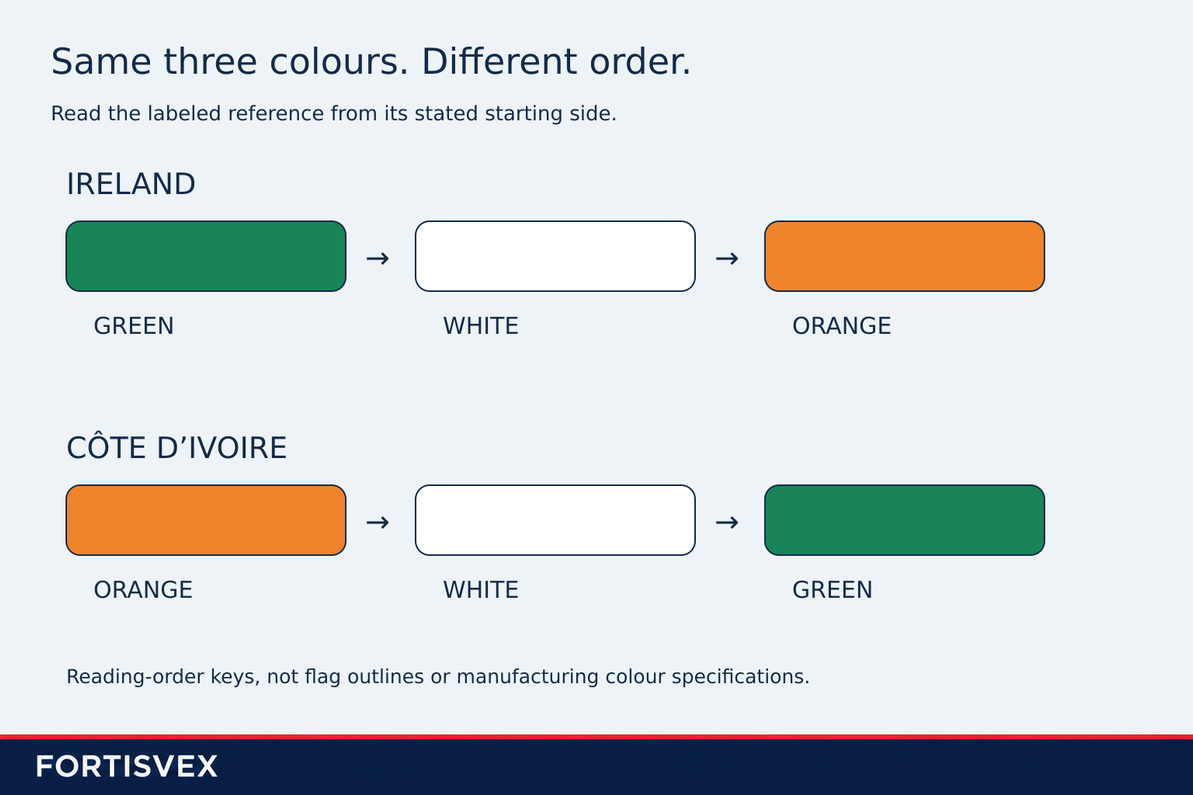
Ireland and Côte d’Ivoire both use green, white and orange in vertical bands. The quick distinction is the order of the outer colours: Ireland’s familiar reference reads green–white–orange, while Côte d’Ivoire’s reads orange–white–green. White stays in the middle.
That is a useful identification key, but only after you know how the picture is being viewed. A small photograph, a reversed image or a flag folding over itself can hide the very edge you need to check.
Start with the labeled reference
The Irish Defence Forces’ national-flag guidance describes three equal vertical colours and places green on the observer’s left in its horizontal-display description. Côte d’Ivoire’s Ministry of Public Service symbols page, in section IV, identifies orange, white and green in equal vertical bands; its accompanying artwork shows that order from left to right.
Our colour-order keys separate those sequences without presenting a shared rectangular template. They are explanatory keys, not scale drawings, product photographs or official colour samples. No overall proportion for the Ivorian flag is asserted here.
Find the starting side before reading across
The hoist is the attachment side of a flag. In a photograph, it may be visible beside a pole, hidden by a crop or out of view. The left edge of the picture is not automatically the attachment edge. Start with the source’s labeled presentation, then establish how the photograph relates to it.
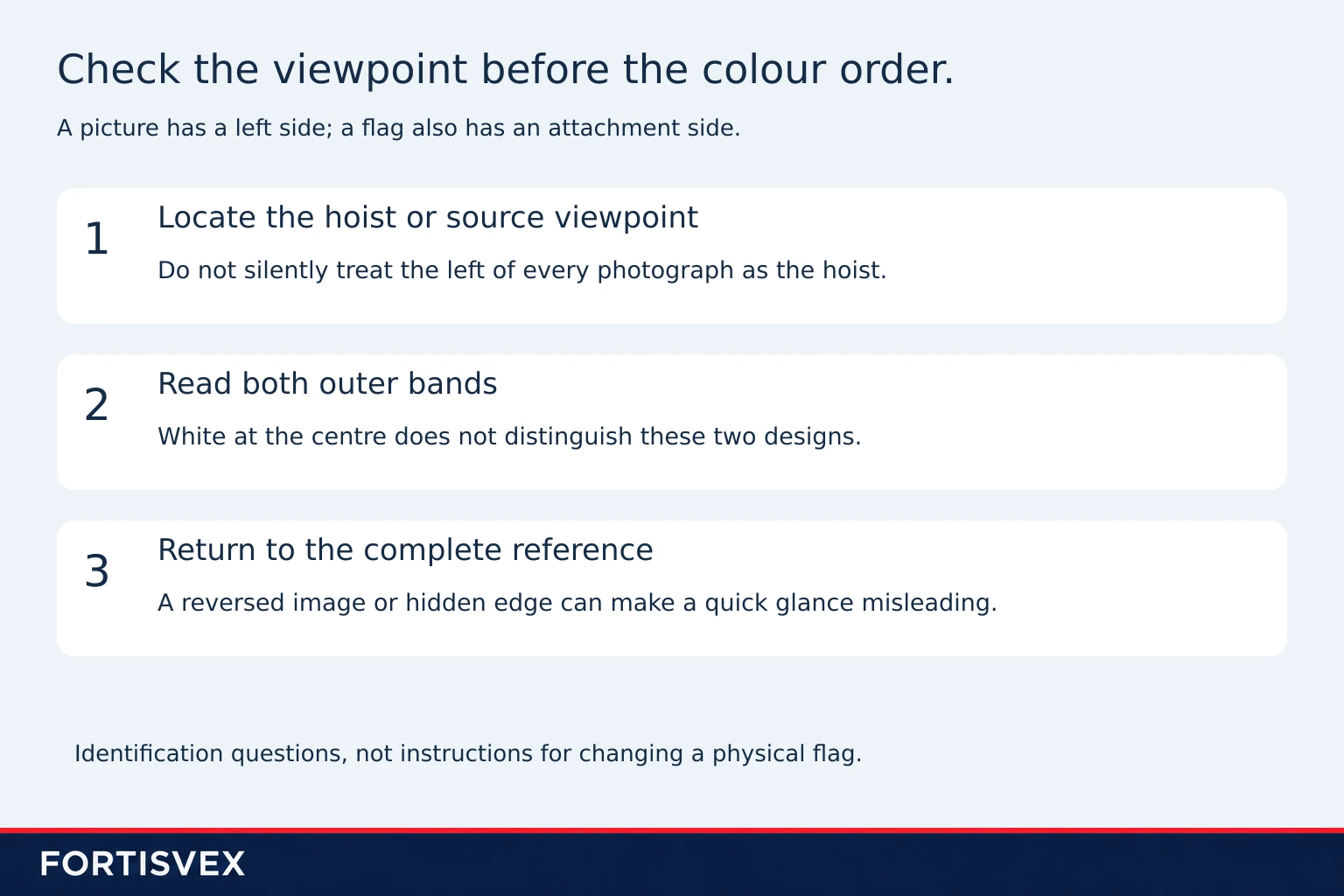
If a photograph has been reversed, the apparent left-to-right sequence reverses too. That changes what you see in the image; it does not rename the physical flag. If the attachment side and full design cannot be established, keep the identification open rather than deciding from one visible patch.
Why the white centre is not enough
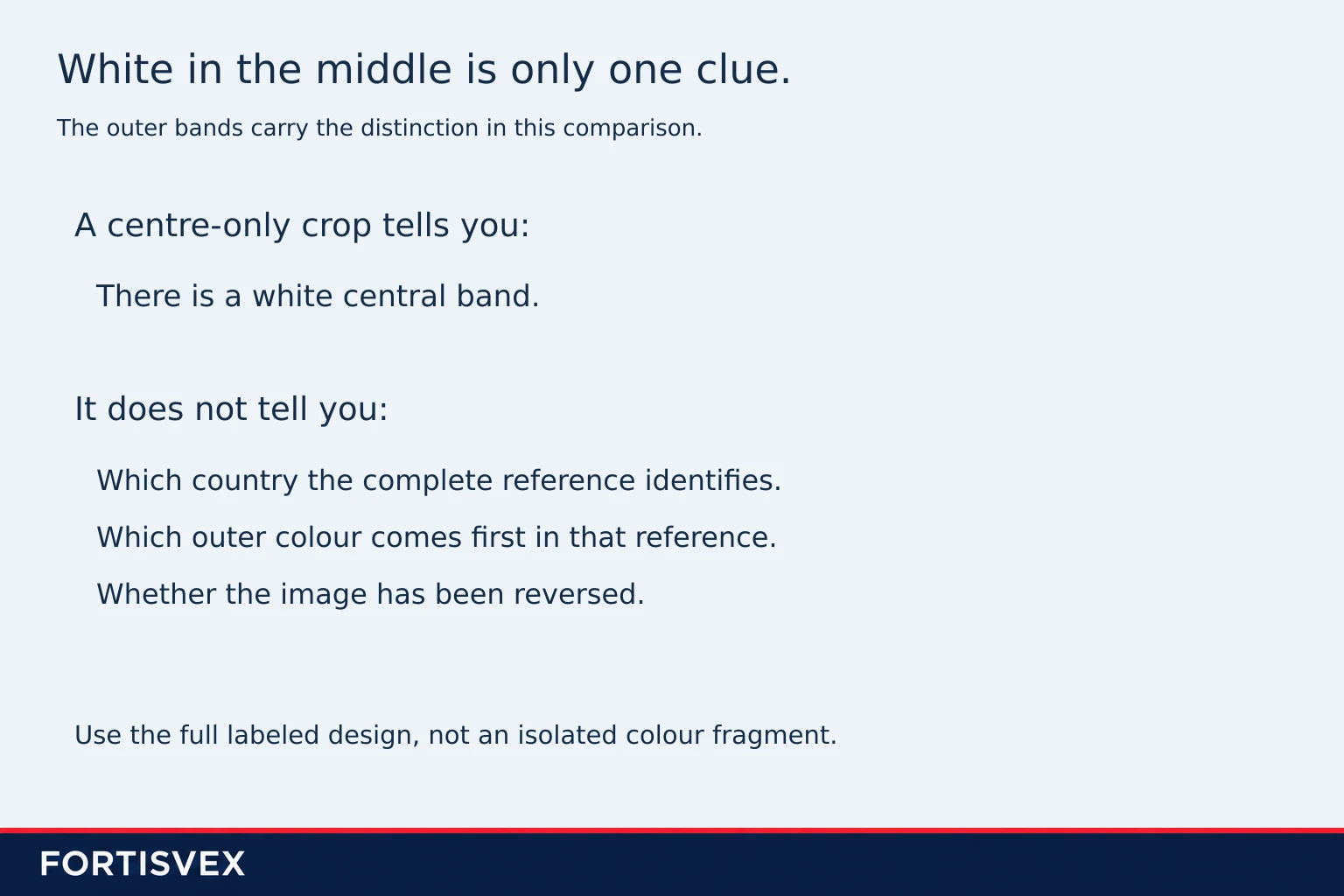
Both references have a white central band, so a centre-only crop removes the distinction. Look for both outer colours and the country label on a complete reference. A folded edge can also hide one band, leaving too little information for a reliable comparison.
Colour naming is a separate question from sequence. For the Irish orange-versus-gold issue, see why Ireland’s tricolour uses orange, not gold. An identification should not quietly replace orange with another colour name.
Keep the comparison specific
The same reading habit helps with Poland and Indonesia’s opposite top bands, although those are horizontal designs: establish orientation, then read the order. That does not transfer their dimensions or display guidance to these vertical tricolours.
Other comparisons require a different feature. Our Australia–New Zealand star-identification guide uses the complete design rather than an isolated star group. Here, the useful feature is the order of the outer bands, checked against the complete labeled reference.
The takeaway is simple: country label first, viewing context next, then both outer bands. Green–white–orange and orange–white–green are different sequences, even though the same three colour names appear in each.
Recent Posts
-

Czechia’s Flag: The Blue Wedge Reaches Halfway Along the Fly
Czechia’s flag is not fully identified by a glimpse of white above red. The blue wedge at the attach …Nov 18th 2026 -

A Capitol-Flown Flag: What Its Certificate Can Tell You
A flag described as “flown over the Capitol” carries a claim about an event, not simply a descriptio …Nov 18th 2026 -
The Olympic Flag: Why Ring Colours Are Not a Continent Key
A colour-coded continent legend can make an Olympic flag display look easy to explain. It also gives …Nov 18th 2026