
Where Does the U.S. Flag Go in a Procession? Two Layouts to Label Before Marching
A procession plan needs a direction of travel, not just a note saying “flag on the right.” Someone watching the group approach and someone carrying a flag can describe opposite sides with the same word. Before assigning positions, label the direction in which the group will move and identify which arrangement the organizer intends.
The Code describes two arrangements
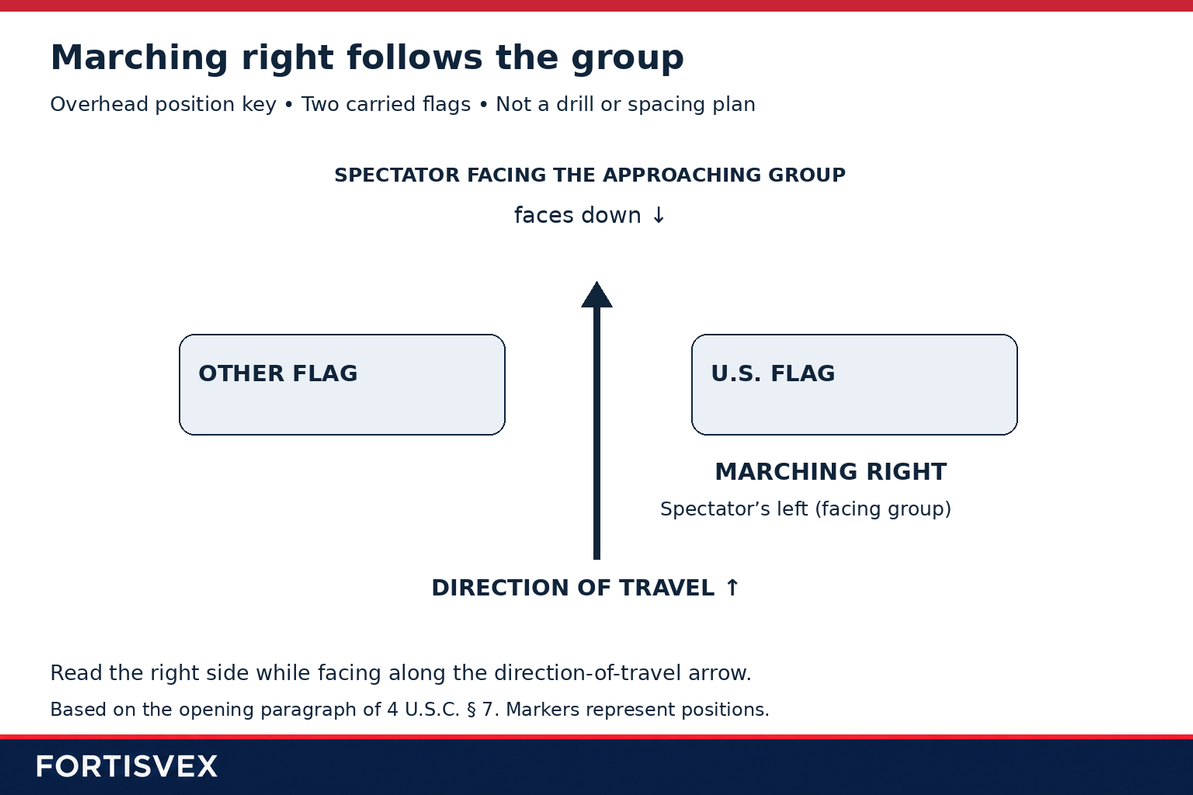
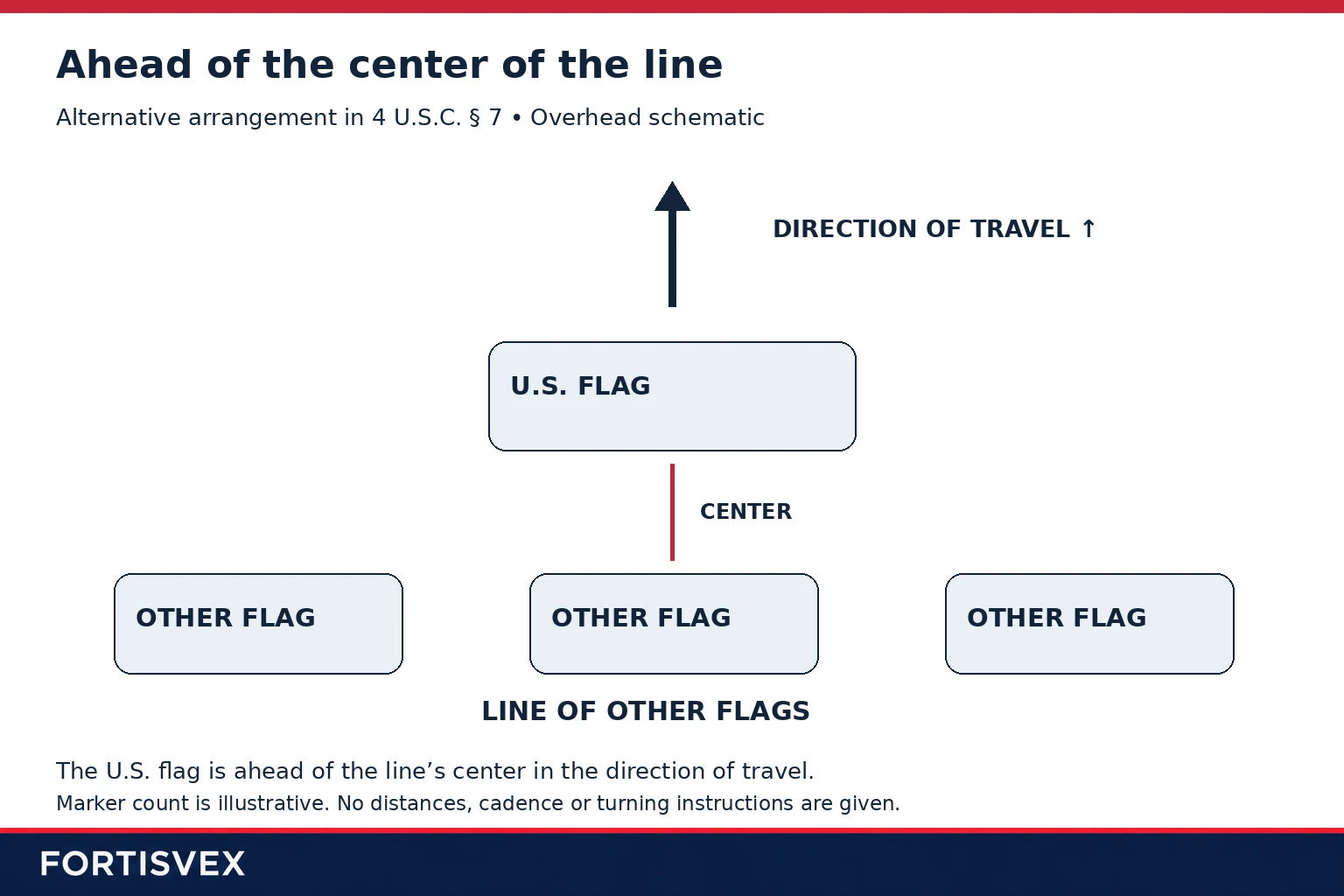
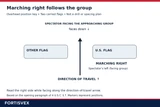
The opening paragraph of 4 U.S.C. § 7 addresses a U.S. flag carried in a procession with other flags. It gives two alternatives: the U.S. flag on the marching right, meaning the flag’s own right; or, where other flags form a line, the U.S. flag ahead of that line’s center.
These are position descriptions. The paragraph does not supply a marching cadence, separation distance, staff angle, turning maneuver or complete color-guard command sequence. For an organized unit, the responsible leader’s applicable procedures still need their own review. The diagrams here are labeled position keys, not drill instructions or measured layouts.
Read marching right in the direction of movement
Start with the simplest comparison: a U.S. flag and another flag carried together. On an overhead sketch, draw an arrow showing the group’s direction of travel. Read right from the position of someone facing along that arrow, not from a spectator facing the approaching group.
That makes the plan understandable from either viewpoint. To a spectator looking directly at the group as it approaches, the marching-right position appears on the spectator’s left. Write both viewpoints on a rehearsal sketch if people will be checking it from different places. A photograph without a travel direction can leave precisely the ambiguity the sketch is meant to remove.
Use the actual organizer-approved arrangement for rehearsal. This article does not instruct bearers how to turn or reposition during a moving ceremony. If a route or formation changes, ask the leader to confirm the intended positions rather than improvising a maneuver from a diagram.
A line of flags has a different alternative
The second arrangement described in § 7 puts the U.S. flag in front of the center of a line of other flags. In a plan viewed from above, label the line and its center, then show the U.S. flag ahead of it in the direction of travel. “In front” describes the relationship to the moving group, not the top edge of an unlabeled photograph.
Do not combine the two examples into a new universal rule requiring the U.S. flag to occupy both positions at once. Identify which arrangement is being discussed. Also keep this carried-procession question separate from arrangements on fixed poles, a wall or a platform; those have their own context in the Code.
If the procession ends at a presentation area, review that destination separately. Our speaker-right and audience-left presentation guide addresses a stationary display. A correctly labeled marching sketch does not, by itself, settle where a flag belongs once the presentation begins.
Position, equipment and audience conduct are different checks
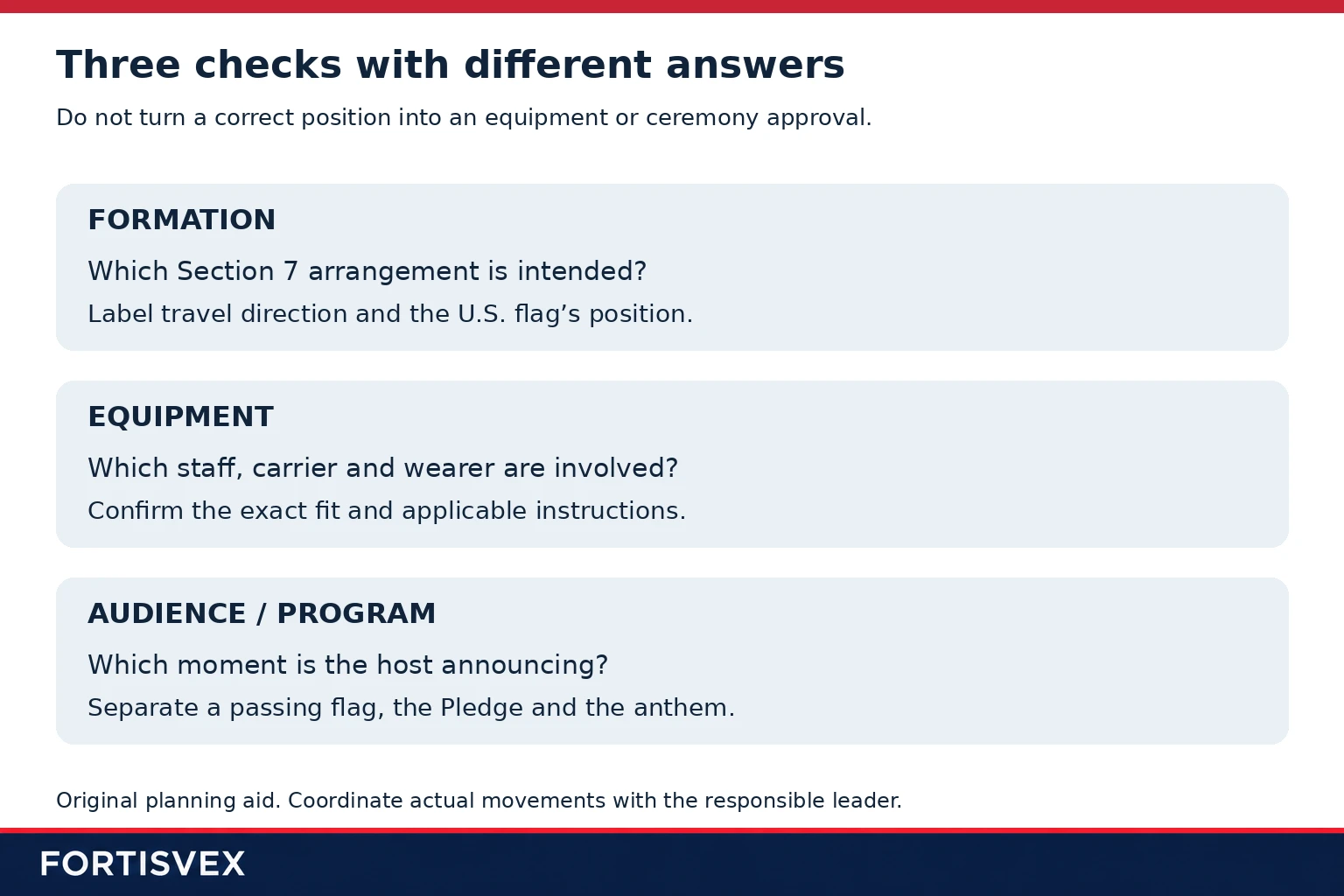
Choosing a place in the formation does not establish that a carrying belt accepts a particular staff or fits its wearer. The parade carrying-belt checklist keeps those equipment questions specific to the actual carrier, lower staff fitting and participant. A schematic marker for a flag supplies none of those dimensions or approvals.
Audience instructions are another separate task. The flag, Pledge and anthem cue sheet distinguishes a passing flag from spoken recitation and music. A host’s audience cue should not be mistaken for a command telling the bearers how to move.
Section 8’s opening guidance also distinguishes the U.S. flag from other colors when it addresses dipping as a mark of honor: it says the U.S. flag should not be dipped to a person or thing. This position guide does not supply a dipping maneuver for any other flag or replace an organization’s protocol.
Leave a plan another organizer can read
A useful final sketch names the arrangement, labels the direction of travel and identifies the U.S. flag without relying only on color. Record who confirmed the plan and what still needs to be resolved. Keep any unit instructions with the event materials rather than replacing them with a generic drawing.
Before the group moves, have the responsible leader confirm that participants understand the intended positions. The goal is a clear shared plan, not a new set of unofficial commands: marching right is read with the group’s movement, and the center-line alternative places the U.S. flag ahead of the other flags’ center.
Recent Posts
-
A U.S. Flag on a Parade Float: Staff Display, Flat Display, or Decoration?
On a parade sketch, a hand-carried flag, a flag on a float and patriotic fabric on a vehicle can all …Nov 19th 2026 -
When a U.S. Flag Cannot Be Lowered: A Mourning Streamer Is Not Half-Staff
You have a half-staff notice in hand, but the U.S. flag at your entrance hangs from an angled staff …Nov 19th 2026 -
Where Does the U.S. Flag Go in a Procession? Two Layouts to Label Before Marching
A procession plan needs a direction of travel, not just a note saying “flag on the right.” Someone w …Nov 19th 2026