
The Speaker’s Right or the Audience’s Left? Place a U.S. Flag for a Presentation
“Put the flag on the right” sounds like a clear instruction until two volunteers approach the platform from opposite directions. One is looking toward the lectern; the other is standing behind it. They can point to different sides of the room and both honestly mean right.
For a U.S. flag displayed from a staff at a presentation, settle the viewpoint before moving the equipment. Start with the speaker facing the audience, then check the same arrangement from the seats. The useful question is not simply which side looks best in a photograph. It is whose right the plan describes.
Start from the speaker’s position
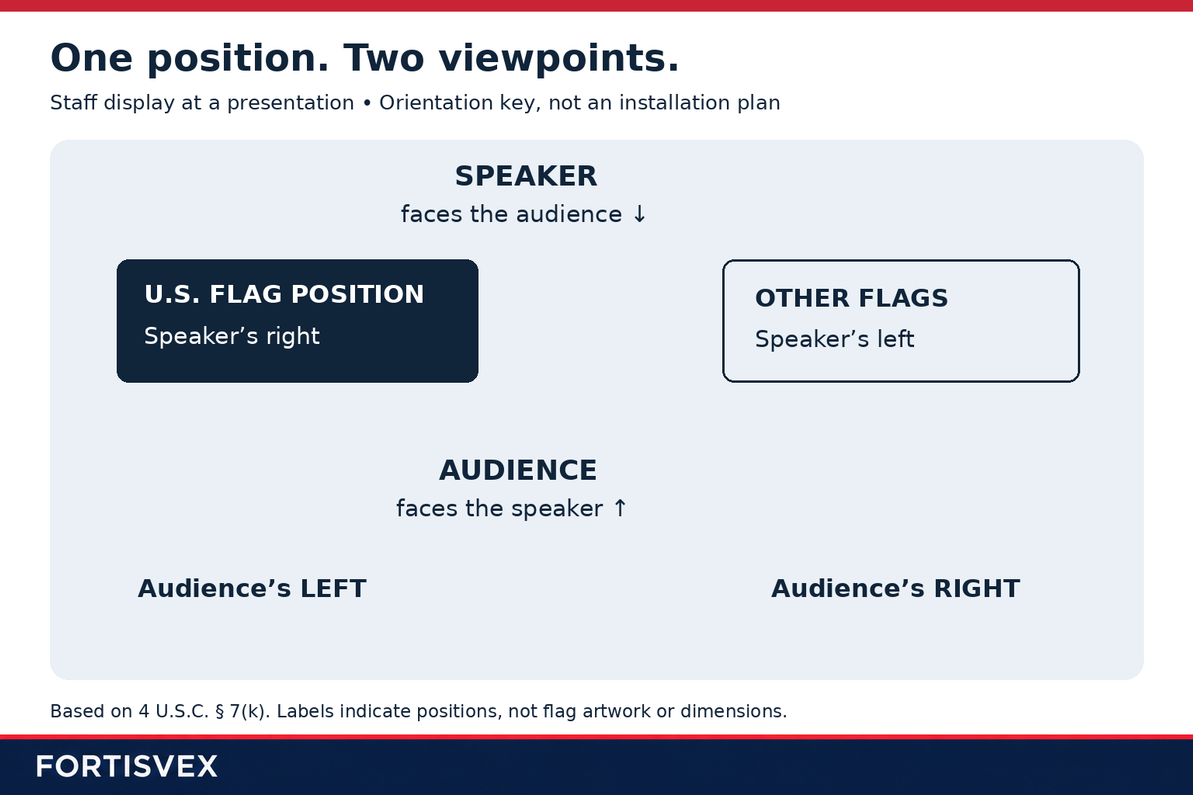
4 U.S.C. § 7(k) describes staff display in a church or public auditorium with the U.S. flag in a prominent position ahead of the audience, at the speaker’s right while the speaker faces the audience. Other flags in that arrangement belong on the speaker’s left. For people facing the speaker, those sides appear reversed: the U.S. flag is on the audience’s left.
Make that translation explicit on the setup sheet. Write “speaker’s right / audience’s left,” rather than “right side” alone. A person arriving later should not have to reconstruct the viewpoint from the location of a door, a camera or a stack of chairs.
These illustrations explain orientation, not a complete ceremony protocol or a room installation. They do not specify flag dimensions, staff height, stand weight, attachment hardware or required aisle clearances. A venue or organization may have additional instructions for its event; resolve those with its responsible person rather than treating a sketch as approval.
Check the arrangement from both positions
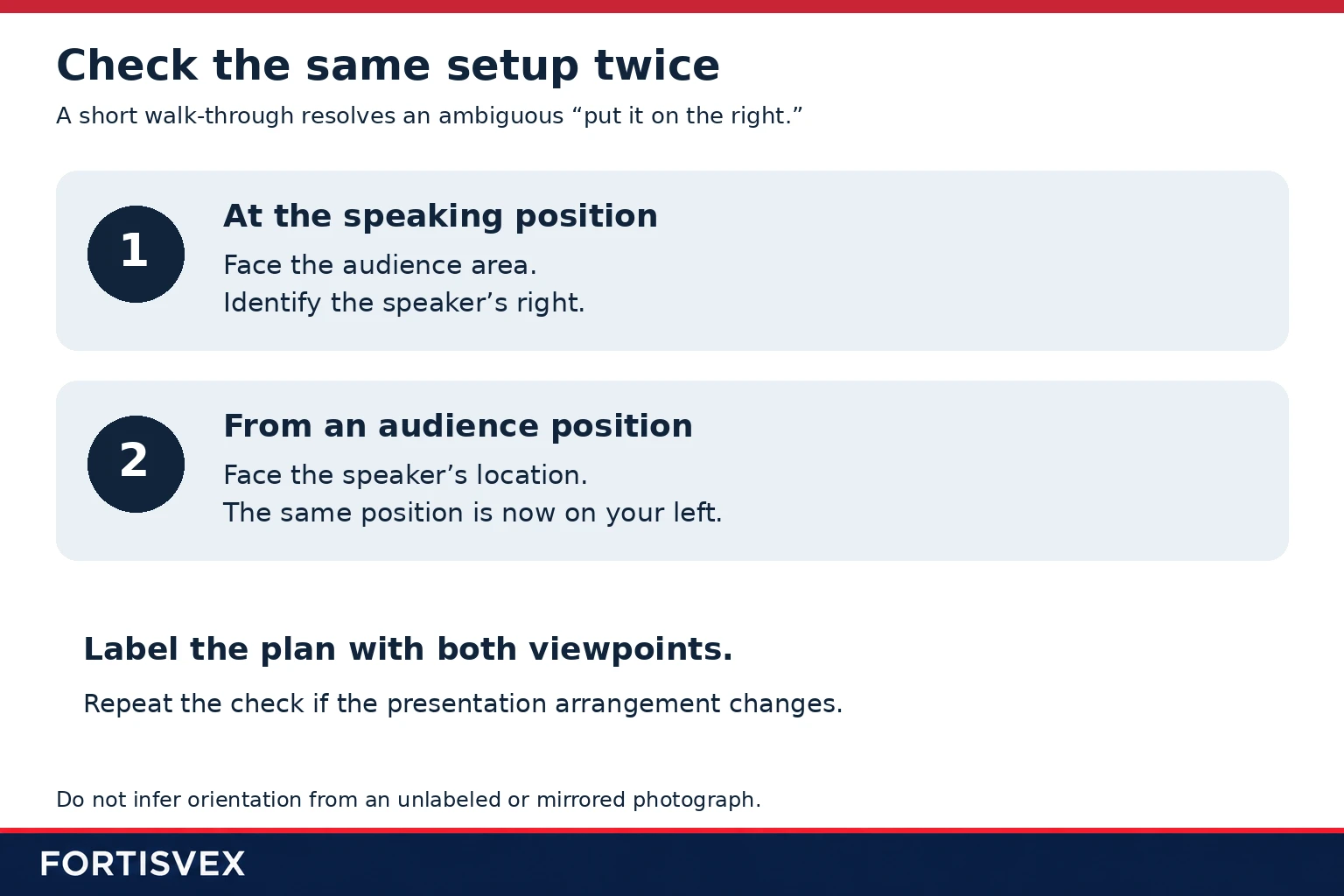
Stand at the intended speaking position and face the audience area. Identify your right without turning around to look at the backdrop. Then walk to a normal audience position and face the speaker’s location. The marked position should now be on your left. This short walk-through is more useful than arguing over a photograph taken from an unspecified direction.
If the lectern moves during rehearsal, repeat the check using the actual presentation arrangement. Label a plan with the audience and speaker positions; do not rely on the top of the sheet to explain which way the room faces. A mirrored image or a photograph from behind the speaker is not a reliable substitute for that labeled plan.
A flat backdrop is a different display choice
Section 7(k) separately addresses a flag displayed flat on a speaker’s platform: above and behind the speaker. Section 7(i) gives the wall-display orientation, with the union uppermost and on the observer’s left. Do not apply a staff-location instruction as though it were a rule for rotating the artwork on a flat flag.
Decide which type of display the event actually uses before choosing equipment or giving instructions. “Flat backdrop” and “flag on a staff” should be separate entries, not interchangeable labels on the same sketch. If the plan changes, review the chosen display again rather than carrying over every detail from the other arrangement.
A flag also has a different job from a platform covering. Our guide to keeping a display flag separate from event bunting and table coverings helps separate those decoration decisions. The backdrop location does not make the flag a convenient cloth for a lectern, equipment table or platform front.
Position does not establish equipment compatibility
Once the location is agreed, check the actual flag and support equipment with the venue. A correct side of the room does not establish that a sleeve fits a staff, that an attachment is suitable or that a stand is stable. Use the relevant equipment instructions and qualified help for those questions.
Our grommet-versus-pole-sleeve checklist explains why the flag’s attachment edge matters. It is a useful separate check when an event reuses existing equipment. Do not modify or improvise attachments just to make the room sketch work.
Leave the next organizer a usable record
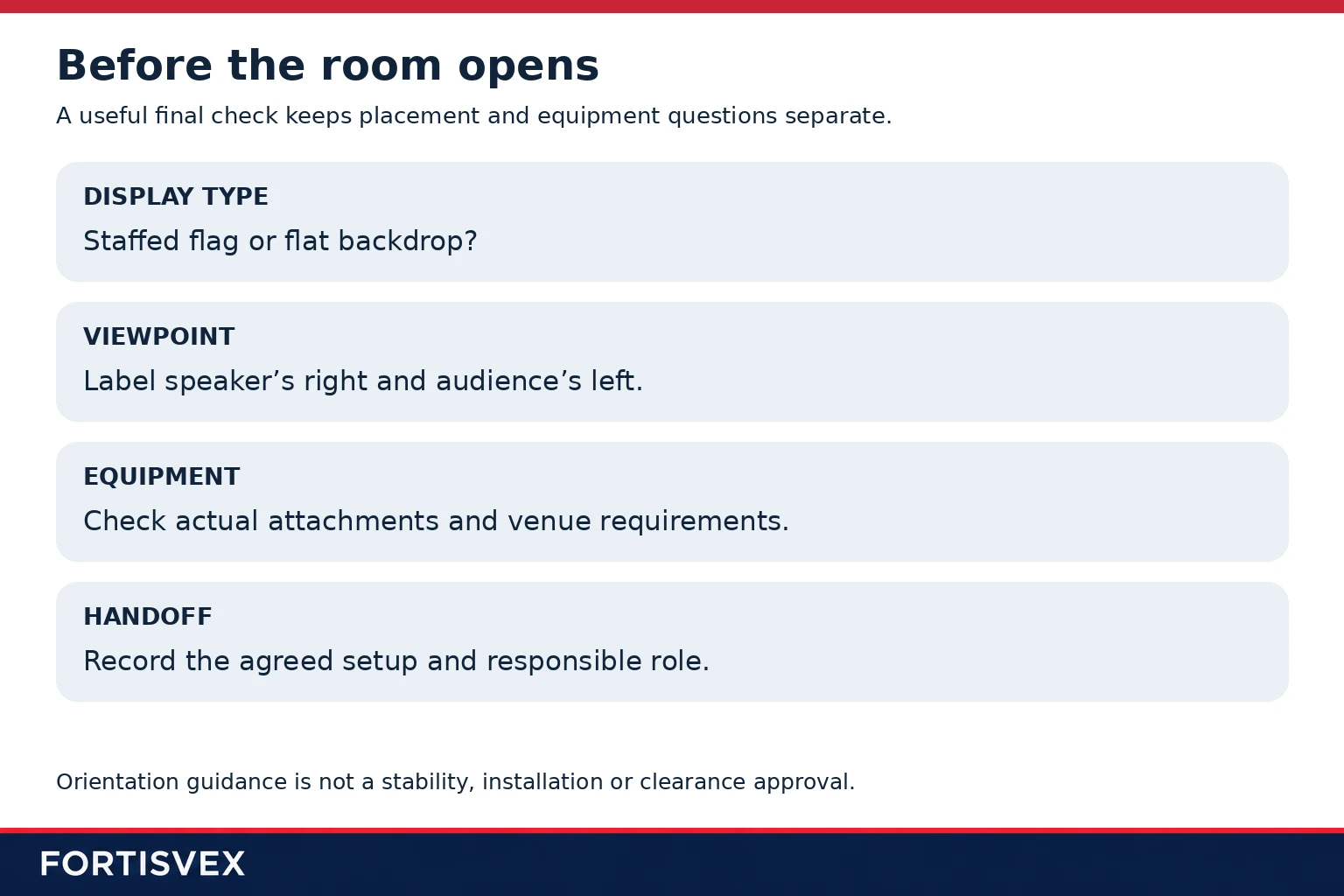
Finish with a brief agreed plan: the speaking position, the audience direction, whether the flag is staffed or flat, and who is responsible for the display. A simple labeled photograph taken from the audience side can accompany the plan. Keep any unresolved equipment or venue question visible instead of letting it disappear into a note saying “flags ready.”
The flag display log offers a way to retain the configuration and its supporting records. For a recurring presentation, a dated plan saves the next team from repeating the same right-versus-left confusion. Recheck it when the room, speaking position or display equipment changes.
The goal is a setup that another person can explain and verify: a stated viewpoint, the appropriate display type, and equipment decisions checked on their own merits.
Recent Posts
-
Flying a U.S. Flag After Dark: Check the Flag, Not Just the Light
A bright porch light and a visible flag are not necessarily the same thing. Before leaving a U.S. fl …Nov 19th 2026 -

Roasted Delicata Squash with Maple-Cider Dressing and Toasted Pepitas
Delicata squash makes a holiday side without tying up a burner. Roast the crescents until their edge …Nov 19th 2026 -
Choosing a Fringed U.S. Flag: Decoration Is Not the Attachment Method
A gold-fringed U.S. flag may look right for a meeting room, reception area or ceremonial display. Be …Nov 19th 2026