
A Flag Display Log: Record the Setup Before the Next Replacement
A flag needs replacing, but nobody knows its size. A fitting is missing, but the last order number is in a former volunteer's inbox. A building has several displays that look similar from the parking lot, yet their attachments are different. These are common recordkeeping problems, and they can make a straightforward purchase unnecessarily uncertain.
A display log gives each location a stable identity and keeps its verified configuration together. It is not an engineering assessment, installation manual or promise that a setup is safe. Its purpose is narrower: help the next responsible person identify the right display, locate the relevant evidence and see what changed. That is useful whether you manage one porch flag or several community-building displays.
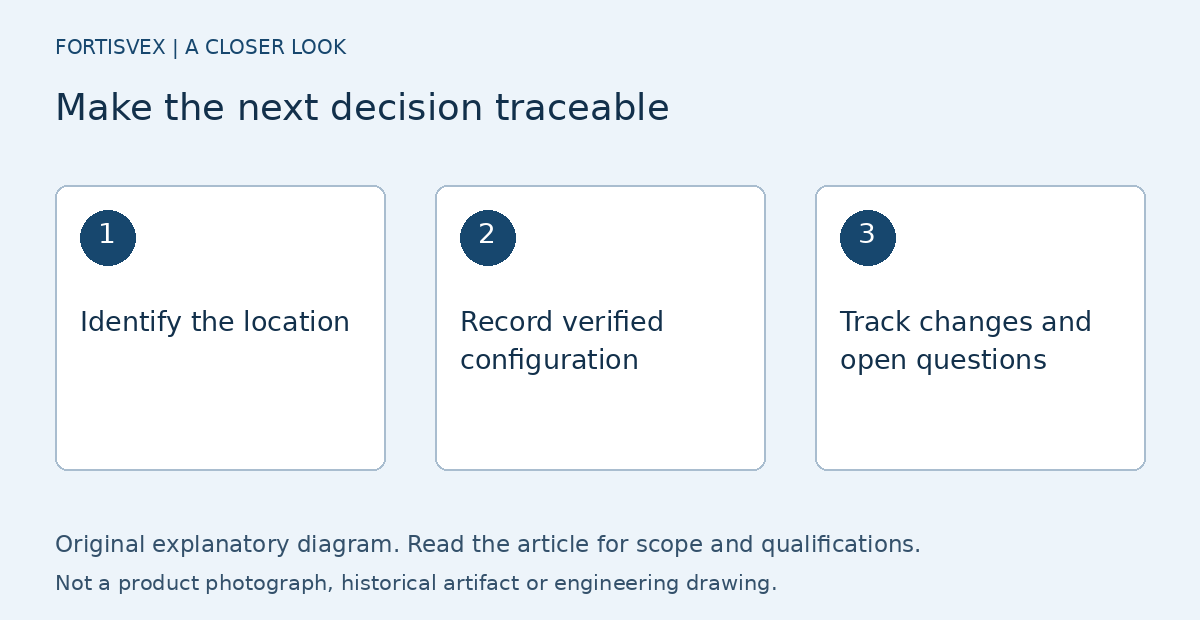
Start with a location identifier
Give the display a plain name that another person can find without your help. 'East entrance, wall-mounted display' is more useful than 'the small flag.' If there are multiple poles or stands, identify each separately. A photograph of the whole location can help, but avoid including private information or people unnecessarily.
Record who is responsible for the display and how decisions are approved within your organization. A role can be more durable than a person's name alone: building manager, facilities coordinator or event lead. Keep contact information in an appropriate private record, rather than publishing it in a public-facing checklist. The log should survive a personnel change without exposing unnecessary personal details.
Separate the textile from the support equipment
Use one section for the flag and another for the pole, stand, bracket or other support. For the flag, record the design, the verified dimensions, the product identifier if available, the stated material and the attachment style. For support equipment, retain the exact model information and relevant documentation rather than guessing from appearance.
A photograph of a heading can be helpful, but a distant image is not proof of a thread specification, metal type or hidden component. Mark uncertain details as unknown. Our replacement-ornament guide explains why fit depends on details such as threads and spindle measurements. The log should point to that kind of evidence instead of converting a visual impression into an order specification.
Keep the source beside each important value
A dimension copied from an invoice, a value read from a label and a measurement taken by a qualified person are different kinds of evidence. Add a source column. Include the document date or the date the information was checked. If two sources disagree, preserve both and mark the discrepancy for resolution.
Do not overwrite an older entry merely because a new figure appears more plausible. Instead, record the change and its reason. For example, a purchase record might identify a replacement flag while an old photograph shows a previous size. Without a date and source, those two true records can look like a contradiction. With a change history, they become a useful sequence.
Make condition notes factual and bounded
A useful observation states what was seen, where and when. 'Visible fraying at the outer edge in today's ground-level photograph' is more informative than 'bad flag.' It also avoids pretending that a quick look is a full inspection. State the observation method and its limits, especially for parts that cannot be seen safely from an accessible position.
Do not climb, dismantle equipment or reach into an unsafe area simply to complete a field in the log. Questions about structural condition, installation or access belong with appropriately qualified people. The record can show that an inspection is needed without supplying a homemade diagnosis. An unresolved field is preferable to a measurement obtained through unnecessary risk.
Track changes that affect the setup
When a flag is replaced, record the date and the actual item installed. When equipment is changed, retain the previous information as history and identify the new configuration. A second flag, different size or additional attachment should not disappear into a note that says only 'updated.'
Our guide to wind ratings before adding a second flag explains why a change should be checked against the specific pole's documentation. The log cannot calculate an allowable load or authorize a modification. It can make the question visible before someone assumes that an apparently small change is inconsequential. That is one of its most valuable functions: bringing missing information to the decision point.
Distinguish routine replacement from a new design decision
If you want to replace like for like, confirm that the old record describes the current installation. If you want something different, label that as a proposed change. Do not let a shopping cart silently become the design record. Keep the proposal, approval and actual installed result distinct.
When browsing American flags, compare the selected item's stated dimensions and attachment details with the verified needs of the location. A familiar product photograph is not enough to establish compatibility. If the record is incomplete, resolve the missing detail before ordering. This avoids turning the next delivery into another unidentified item that someone else must investigate later.
Keep photographs useful over time
Take a consistent overview from a safe accessible position and, where practical, a separately identified detail view. Record the date and the location identifier. Keep original files so that later crops do not become the only surviving evidence. A detail image should be connected to the correct display, especially when several locations use similar equipment.
Use simple filenames and a short index. An image called 'east-entrance-overview' with a date is easier to retrieve than a collection of unrelated phone filenames. Avoid filling the folder with nearly identical pictures that no one can interpret. One clear overview, the necessary details and a note about what they show are usually more useful than an undocumented pile.
A minimum record you can actually maintain
Begin with eight fields: location, responsible role, flag identity, verified dimensions, attachment type, support-equipment reference, last documented change and open questions. Add links to purchase records and photographs. Expand only when a field supports a real decision.
Set the review around actual events: replacement, a change of custodian, a reported concern or a planned modification. Do not claim that a record review substitutes for a required inspection or the equipment's own maintenance instructions. The purpose is continuity. When the next person asks what belongs at a location and why, the answer should be a traceable record rather than a guess.
Sources and further reading
Recent Posts
-
South Korea’s Taegeukgi: Check the Four Trigrams and Artwork Orientation
The South Korea flag, known as the Taegeukgi, is a good example of why artwork review should go beyo …Nov 2nd 2026 -
Brazil Flag Artwork: Check the Star Map Before Approving the Proof
The blue globe on a Brazil flag rewards a closer look. When buying a flag or reviewing a production …Nov 2nd 2026 -
Mexico Flag: The Eagle Is Part of the Design, Not an Optional Logo
A Mexico flag can look familiar at a glance while still needing a closer artwork check. When compari …Nov 2nd 2026