
The Flag, the Pledge and the Anthem: A Clear Ceremony Cue Sheet
A flag enters the room, a host invites the Pledge of Allegiance, and a musician begins the national anthem. These moments may occur close together, but they are not interchangeable. Each has its own statutory description, and a clear program lets participants know which moment is happening without turning the introduction into a lecture.
This guide compares civilian ceremony planning with the conduct described in 4 U.S.C. §§4 and 9 and 36 U.S.C. §301. It is not a command script for a military color guard. Coordinate a participating unit's movements and commands with its leader rather than assigning them from a general audience guide.
1. When the flag is being raised, lowered or passing
4 U.S.C. §9 addresses the ceremony of hoisting or lowering the flag and a flag passing in a parade or review. It describes a military salute for people in uniform and permits members of the Armed Forces and veterans who are not in uniform to salute. It describes the other participants facing the flag at attention with the right hand over the heart, with the applicable headwear provision.
For a moving column, the section ties the conduct to the moment the flag passes. That is a useful distinction for an announcer: the flag's arrival is not a direction to keep a salute throughout an entire parade, including unrelated vehicles and performers.
The same section separately says citizens of other countries present should stand at attention. Do not announce that visiting international guests must recite an American pledge merely because they are attending a flag ceremony. These are distinct parts of the program.
2. During the Pledge of Allegiance
Under 4 U.S.C. §4, the described manner of delivery is standing at attention, facing the flag, with the right hand over the heart. The headwear provision for men not in uniform specifies non-religious headwear, held at the left shoulder with the hand over the heart.
People in uniform are described as remaining silent, facing the flag and rendering the military salute. Members of the Armed Forces not in uniform and veterans may render the military salute in the manner provided for people in uniform. An instruction that “everyone must say the words with a hand over the heart” would erase that distinction.
If you are arranging the room, identify a flag that the participants can actually locate. Choosing an American flag for the display is only one part of that preparation; the program leader also needs to know its installed position. A spoken cue such as “Please face the American flag beside the stage” is clearer than pointing while the audience searches the room.
3. During the national anthem
36 U.S.C. §301 identifies the Star-Spangled Banner as the national anthem and describes conduct during its rendition. With the flag displayed, people in uniform should salute from the first note through the last. Armed Forces members and veterans not in uniform may use that salute as well.
For other people present, the provision describes facing the flag, standing at attention and placing the right hand over the heart. Its headwear language addresses men not in uniform, if applicable, removing the headdress with the right hand and holding it at the left shoulder with the hand over the heart. Do not copy the Pledge's exact headwear wording into a quotation of the anthem statute; the texts are not identical.
If no flag is displayed, the anthem provision explicitly directs those present to face toward the music and act as they would if the flag were displayed. It does not direct them to face an imagined flag, the nearest doorway or an arbitrary compass direction. The Pledge section does not supply an equivalent absent-flag procedure, so do not transfer the anthem instruction to the Pledge and call it the same rule.
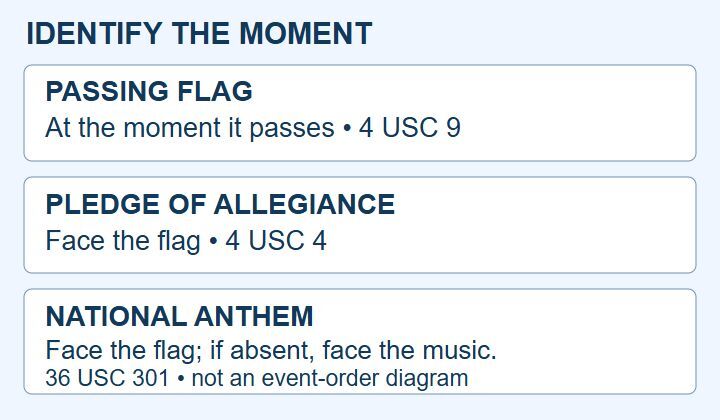
Read the three cues
- Passing flag: render the described conduct at the moment the flag passes in a moving column (4 U.S.C. §9).
- Pledge of Allegiance: face the flag during the Pledge (4 U.S.C. §4).
- National anthem: face the flag; if no flag is displayed, face toward the music (36 U.S.C. §301).
These are separate moments, not a required running order for your event. The sections above explain the conduct for each.
Build a run sheet that removes guesswork
The cited sections describe conduct; they do not give your event a complete running order. Put the sequence agreed with the participants on a single run sheet. For each item, name the person who starts it, the visible or audible cue, and the person who signals the transition. Keep that operational detail separate from the audience announcement.
For example, if your chosen program includes a color presentation, the Pledge and then the anthem, confirm with the color-guard leader where the flag will be when the Pledge begins. Confirm with the musician whether there is an introduction before the anthem itself. Agree on when the host resumes speaking so the final note is not covered by the next announcement. These are rehearsal choices, not additional Flag Code commands.
Sample host language to adapt
- Before the Pledge: “We invite you to join in the Pledge of Allegiance. The American flag is beside the stage.”
- Before the anthem, with a flag: “Please direct your attention to the American flag for the national anthem.”
- Before the anthem, without a flag: “For the national anthem, please direct your attention toward the music.”
These are suggested introductions, not statutory quotations or instructions to enforce participation. Use wording appropriate to your audience and coordinate accessibility needs in advance. A host does not need to single out seated guests or explain someone's personal circumstances from the microphone.
Check the display separately from the script
The right words do not fix an unsuitable display setup. Confirm the flag's location, the components used to support it and the participating group's requirements before the rehearsal. If you need additional equipment, review indoor display and parade accessories at FORTISVEX against the exact dimensions and attachments you have. Do not assume accessories are included or universally compatible.
Keep the final cue sheet short enough for a host to use at a glance: which moment, which direction, who starts it and what ends it. The fuller explanation belongs in preparation. That separation lets the ceremony remain composed while preserving the important differences between honoring a passing flag, delivering the Pledge and hearing the anthem.
Source scope: official HTML text of 4 U.S.C. §§4, 5 and 9 and 36 U.S.C. §301. Section 5 describes the civilian rules-and-customs framework for flag display and use; this article does not create an enforcement policy or replace applicable agency regulations. The sample announcements and rehearsal checklist are FORTISVEX editorial suggestions.
Recent Posts
-

Rupert, Idaho: Read the History Around the Town Square
Rupert’s historic square rewards a closer look than a quick photograph. Its buildings record change …Oct 29th 2026 -
Reading the Swiss Flag: Shape, Cross and Context
The Swiss flag is easy to recognize, but its simplicity rewards a closer look. Its ordinary national …Oct 29th 2026 -
Why the European Flag Keeps Twelve Stars
Twelve gold stars form a circle on a blue field. The European flag is easy to recognize, but its nu …Oct 29th 2026