
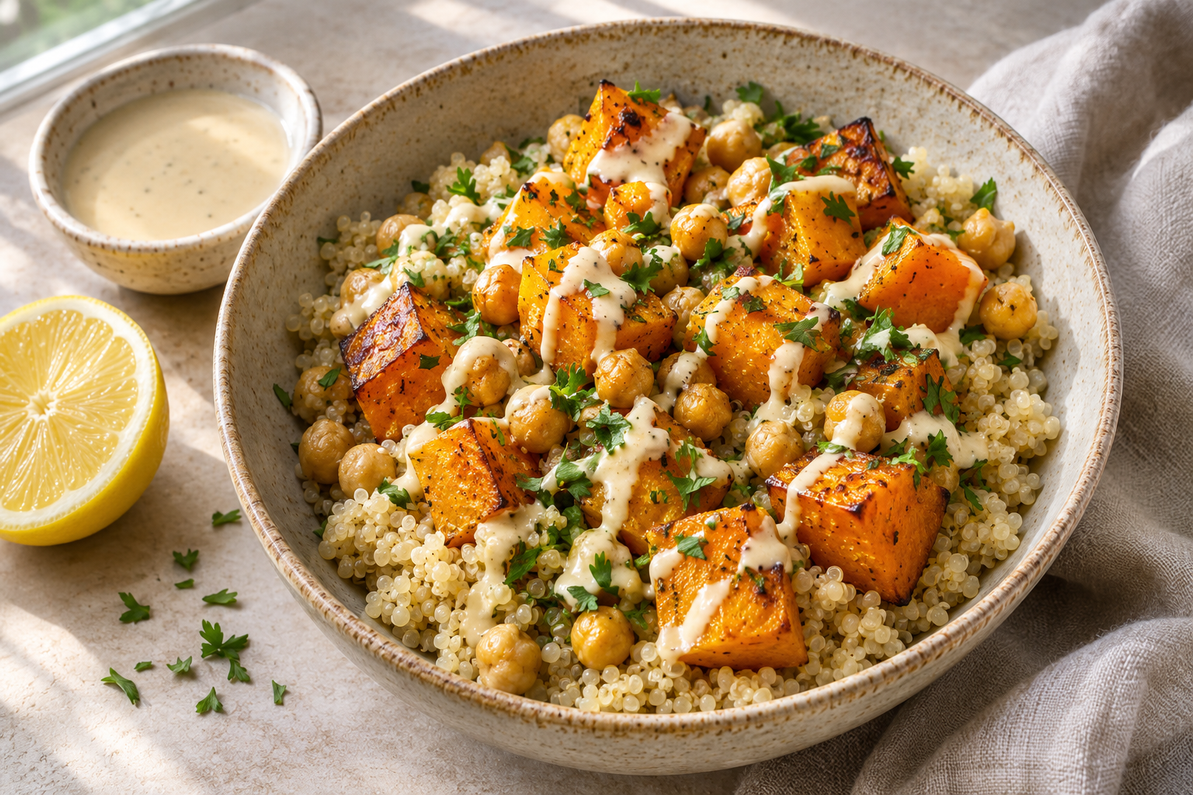
Roasted Butternut Squash and Chickpea Bowls with Lemon-Tahini Sauce
FORTISVEX · RECIPES
Sweet-edged squash, warm chickpeas and fluffy quinoa make a generous bowl without a long list of toppings. The lemon-tahini sauce brings a sharper, creamy finish: spoon on a little, taste a bite with the quinoa, then add more if you want it.
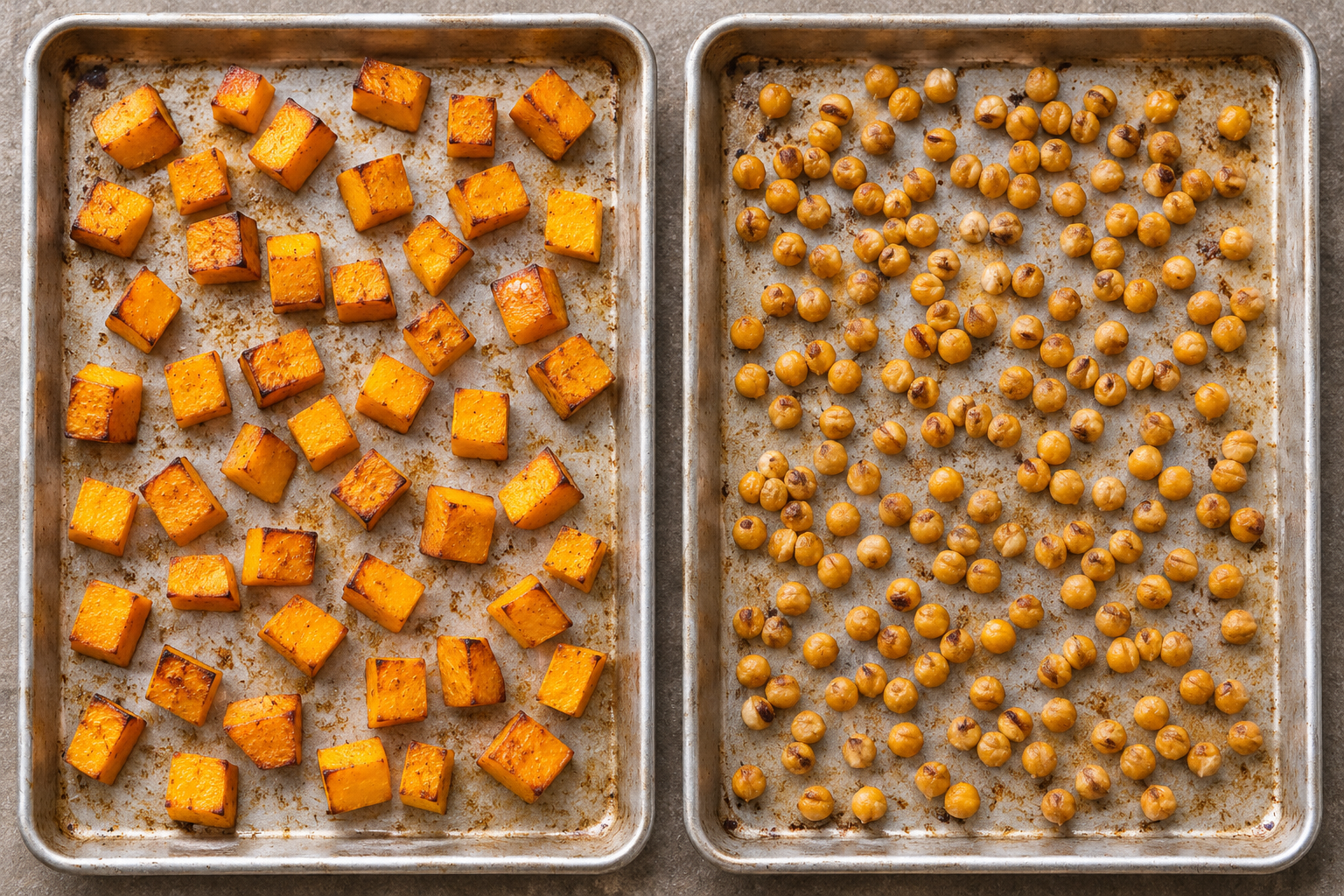
The most useful trick is to roast the squash and chickpeas on separate trays. Their ideal finishing times are not always the same, and each browns better when it has room. For a different weeknight bowl with a skillet method, try our tofu and broccoli rice bowls with ginger-garlic sauce.
Keep the sauce light enough to leave the roasted edges visible.
Roasted Butternut Squash and Chickpea Bowls
Serves: 4 substantial bowls. Preparation: about 25 minutes. Roasting: about 25–35 minutes. Quinoa: about 20–25 minutes, alongside roasting. Total: about 55–65 minutes with overlapping steps; allow longer for a slow oven or whole-squash preparation. Times and yields are estimates; follow the doneness cues.
Equipment
Two rimmed baking sheets, ideally about 13 × 18 inches each; a saucepan with a lid; a fine-mesh strainer; a stable cutting board; a sharp chef’s knife and vegetable peeler; a mixing bowl, whisk and spatula. A food thermometer is useful for reheating leftovers.
Ingredients
For the bowls
- 1½ pounds (680 g) peeled, seeded butternut squash, cut into ¾-inch cubes—buy roughly a 2–2½-pound whole squash, or weigh prepared cubes
- 2 cans chickpeas, 15 ounces (425 g) each, drained and rinsed; about 3 cups after draining
- 3 tablespoons olive oil, divided
- 1 teaspoon ground cumin, divided
- ½ teaspoon smoked paprika
- ¾ teaspoon fine salt, divided, plus a little more only if needed
- ¼ teaspoon freshly ground black pepper
- 1 cup dry quinoa, rinsed if its package does not say pre-rinsed
- 2 cups water for the quinoa, or the amount specified by its package
- ¼ cup chopped fresh parsley
For the lemon-tahini sauce
- ⅓ cup well-stirred tahini (sesame paste)
- 3 tablespoons fresh lemon juice, plus more to taste
- 1 small garlic clove, finely grated
- ¼ teaspoon fine salt
- ¼ cup cool drinking water, plus 1–2 tablespoons more as needed
The sauce makes approximately ¾ cup, depending on how much water you add. Tahini should pour or spoon smoothly after stirring; work the oil back into the solids in the jar before measuring.
Method
- Heat the oven and prepare the produce. Set racks in the upper and lower thirds and heat a conventional oven to 425°F (220°C). Wash hands and clean the preparation area. Rinse the squash, lemon and parsley under running water before cutting; do not use soap on produce. Dry the squash. Trim its ends, separate the narrow neck from the rounded base, and peel. Place each section on a flat cut surface, halve the base and scoop out the seeds. Cut uniform ¾-inch cubes. If the squash is too hard to cut securely, use prepared fresh cubes rather than forcing a knife through it.
- Dry and season separately. Pat the rinsed chickpeas dry with a clean towel. Toss the squash with 2 tablespoons oil, ½ teaspoon cumin, ½ teaspoon salt and the pepper. Spread it on one tray in a single layer. Toss the chickpeas with the remaining tablespoon oil, ½ teaspoon cumin, ¼ teaspoon salt and the smoked paprika; spread them on the second tray. Do not pile either ingredient into a deep layer.
- Roast and check each tray. Roast both trays, stirring the chickpeas and turning the squash after about 15 minutes. Swap the trays between racks and rotate them front to back. Start checking the chickpeas at 20 minutes; they are ready when hot throughout, dry on the surface and lightly browned, often around 25–30 minutes. Remove their tray if they finish first. Check the squash at 25 minutes and continue until a fork enters the centers easily and edges have browned, usually 25–35 minutes total. Large or wet cubes may take longer. Chickpeas should be pleasantly firm with tender centers, not promised snack-like crunch.
- Cook the quinoa while the trays roast. Follow the package if its ratio or method differs. Otherwise bring 2 cups water to a boil in the saucepan, stir in the rinsed quinoa and return to a gentle boil. Cover, reduce the heat to low and simmer about 12–15 minutes. Turn off the heat and leave covered for 5–10 minutes, until the water is absorbed and the grains are tender. If still firm and dry, add a little water and simmer briefly before resting again. Fluff with a fork; keep covered until assembly.
- Whisk the sauce. Mix the tahini, lemon juice, garlic and sauce salt. It may become thick at first. Whisk in the ¼ cup water gradually until smooth, then add more water a tablespoon at a time until it falls from a spoon in a thick ribbon. Taste with a piece of squash before adding extra lemon or salt. Refrigerate the sauce if it will wait while the meal finishes.
- Assemble and serve. Divide the cooked quinoa among four bowls. Add one quarter each of the squash and chickpeas, then about 2 tablespoons sauce per bowl. Scatter over the parsley and offer the remaining sauce separately. Serve promptly; sauce and steam soften roasted surfaces.
Make the texture work for you
If the squash is pale: check the centers first. Firm cubes need more time; tender cubes may need a few extra minutes with a broad cut face against the pan. Crowding traps moisture, so split a larger batch across more trays or roast in batches rather than raising the heat sharply. Dark pans and small ovens can brown food faster; lower the heat if the edges darken before the centers soften.
If the chickpeas stay soft: that is not a failed meal. Surface drying, room on the tray and serving promptly help, but canned chickpeas vary. Avoid roasting them until rock-hard in pursuit of crunch. Keep the sauce off until serving.
If the sauce is too thick or sharp: add water for thickness. For excessive acidity, whisk in a small spoonful of tahini and then enough water to loosen it. Adding more lemon to thin an already tart sauce makes the balance harder to recover.
Substitutions and allergens
Contains sesame. Tahini is sesame paste. For a diner with a sesame allergy, leave it out and prepare a separate suitable dressing only after checking every ingredient and preventing cross-contact. A different seed butter is not automatically safe for that person. No dairy or egg is required in the stated recipe; check packaged ingredients and any additions against diners’ needs.
Fresh prepared squash saves peeling time; trim oversized pieces to the same ¾-inch size. Frozen squash releases more water and has a softer texture, so it is not an identical timing or browning swap. Cook it according to its package and evaluate separately. For another base, use freshly cooked rice with its own package method; do not apply the quinoa water ratio to every grain. If gluten avoidance matters, check quinoa, seasonings and tahini labels and kitchen cross-contact.
Serving and planning ahead
The bowls can stand alone. For an extra vegetable at a larger dinner, lemon-parsley green beans add a crisp-tender contrast without taking another oven rack. Keep that recipe’s ingredients and cooking schedule separate.
For dessert, make the cinnamon apple-oat crisp before roasting these trays, or bake it afterward at its own specified temperature. Do not assume both dishes can share the 425°F oven. The dessert has its own allergen considerations.
Store and reheat safely
Refrigerate the cooked components and prepared sauce promptly in shallow containers, within 2 hours, or within 1 hour above 90°F (32°C). Keep the refrigerator at 40°F (4°C) or below; do not wait for a deep pot of quinoa to cool on the counter. Store sauce separately for better texture and use the safely refrigerated meal within 3–4 days. An older ingredient does not gain a new storage period when mixed into this meal.
Reheat the quinoa, squash and chickpeas with a small splash of water in a covered, vented microwave-safe dish, stirring during heating and measuring several spots until they reach 165°F (74°C). Follow appliance standing-time instructions. Add refrigerated sauce after heating and serve promptly. Discard food held beyond safe limits; reheating does not reverse unsafe storage.
Sources and recipe note
Oregon State University’s Food Hero squash recipe provides a reference for peeling, cubing and fork-tender doneness, and its stovetop quinoa guidance informs the covered cooking and resting approach. Our seasonings, chickpeas, sauce and oven schedule differ. See the FDA’s produce handling guidance and FoodSafety.gov’s storage and reheating guidance for the safety practices used here.
Recent Posts
-
West Virginia Half-Staff Order Honors Jay Rockefeller Through November 13, 2026
Governor Patrick Morrisey issued a November 6, 2026 order lowering the U.S. and West Virginia flags …Nov 8th 2026 -
Replacing a Kansas Flag: Match Size and Attachment
A replacement Kansas flag should match more than the state design. Before ordering, record the flag …Nov 8th 2026 -
Replacing a Storm-Warning Flag: Match the Piece and Dimensions
A missing or worn storm-warning flag does not necessarily call for a whole new collection. The firs …Nov 8th 2026