
Retailer SKU or Manufacturer Part Number? Build a Reliable Flag-Hardware Cross-Reference
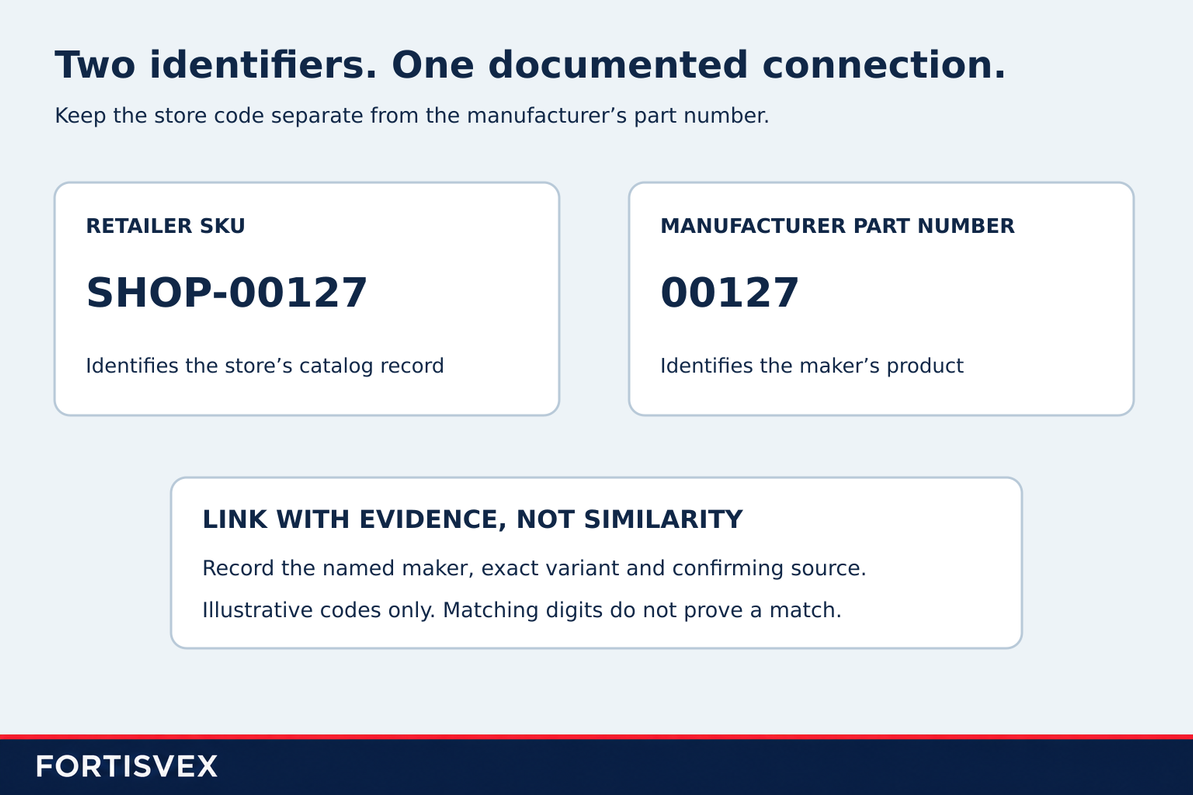
A retailer’s SKU and a manufacturer’s part number can both point toward the hardware you need, but they answer different questions. One identifies a record in a store’s catalog. The other identifies a product within a manufacturer’s range. Keeping both, with the evidence connecting them, makes a replacement inquiry far more useful than a loose list of numbers.
The goal is a reliable cross-reference, not a shortcut around checking the actual part. An identified item still needs a separate compatibility check for the installation.
Start with two separate fields
SKU means stock keeping unit. It is a code a business uses to organize inventory. Shopify’s SKU guidance describes these as internal tracking codes and recommends distinct codes for product variants. A retailer may use a manufacturer’s number as its SKU, add a prefix, or use an entirely different code. The label on the record tells you which identifier you are looking at.
An MPN is a manufacturer part number. Google’s MPN documentation distinguishes the maker’s assigned identifier from a seller-created value and emphasizes selecting the correct variant. Store the manufacturer’s name alongside the MPN: the number alone does not identify its issuing company.
For example, a fictional store SKU SHOP-00127 and a fictional manufacturer MPN 00127 might refer to the same item. Similar digits are not evidence that they do. Record the connection only when the exact listing, manufacturer record or supplier confirmation supports it. These example codes are not FORTISVEX product references.
Preserve the code exactly
Copy identifiers as text, including leading zeros, letters, hyphens and suffixes. Keep 00127 distinct from 127 in your notes unless the issuing company confirms otherwise. If you use a spreadsheet, format the identifier columns as text before entering or importing the values, then check the result against the source. Do not silently remove a prefix because another listing looks similar.
A model name deserves its own field too. A family name can cover several sizes, finishes or package options. It should not replace the exact part number when the source provides one.
Build one row for the exact variant
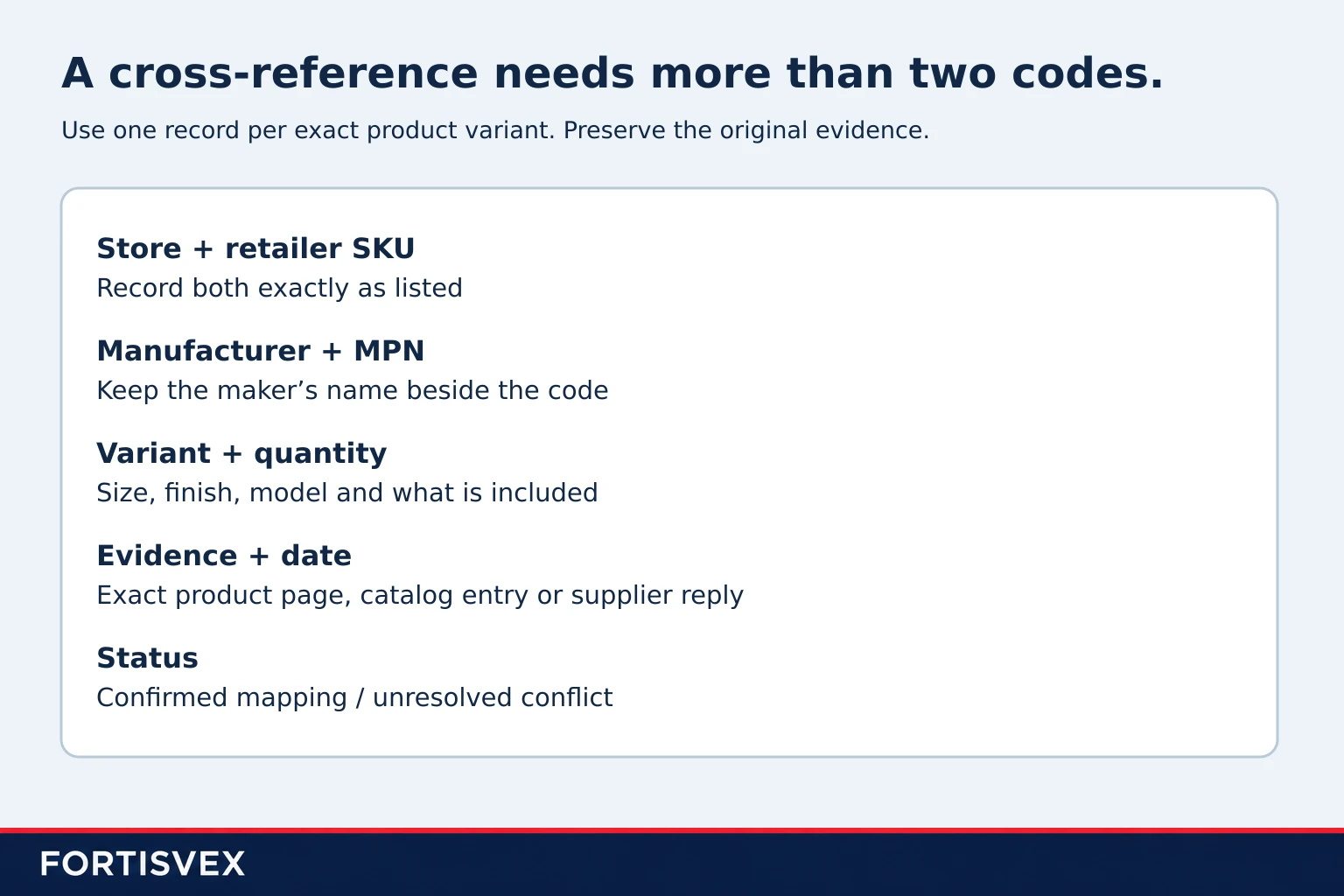
A practical record has five parts:
- Retailer and SKU: the store name, exact code and product-page link.
- Manufacturer and MPN: the maker’s name and the identifier explicitly associated with that item.
- Variant and contents: the stated model, size, material, finish and quantity supplied. Mark information that is not stated as unknown.
- Evidence: the exact page, catalog entry or dated supplier response supporting the mapping, plus the date you checked it.
- Status: confirmed identifier mapping, or unresolved with the specific question still open.
Package contents matter as much as a familiar model name. A single component, pair and kit are not interchangeable purchasing descriptions. Our guide to halyard diameter, supplied length and package contents shows why the amount supplied belongs in the record.
Resolve conflicts without guessing
If a store listing and manufacturer entry disagree, preserve both references. Note the exact conflict, such as a different finish or package quantity, and ask the supplier to confirm which manufacturer part number applies to the item being sold. A family photograph or a nearly identical title cannot settle that conflict on its own.
Keep identification separate from fit
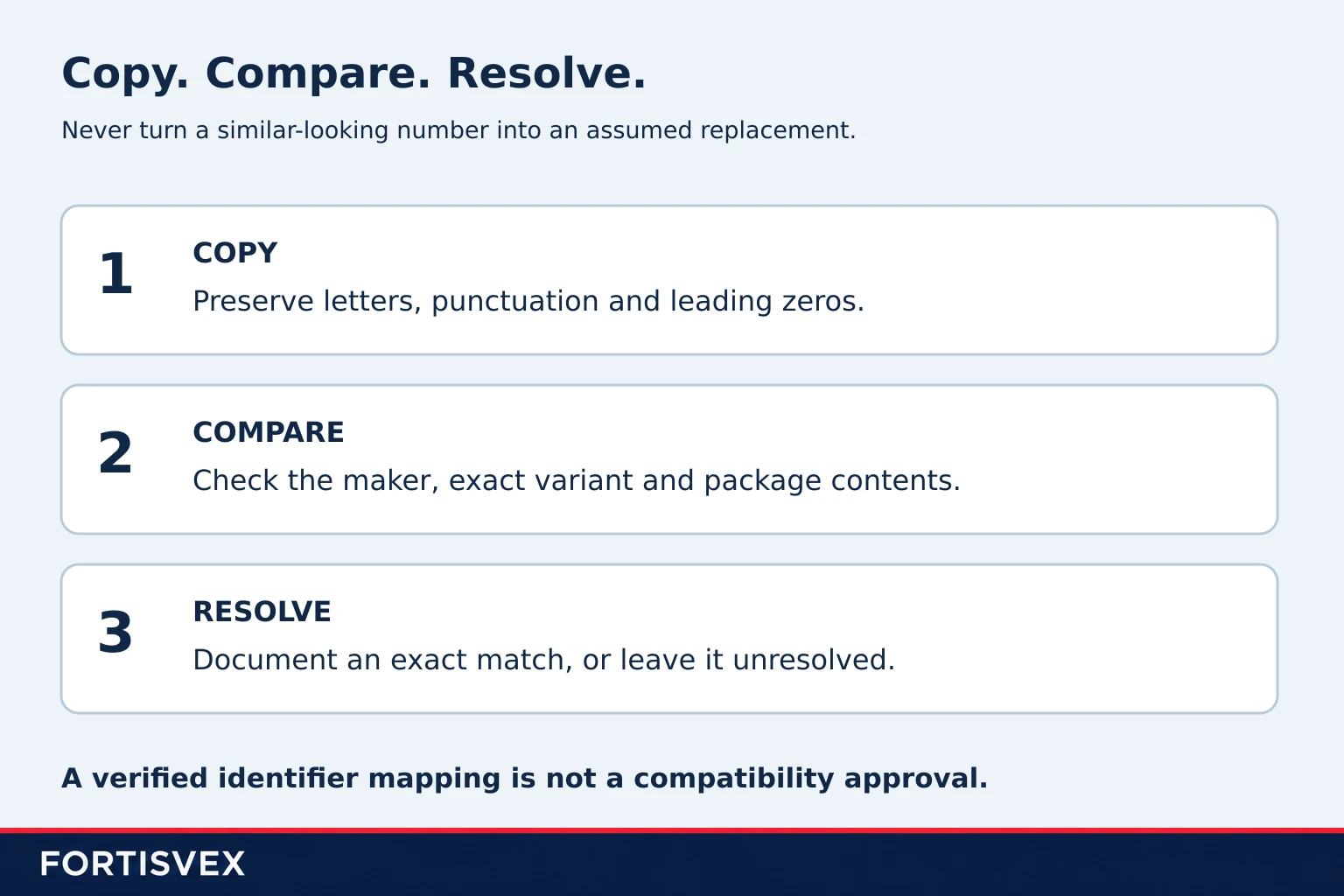
A confirmed cross-reference tells you which item a listing represents. It does not prove that item fits your pole, truck, ornament or other hardware. Check the installation’s requirements against the manufacturer’s specifications separately. Our ornament-fit guide explains why thread and spindle details deserve their own attention.
Once the part is confirmed and actually installed, connect its cross-reference to the relevant entry in your flag display log. Keep a proposed replacement separate from an installed component. That leaves the next person with a clear trail: what was listed, what was verified and what is now in use.
Recent Posts
-
Toasted Sesame Tahini Blondies
Tahini gives these brown-sugar blondies a toasted, nutty flavor without adding chopped nuts. A small …Nov 24th 2026 -
Slow-Cooker Beef and Barley Soup with Cremini Mushrooms
Slow-cook beef chuck, carrots and browned cremini mushrooms until the beef yields to a fork. Cook t …Nov 24th 2026 -
How to Measure an Old Flag Before Ordering a Replacement
A worn flag can look like the wrong size, especially when the edge farthest from the pole has frayed …Nov 24th 2026