
Buying Flagpole Halyard: Diameter, Supplied Length and Package Contents
Flagpole halyard listings often put a fraction, a length and a material in one title. Add a spool quantity or a set of snaps, and it becomes easy to compare unlike items. A 50-foot rope and a 1,000-foot spool may share a diameter, but they represent very different purchases.
Before choosing a replacement, separate the equipment specification from the amount sold. This guide explains how to read those fields and build an order record. It does not prescribe a rope for an unidentified pole, calculate a load rating or provide instructions for restringing equipment.
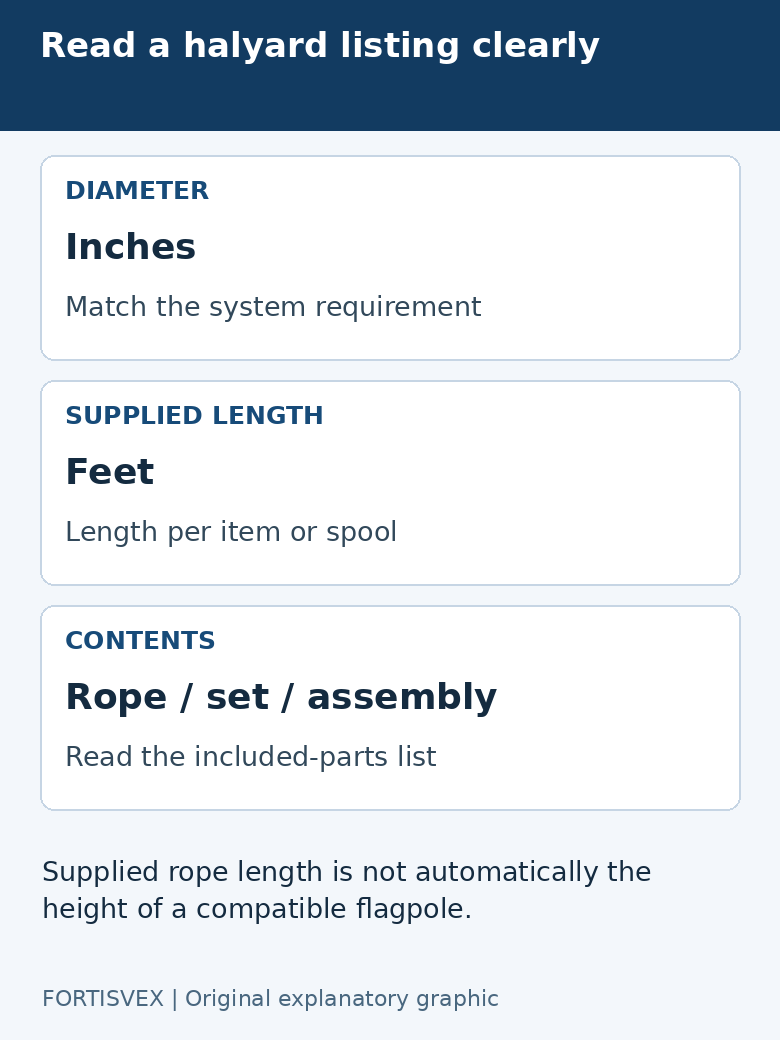
Diameter and length use different units
The ¼-inch by 50-foot white polypropylene halyard describes a rope diameter in inches and a supplied length in feet. The first measurement is not the width of a package, and the second is not automatically the height of a compatible flagpole.
Record both units explicitly. “¼ by 50” is less useful than “¼-inch diameter, 50-foot supplied length.” The same discipline helps when another person reorders the part later. Do not round a fractional diameter to a nearby size simply because the number looks close.
The system documentation should establish the required diameter and construction. A worn rope can be flattened, frayed or altered, so its present appearance may not reliably identify the intended replacement. Preserve an original part number or equipment specification when possible.
A spool is a purchase format
The ¼-inch by 1,000-foot white polypropylene spool 350196 is listed with a much greater supplied length. The listing describes solid-braided multifilament polypropylene. Its spool length should not be treated as a recommendation for the length required on an individual flagpole.
A facilities buyer comparing a spool with shorter lengths has two decisions to make. First, is the rope specification appropriate for the equipment? Second, is the purchase format appropriate for the work and storage plan? A large spool does not make an incompatible rope suitable, and buying more length than needed does not resolve a missing equipment specification.
For a hypothetical inventory calculation, suppose a maintenance plan calls for four independently confirmed 60-foot pieces of the same approved rope. The arithmetic total is 240 feet before any allowances required by that plan. This is an inventory example only, not a recommended length for any pole. The responsible installer must determine the actual lengths and any preparation requirements.
Separate rope-only listings from sets and assemblies
If you are comparing a rope-only offer with a stated rope-and-snap set or a finished assembly, treat them as different sale units. Do not assume that the two rope listings discussed here describe every available package format. Read the supplied-components statement rather than assuming every item shown beside the rope is included.
A finished assembly can have application-specific fittings or other requirements. Do not replace it with bulk rope merely because the material name or apparent diameter seems similar. Conversely, a rope-only order should not be expected to arrive with snaps, covers or a completed arrangement unless the listing expressly includes them.
Write the purchase in plain language before ordering: “one supplied length of rope” or “one listed set with the stated components.” Then check the order quantity. A quantity of two for a spool listing means two spools, not two feet and not necessarily two ready-to-install replacements.
Do not let color stand in for construction
Two white halyards can have different constructions. Keep the material and construction description in the equipment record, not just the color and approximate thickness. This guide does not rank materials or declare one universally better. The appropriate choice depends on the actual system requirements.
If a title and description conflict, do not choose whichever statement suits your plan. Ask for clarification about the exact part. Product identification is especially important when a page includes several related products or a gallery image represents a range of configurations.
Build a reorder record before the old package disappears
| Field | Record explicitly |
|---|---|
| Equipment | Pole or system identification and the source of its requirements |
| Diameter | Exact fraction and unit |
| Construction | Material and listed construction, without a guessed substitute |
| Required length | Length established for the actual installation |
| Supplied length | Length per ordered item or spool |
| Contents | Rope only, set or specified assembly |
| Traceability | Product URL, part number and order record |
For shared facilities, keep this information where the next maintenance person can find it. A photograph of the pole does not usually capture the rope specification. A handwritten note that says only “white flag rope” loses most of the information needed for a careful replacement.
Resolve fit before scheduling the work
If the old halyard is broken, inaccessible or connected to unfamiliar internal equipment, have the responsible installer assess the replacement procedure. Do not climb or improvise a method to recover the line on the strength of a shopping article. Ordering and installation are separate stages, and each needs the appropriate information.
Compare the current short-length listing and spool listing only after the equipment requirements are known. A complete specification and a clear sale unit make the purchasing decision easier to check and easier to repeat correctly.
Recent Posts
-
Heyburn, Idaho: A Planned Town Shaped by Water, Rail and Lot Buyers
Heyburn’s early history brings together two different kinds of planning. Engineers designed a regio …Nov 1st 2026 -
Ketchum, Idaho: The Work Behind the Ore Wagons
Ketchum's great ore wagons are impressive objects, but their size is only the beginning of the stor …Nov 1st 2026 -
Beaded Retainer Ring Sizes: Pole Diameter, Assembly Length and Bead Size
A beaded retainer ring listing can give you a pole diameter, an assembly length and a bead diameter …Nov 1st 2026