
FORTISVEX
FORTISVEX Montana State Flag 6x10 Feet Nylon - Made in USA with Brass Grommets

- MPN:
- FPAMSTMTNYL6x10G
- Availability:
- Free Shipping* https://fortisvex.com/shipping-returns-terms/
- Shipping:
- Calculated at Checkout

Description
This is the size where a state flag leaves residential territory behind. Sixty square feet is commercial, flown on a commercial flagpole, and it is the last size built with grommets before rope takes over.
This is the Montana state flag at 6x10 Feet (60 square feet) in nylon, made in the United States and finished with brass grommets.
Built to the Montana flag specification
The Montana flag is set out in Montana Code Annotated Section 1-1-502, at a two to three ratio. It is the state seal on blue with the word Montana in gold above.
Derived from the banner of the First Montana Infantry in the Spanish-American War and adopted in 1905; the word Montana was added in 1981 and the font standardized in 1985.
What the statute here fixes is the design, the colors and the seal or emblem; it does not fix a size for an outdoor flag to hit. That is the position in most of the country, and it is the reason every manufacturer settles on the same standard sizes.
We build a faithful reproduction of that design at the standard outdoor sizes the industry uses, the same sizes states order for themselves. Correct colors, seal and emblems are what an outdoor flag has to get right, and that is what this one gets right.
The law that defines it, in its own words
Montana Code Annotated Section 1-1-502 reads:
There is hereby established a state flag of Montana. The state flag of Montana shall be a flag having a blue field with a representation of the great seal of the state in the center and with golden fringe along the upper and lower borders of the flag; the same being the flag borne by the 1st Montana Infantry, U.S.V., in the Spanish-American War, with the exception of the device, "1st Montana Infantry, U.S.V."; and above the great seal of the state shall be the word "MONTANA" in helvetica bold letters of gold color equal in height to one-tenth of the total vertical measurement of the blue field.
The emblem itself is defined by reference to the great seal, so these words are the frame and not the whole picture.
You do not have to take our word for any of that. Read Montana Code Annotated Section 1-1-502 in full at Justia, and check what we sell against it.
This is what we actually make, not a stand-in for it.
What is on it and what it means
The seal shows mountains, the Great Falls of the Missouri, a plow, a pick and a shovel, with the motto Oro y Plata, Gold and Silver.
Worth knowing about this flag
The flag was a military banner before it was a state flag, which is why the seal sits where it does. And the lettering above the seal is a late addition, only fixed as to font in 1985.
Where the Montana flag flies
A private flagpole of a hundred and thirty feet flying a thirty by sixty foot flag in the Moiese Valley, Sanders County. The owner told the Daily Inter Lake he surveyed other poles at around a hundred feet and believes his is the state's tallest.
Fly it on Montana’s birthday
Montana became the 41st state on November 8, 1889. Under the United States Flag Code as amended July 7, 1976, a state flag flown on the state’s birthday takes its place beneath the United States flag, and that day is the one date every year the Montana flag has an official reason to go up.
Buy it now and it is on the flagpole for the day. The full list of state birthdays is on our state birthdays page.
Nylon or polyester in Montana
Polyester on the wind scoured plains and Rocky Mountain Front. Great Falls is among the windiest American stations, and Billings sees chinook winds. Nylon only in sheltered western valleys at Missoula.
For scale, the National Weather Service ultraviolet index forecast for Billings on July 23, 2026 was 9 at solar noon, in the very high band. That is the sun this flag has to survive.
This is a commercial flag at sixty square feet, and on the exposed sites named above, material choice separates a one-season flag from a three-season one.
This is the nylon listing, suited to the sheltered and moderate wind sites named above, to any house bracket, and to anywhere you bring the flag in during storms. Two factors drive that choice. Nylon is light, catching the breeze most yards actually get instead of hanging still, and it dries quickly, which is what keeps mildew at bay in humid air. The cost is ultraviolet life: nylon’s amide bonds absorb and break under ultraviolet exposure, fading faster than polyester, and it loses about a tenth of its strength wet. On one of the exposed sites named above, look instead at the polyester version.
There is one more factor, and most people only discover it after buying the wrong material once: a nylon flag moves on days a polyester flag stays limp. If it matters to you that the flag is actually flying on a still morning, a holiday, at a funeral, at a ceremony, that favors nylon even where polyester would outlast it. A flag hanging motionless has failed at its job too.
The number most institutions rely on traces to the American Legion, which reports a roughly ninety-day expectation from the federal government for a flag flown daily sunrise to sunset, and about a quarter of that flown around the clock. Retailer experience puts nylon at three to six months daily, polyester at four to eight, and an occasionally flown flag at one to three years. These figures are practical guidance, not a warranty, and exposure will move them considerably.
How the 6x10 Feet is built
Six rows of lock stitching replace four at this size, because sixty square feet generates far more force at the fly end than any house flag experiences. Four rows would not hold.
Work the numbers and you get 60 square feet of nylon at roughly two ounces a square yard. At thirty miles an hour, the fly end actually outpaces the wind, because the wave running to the tip accelerates along the way — the reason the tip fails first, and the reason fly-end stitching count is the number that matters.
Proper folding at this size needs two people and clear ground. Sixty square feet is too much fabric for a tailgate fold.
A lock stitch ties into the stitch next to it, so one broken thread does not unzip the whole seam — it just stops. 6 rows is not 6 times the strength; it is 5 backups. Two inches of reinforced heavy duty white heading carries brass grommets and tooth washers here — the part of the flag under the most sustained strain at this size.
This is commercial grade nylon: light enough to fly in a light wind, quick to shed water instead of holding it, and fast to dry, which matters because a waterlogged flag is a heavier flag putting more strain on its seams. UV resistant, field tested ink is what fights the sun, which is the real driver of color loss over time.
Why this flag is harder to make than most
A landscape seal with tools and a Spanish motto, plus lettering. Landscape detail at flag scale is the hardest thing to print well.
For what it is worth, the North American Vexillological Association surveyed 72 state, provincial and territorial flags in 2001 and rated them from zero to ten. The Montana flag placed 70, at 3.00 out of 10.
Will it fit my flagpole?
It suits an in-ground flagpole of thirty to forty feet.
Questions about the 6x10 Feet
What size flagpole for a 6x10 foot flag? Thirty to forty feet. At this size the flag is commercial and the flagpole has to be an in-ground pole with a truck and halyard.
Why does the 6x10 foot flag have grommets when the 8x12 foot flag has a rope? Sixty square feet is the most two brass grommets can be asked to carry. Above this the load is spread along a rope sewn the length of the heading.
Does a 6x10 foot flag need a heavier flagpole? A sixty square foot flag in a gust loads a flagpole hard. If the pole was sold for a 4x6 foot or 5x8 foot flag, check its rating before stepping up.
The last size on grommets
Everything above this is finished with a rope sewn the full length of the heading rather than two grommets, because two points can no longer carry the load. The 6x10 foot flag sits right at that boundary, which is why it runs six rows of stitching and a two inch heading while still using grommets.
Specifications
- Size: 6x10 Feet
- Area: 60 square feet
- Material: 100 percent nylon
- Fly end: 6 rows of lock stitching
- Heading: heavy duty white, reinforced, 2 inch
- Finish: Brass Grommets
- Ink: UV resistant, field tested
- Made in the United States by FORTISVEX
Which size do I need?
The proportion that makes both tables work is simple: length equal to roughly a quarter to a third of the flagpole’s height. Sitting between two sizes is common, and the choice there is really a trade between a flag that flies often and one that is seen from a distance.
If you know your flagpole height, start here.
- 6 Feet house bracket: 2x3 Feet or 3x5 Feet
- 15 to 20 Feet flagpole: 3x5 Feet or 4x6 Feet
- 20 to 25 Feet flagpole: 4x6 Feet or 5x8 Feet
- 25 to 35 Feet flagpole: 5x8 Feet or 6x10 Feet
- 35 to 45 Feet flagpole: 6x10 Feet or 8x12 Feet
- 45 to 60 Feet flagpole: 8x12 Feet or 10x15 Feet
- 60 to 80 Feet flagpole: 10x15 Feet or 12x18 Feet
- 80 to 100 Feet flagpole: 12x18 Feet or 15x25 Feet
- 100 to 120 Feet flagpole: 15x25 Feet or 20x30 Feet
- 120 to 150 Feet flagpole: 20x30 Feet or 20x38 Feet
- 150 to 200 Feet flagpole: 20x38 Feet or 30x50 Feet
- 200 to 240 Feet flagpole: 30x50 Feet or 30x60 Feet
- 240 Feet and above: 30x60 Feet or 50x80 Feet, engineered to the flagpole
If you know your flag size, start here.
- 2x3 Feet: 4 to 8 Feet bracket or garden flagpole
- 3x5 Feet: 6 Feet bracket, or 15 to 20 Feet in-ground flagpole
- 4x6 Feet: 18 to 25 Feet in-ground flagpole
- 5x8 Feet: 25 to 35 Feet flagpole
- 6x10 Feet: 30 to 40 Feet flagpole
- 8x12 Feet: 40 to 50 Feet flagpole
- 10x15 Feet: 50 to 60 Feet flagpole
- 12x18 Feet: 60 to 80 Feet flagpole
- 15x25 Feet: 80 to 100 Feet flagpole
- 20x30 Feet: 100 to 120 Feet flagpole
- 20x38 Feet: 120 to 150 Feet flagpole. This is the garrison size under Executive Order 10834, at a one to one point nine ratio rather than the two to three of the commercial sizes, and it is the size flown at the White House and the Capitol
- 30x50 Feet: 150 to 200 Feet flagpole
- 30x60 Feet: 200 to 240 Feet flagpole. This is the largest standard commercial size
- 50x80 Feet: 240 Feet and above, engineered to the flagpole
Push the flagpole past a hundred feet and the same ratio still applies, but it stops being a simple lookup: the flag, the truck, the halyard, the foundation and the wind load need to be engineered as a unit, and skipping that step damages the flagpole before it damages the flag. A number of famous large flags deliberately break the rule of thumb, on an engineer’s word rather than a table’s.
We carry the full range whether or not every size appears on this website. If the size you need is not listed, we can still supply it.
About the back of the flag
Every printed flag looks right from one side and mirrored from the other, and that is simply how the overwhelming majority of American flags are built. Making both sides read correctly means building what is really two flags stitched together over a liner, at roughly twice the price and twice the weight. Single sided is the standard, and it is the right choice unless a state’s statute specifically requires otherwise.
Flying it with the United States flag
The rule comes from Title 4, Section 7 of the United States Flag Code: no flag is displayed above the United States flag, and none is placed to its right at the same level, which from the viewer’s position means the left. Equal-height flagpoles carry the United States flag on the viewer’s left with matching flag sizes; unequal flagpoles put it on the taller one; a single flagpole with two flags carries it at the top. Civilians face no penalty for departing from the Flag Code, but it is the standard institutions hold to.
Buy two and they both last longer
Keep two flags and swap them monthly. That single habit will outlast three flags run to destruction, since resting fabric recovers and the fly end is spared the repeated wear of constant flying. Take the flag down ahead of severe weather, since one bad storm night can outdo six calm months. Watch the fly end rather than the center; a little stitching early saves a whole season.
For cities, counties, schools and agencies
We supply state flags to municipalities, school districts, fire and police departments, courthouses and state agencies. Tax exempt accounts are handled through the tax exempt page. For quantities, replacement schedules or sizes not listed, use the contact page.
Why buy it from us
We are a small company based in America, and we keep in stock what we sell. Every flag is made domestically, printed in UV resistant ink, and finished to the construction described above rather than scaled down to a price. Selling a flag that lasts matters more to us than selling three that don’t. Orders over twenty five dollars ship free.
Additional Information
Material Type: |
Commercial Nylon |
Flag Size: |
6x10 Feet |
Made in: |
USA |
Finish: |
Brass Grommets |
Related Products
Related Products

FORTISVEX Minnesota State Flag 6x10 Feet Nylon - Made in USA with Brass Grommets
FORTISVEX

FORTISVEX Hawaii State Flag 6x10 Feet Nylon - Made in USA with Brass Grommets
FORTISVEX

FORTISVEX Kentucky State Flag 6x10 Feet Nylon - Made in USA with Brass Grommets
FORTISVEX

FORTISVEX Washington State Flag 6x10 Feet Nylon - Made in USA with Brass Grommets
FORTISVEX
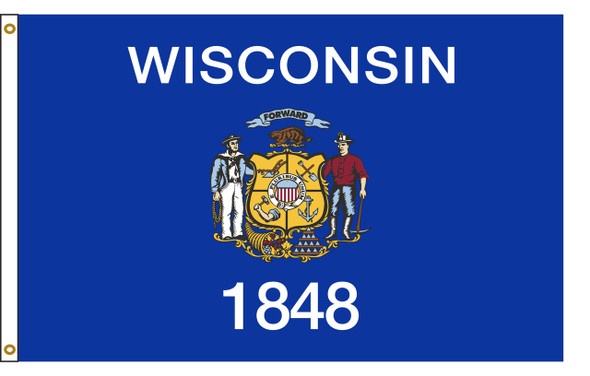
FORTISVEX Wisconsin State Flag 6x10 Feet Nylon - Made in USA with Brass Grommets
FORTISVEX