
Why Flags Fray at the Fly End, and What You Can Do About It
Go and look at your flag. Not the whole thing — just the far edge, the one furthest from the pole. If it has been up more than a season, that edge is where you will find the damage: threads pulled loose, a corner going soft, maybe a split working its way in from the tip.
That edge is called the fly end, and it is where almost every flag in America gives out.
What is actually happening up there
A flag in wind is not a sheet being pushed. It is a wave travelling from the heading out to the fly end, and like any wave it gets faster and more violent as it runs out of material to travel through.
By the time that wave reaches the tip it is moving fast enough to crack. That crack is the sound you hear on a windy day, and it is the same physics as a bullwhip. The tip of a flag on a 25 foot flagpole can move several times faster than the wind itself.
Thread does not fail because it is weak. It fails because it is being snapped, thousands of times a day, at the one point on the flag where the motion is worst.
Why cheap flags come apart so fast
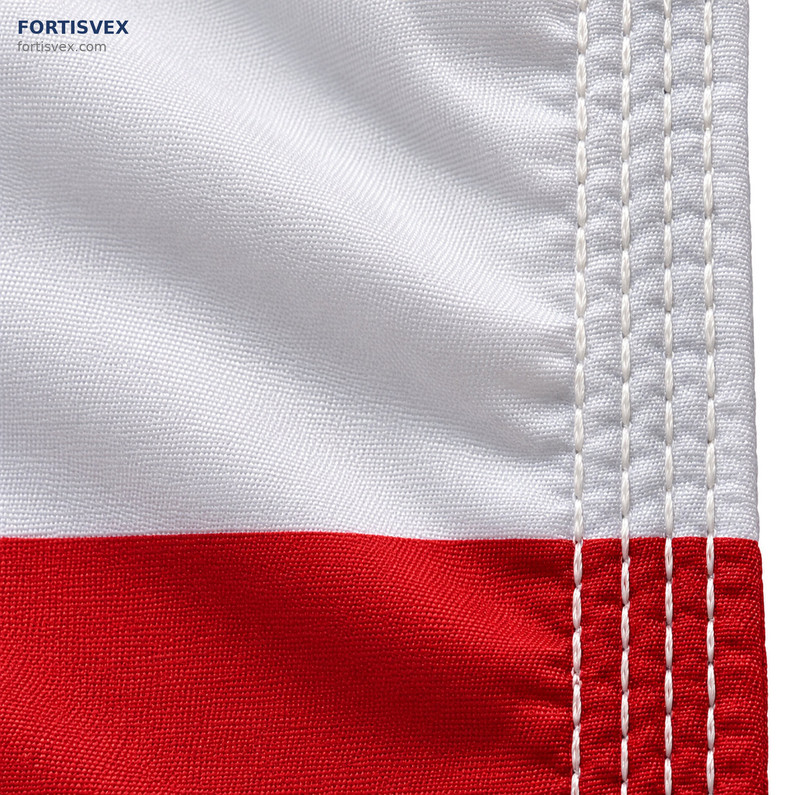
Every flag has a hem on the fly end. The difference between a flag that lasts a season and one that lasts three is how many rows of stitching are in it, and what kind.
Lock stitching means each stitch is knotted into the next. Cut one thread and the damage stops where it started. A chain stitch, which is faster and cheaper to sew, will unzip along the whole seam from a single broken thread — which is why a flag can look fine on Monday and be six inches shorter by Friday.
Row count is the other half. A budget flag runs one or two rows of stitching on the fly end. A properly built one runs four. The largest sizes run six.
Four rows does not mean four times the strength. It means three backups. When the outer row goes — and it will — there are three more holding the hem together while you notice and decide what to do.
Where the size changes the answer
The forces are not the same at every size, and construction changes to match.
Up to 6 x 10 feet, a flag is finished with a heavy duty heading and two solid brass grommets. Four rows of lock stitching on the fly end handles the load.
At 6 x 10 feet the stitching goes to six rows and the heading widens from an inch and a half to two inches. Sixty square feet of cloth generates far more force at the tip than a house flag ever will.
From 8 x 12 feet up, the grommets disappear entirely. A rope is sewn the full length of the heading with two plated steel thimbles, so the load runs through the rope instead of tearing at two points, and the fly end corners get zig zag stitched because a straight seam can be worked open at a corner.
None of that is upselling. It is what each size actually needs to survive.
What you can do about it
Take it down in the worst weather. The single biggest thing. A flag left up through a real windstorm can take more damage in one night than in six normal months. There is no dishonor in it — the Flag Code itself says the flag should not be displayed in inclement weather unless it is an all weather flag.
Rotate two flags. Fly one for a month, then swap. Two flags rotated monthly will outlast three flags flown to destruction, because cloth recovers when it rests and the fly end stops taking the same abuse in the same place.
Watch the tip, not the middle. When the fly end starts to fray, a few minutes with a needle or a visit to a tailor buys you another season. Left alone, that fray becomes a split and the flag is finished.
Check the hardware. A worn flag snap or a halyard that has gone stiff makes a flag whip harder than it should. The flag usually gets blamed for a hardware problem.
Buy the right size for the flagpole. A flag too large for its pole loads everything — the truck, the halyard, the snaps and the fly end — every time the wind gets up. The rule is that your flag's length should run about a quarter to a third of your flagpole's height.
The part nobody tells you
The flag that costs the least is almost always the flag you buy the most times.
A twenty dollar flag that lasts four months and a fifty dollar flag that lasts two years are not close on price. The cheap one costs you more, and in between you get to look at a faded, frayed flag over your house for weeks at a time before you get round to replacing it.
That is the real cost, and it does not show up on the receipt.
Every United States flag and state flag we make is finished with four rows of lock stitching on the fly end — six on the larger sizes — printed in UV resistant ink, and made in the United States.
Recent Posts
-
July 16, 1790: How Washington, D.C. Was Founded
Washington, D.C. is not a state, and it has no admission date the way the fifty states do. Its found …Sep 17th 2026 -
September 9, 1850: California Becomes the 31st State of the Union
California became the 31st state on September 9, 1850, admitted directly as a free state under the C …Sep 17th 2026 -
December 29, 1845: Texas Becomes the 28th State of the Union
Texas became the 28th state on December 29, 1845, admitted directly from an independent republic, wi …Sep 17th 2026