
Sweden and Finland: Compare the Crosses at the Same Height
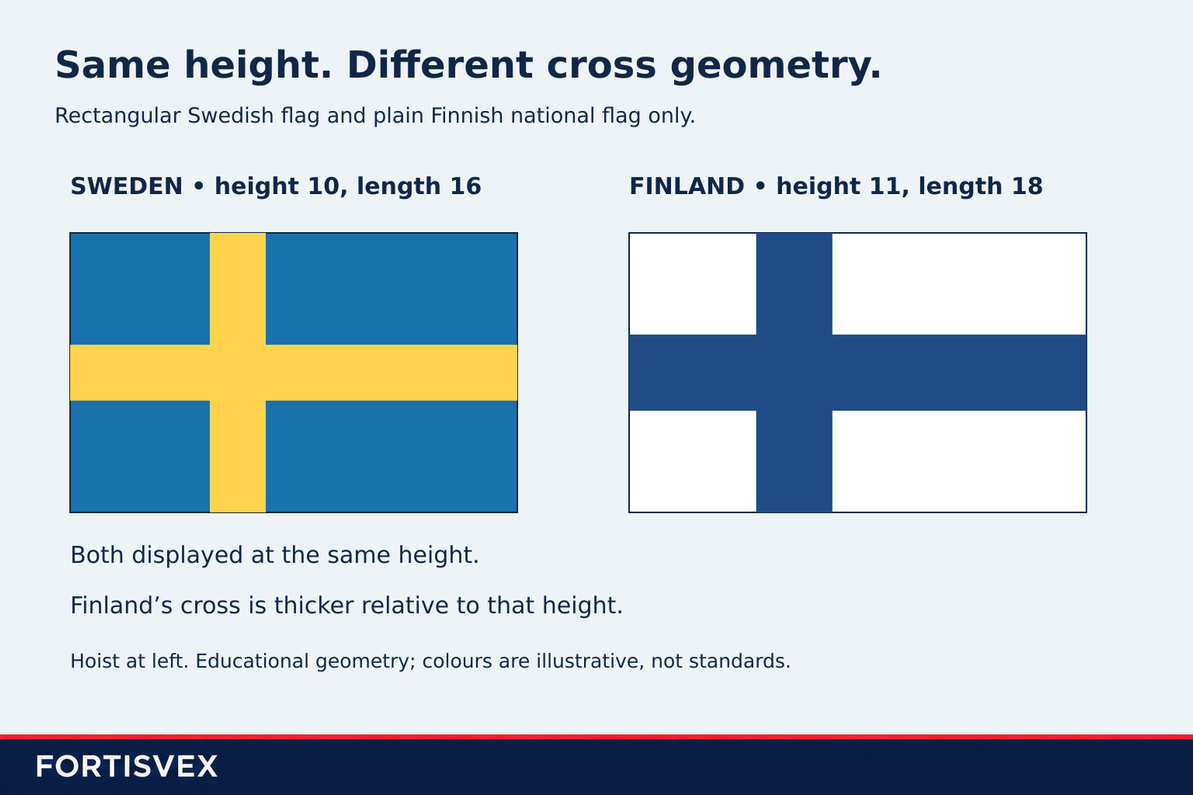
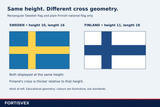
Sweden’s yellow cross on blue and Finland’s blue cross on white share a familiar arrangement: the upright sits nearer the hoist than the fly. But they are not the same drawing in different colours. Put the two rectangular flags at the same height and the difference becomes clear.
This comparison uses Sweden’s rectangular flag and Finland’s plain national, or civil, flag. It excludes forked versions and designs bearing additional emblems. Our diagrams explain geometry, not official colour specifications, finished-product construction or permission to use a particular variant.
Start with two separate grids
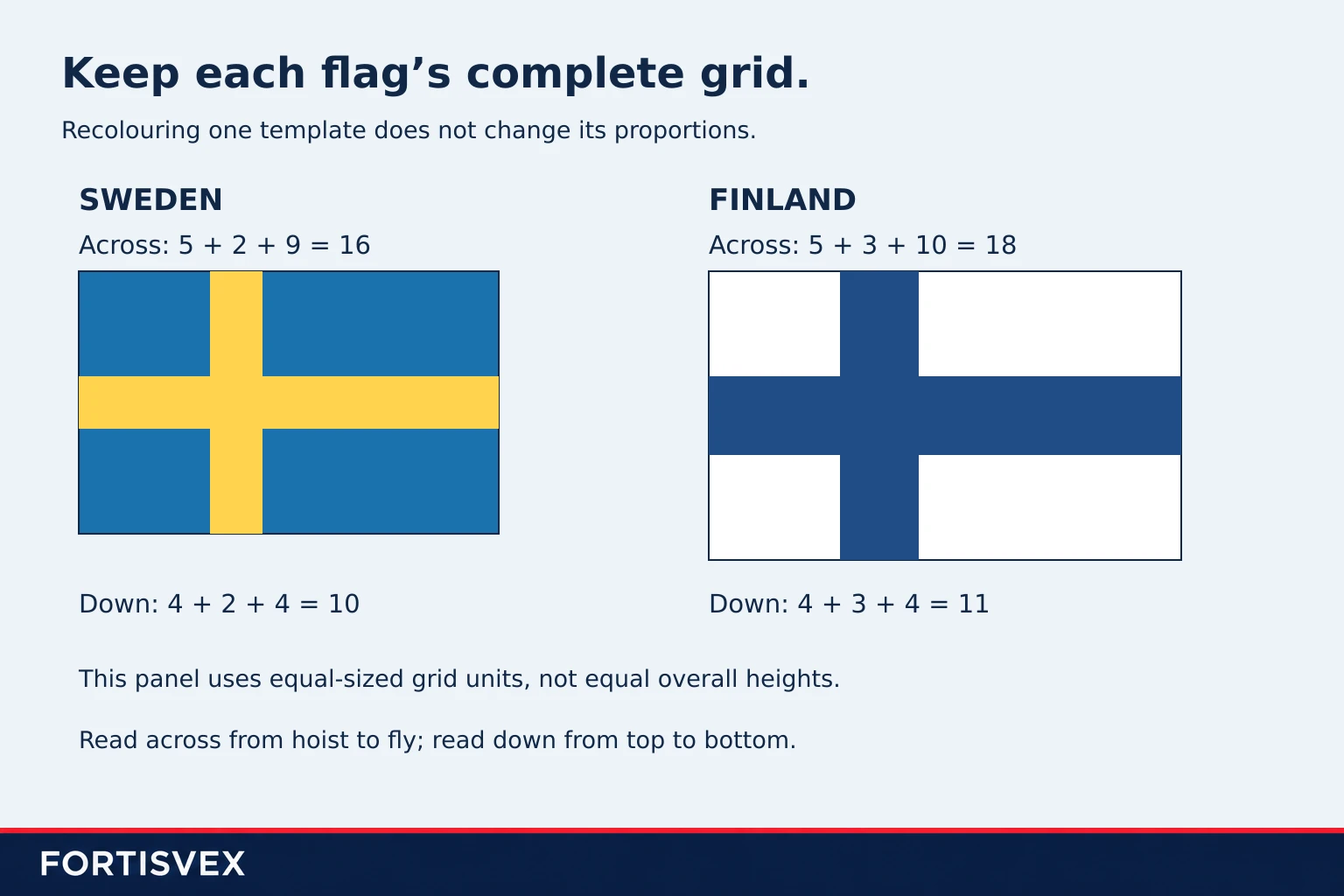
Sweden’s flag law specifies a rectangular height-to-length ratio of 10:16. Its field proportions and cross-width rule produce horizontal divisions of 5:2:9 and vertical divisions of 4:2:4. Finland’s Ministry for Foreign Affairs publication gives a height of 11 units, a length of 18 and a cross width of 3, producing divisions of 5:3:10 across and 4:3:4 down.
For the Finnish design on its own, our Finnish flag grid and variant guide separates the plain flag from state versions. Identify the version before comparing its measurements.
Equal height changes the comparison
To compare the two at equal height, divide each measurement by that flag’s total number of vertical units. The Swedish cross is 2/10 of the height, or 20%. The Finnish cross is 3/11, approximately 27.27%. That is why the Finnish cross looks thicker in the equal-height illustration, even though both designs have four-unit fields above and below it.
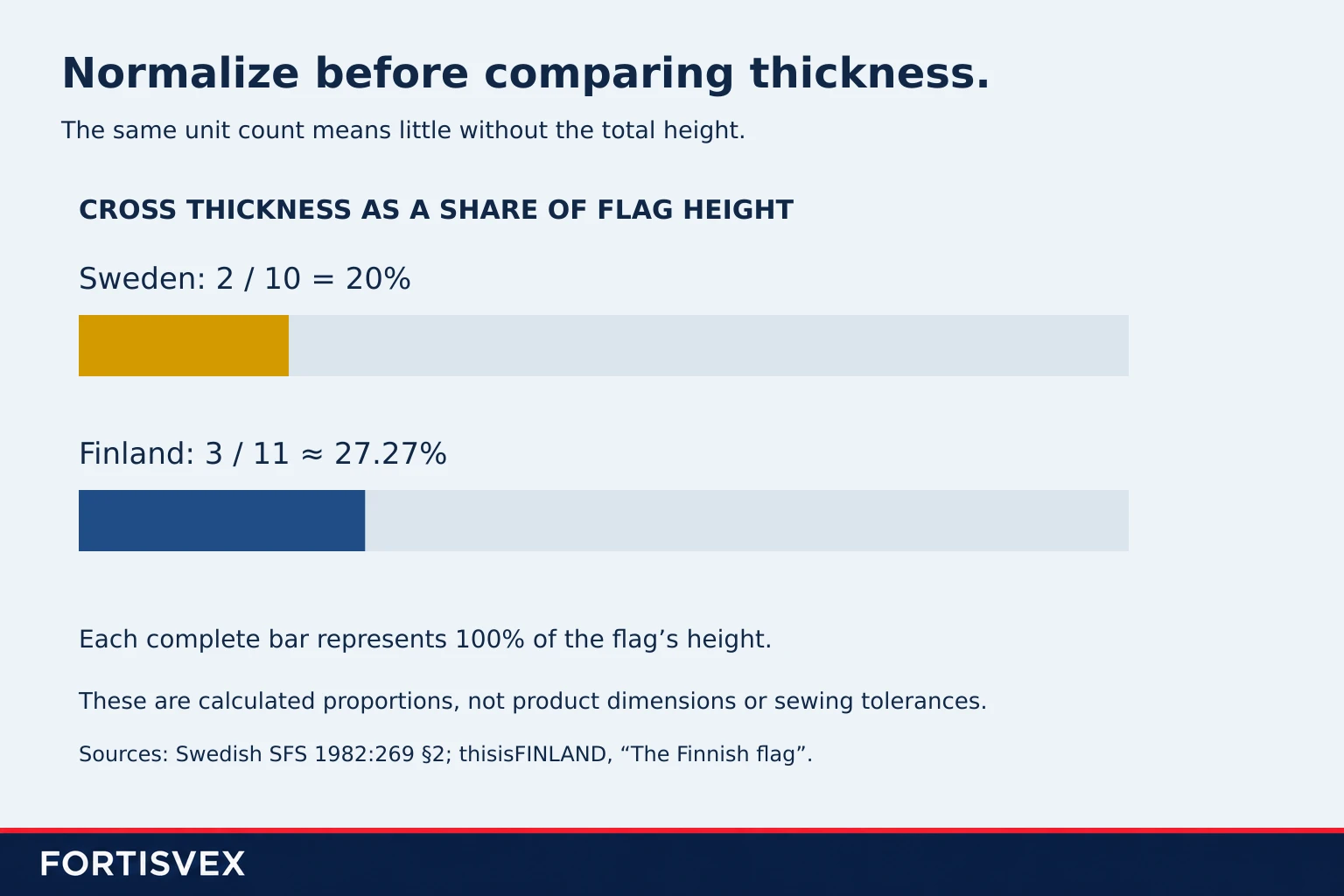
The same calculation applies horizontally. At height H, Sweden’s length is 1.6H; Finland’s is 18H/11, about 1.636H. The upright starts 0.5H from Sweden’s hoist and 5H/11, about 0.455H, from Finland’s. These are arithmetic consequences of the grids, not additional manufacturing specifications.
Compare the complete design, not a cropped cross
Use a flat, complete view with the hoist on the left. Keep the top and bottom aligned when judging equal height; do not stretch both images to the same width as well. That would distort at least one outline and hide the very difference you are checking.
A country name alone may not identify the outline. The distinction between Denmark’s rectangular and split flags is a useful reminder to settle the variant first, not a source of Swedish or Finnish use rules. Likewise, the Swiss square flag and centred cross belong to a different layout, not this offset-cross template.
When reviewing a listing or artwork preview, check the full rectangle, cross thickness and upright position together. A correct-looking colour combination alone does not establish correct proportions. This visual check does not certify dye shades, stitching, attachment details or suitability for a pole.
Primary sources and diagram method
Geometry is based on Sweden’s flag law, SFS 1982:269, sections 1–3, and thisisFINLAND’s official flag description. FORTISVEX created the educational diagrams and calculated the equal-height fractions from those measurements. The displayed colours are illustrative, not colour-standard proofs or product photographs.
Recent Posts
-
Poland and Indonesia: Check the Top Band Before the Size
Poland and Indonesia both use red and white in two equal horizontal bands. The quickest distinction …Nov 18th 2026 -
Sweden and Finland: Compare the Crosses at the Same Height
Sweden’s yellow cross on blue and Finland’s blue cross on white share a familiar arrangement: the up …Nov 18th 2026 -

Charcoal-Kettle Savoy Cabbage Wedges with Mustard Vinaigrette
Savoy cabbage’s crinkled leaves catch a little oil and brown at their edges, while the thicker base …Nov 18th 2026