
Reading the Swiss Flag: Shape, Cross and Context
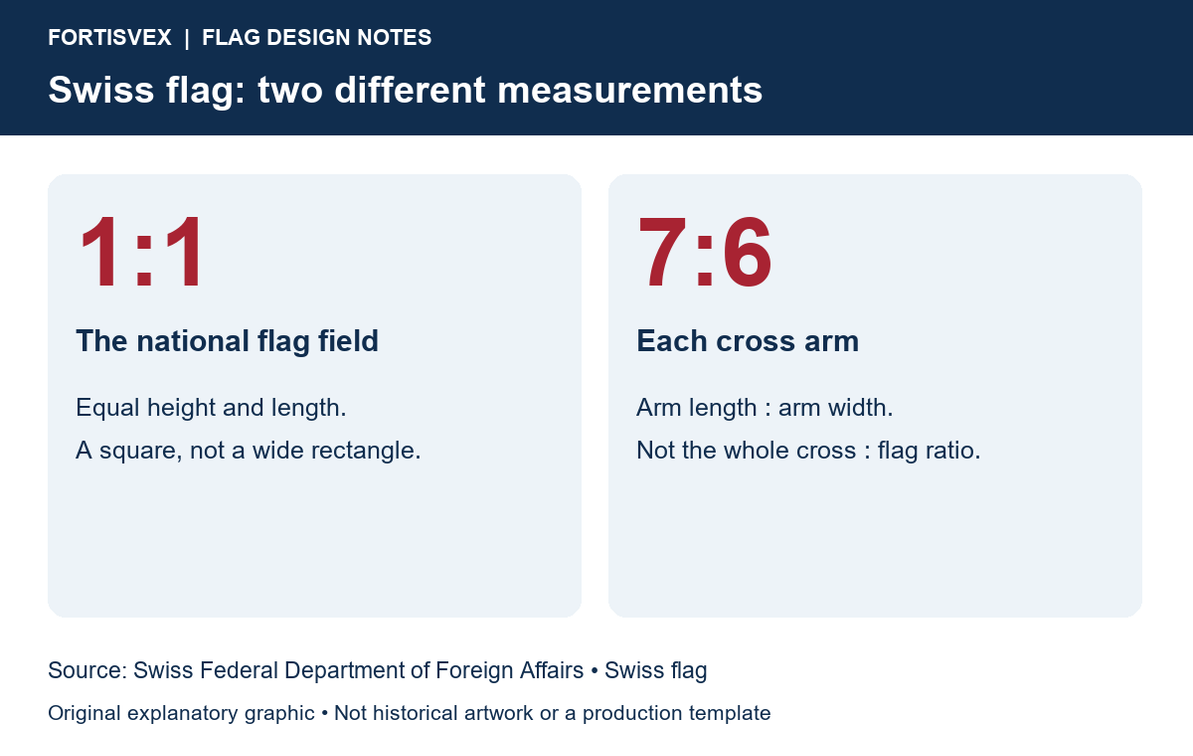
The Swiss flag is easy to recognize, but its simplicity rewards a closer look. Its ordinary national form is square, with a centred white cross on red. Both the outline of the flag and the proportions of the cross matter. Reading only the colours misses an important part of the design.
Start with the square
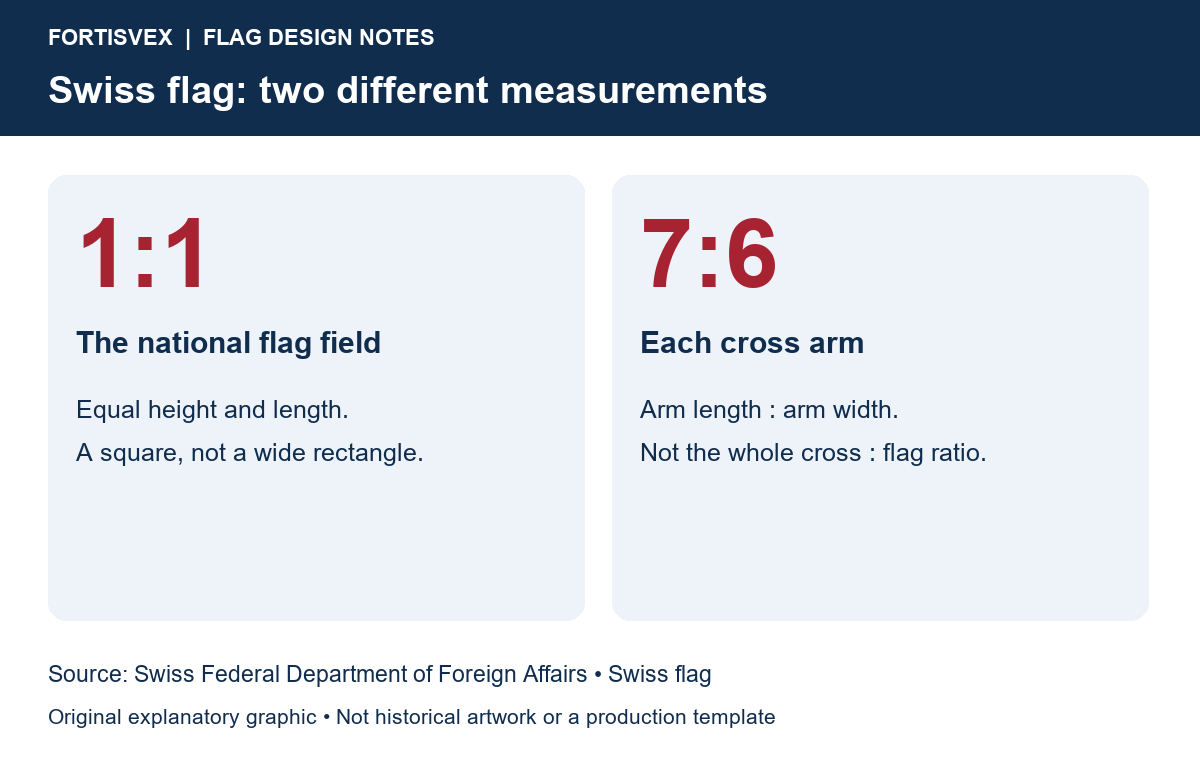
Switzerland’s national flag does not use the broad rectangular field familiar from many other countries. The square is a defining feature, not empty space that can be adjusted to fit a page. The Swiss government’s flag description connects that form with the design’s military background.
That distinction matters when choosing a flag for a school display, a cultural event or a collection. Read the finished dimensions rather than relying on a thumbnail, which may have been fitted into a rectangular image box. A three-by-three-foot item and a three-by-five-foot item have different proportions even when the product titles name the same country.
What the cross measurement actually means
The official description specifies equal arms whose length is one-sixth greater than their width. Written as a ratio, that is seven units long for six units wide. It describes the projecting arms of the cross; it does not say that the entire cross is seven-sixths as wide as the flag.
For a reader checking an illustration, this is a useful distinction between a component measurement and a complete layout. A diagram that gives only the arm ratio has not supplied every measurement needed to manufacture a flag. Likewise, a bold plus sign selected from a typeface is not a dependable substitute for verified national artwork.
The government also names a specific red, Pantone 485C. A screen preview cannot by itself verify a fabric colour standard: display settings, photography and lighting all affect what a shopper sees. Treat a technical colour claim as something to verify from the item’s documentation, not from how vivid its photograph looks.
A recognition mark before a national emblem
The white cross has a longer history than the modern federal flag. The Swiss government traces its military use to the Battle of Laupen in 1339, when crosses helped identify combatants. Its account describes later military use, a common Swiss military flag adopted under Guillaume-Henri Dufour’s leadership in 1840, and national adoption in 1848. The cross-arm specification followed in 1889.
This chronology separates the history of a symbol from the adoption of a national design. A medieval recognition mark and a modern national flag are related, but they are not interchangeable objects. It is more accurate to explain that development than to label every early white cross “the current Swiss flag.” See the government’s historical account of the Swiss flag for the stages.
Avoid explanations the evidence does not support
Four arms may invite an appealing story about Switzerland’s four national languages. The official historical account says that correspondence is coincidence. It should not be presented as the reason the cross was designed that way.
The origin of the red background also deserves care: the government’s overview notes competing historical explanations. A confident single-sentence story about what the red “must mean” would conceal that uncertainty. An honest caption can identify the colours and cross without assigning an unverified meaning to each feature.
Match the flag to the setting
Start with the square national design when evaluating an ordinary land display. If a rectangular item is being considered for a specialised setting, ask for the applicable specification rather than assuming that a retail shape establishes official use. This article does not provide maritime or ceremonial exception instructions.
Browse Switzerland flags with the dimensions, material and attachment requirements of your own display in hand. Check each listing rather than inferring its construction from the national design. A correctly drawn cross does not tell you whether a flag has a sleeve, grommets or hardware included.
For an international display, allow each flag enough space to retain its documented shape. A square should not be stretched to fill a neighbouring rectangular outline. The international flag collection can help you compare items, while the government sources above explain the design you are looking for.
Recent Posts
-

Rupert, Idaho: Read the History Around the Town Square
Rupert’s historic square rewards a closer look than a quick photograph. Its buildings record change …Oct 29th 2026 -
Reading the Swiss Flag: Shape, Cross and Context
The Swiss flag is easy to recognize, but its simplicity rewards a closer look. Its ordinary national …Oct 29th 2026 -
Why the European Flag Keeps Twelve Stars
Twelve gold stars form a circle on a blue field. The European flag is easy to recognize, but its nu …Oct 29th 2026