
Norway’s Flag in 1821: Agreement on Design, Disagreement on Authority
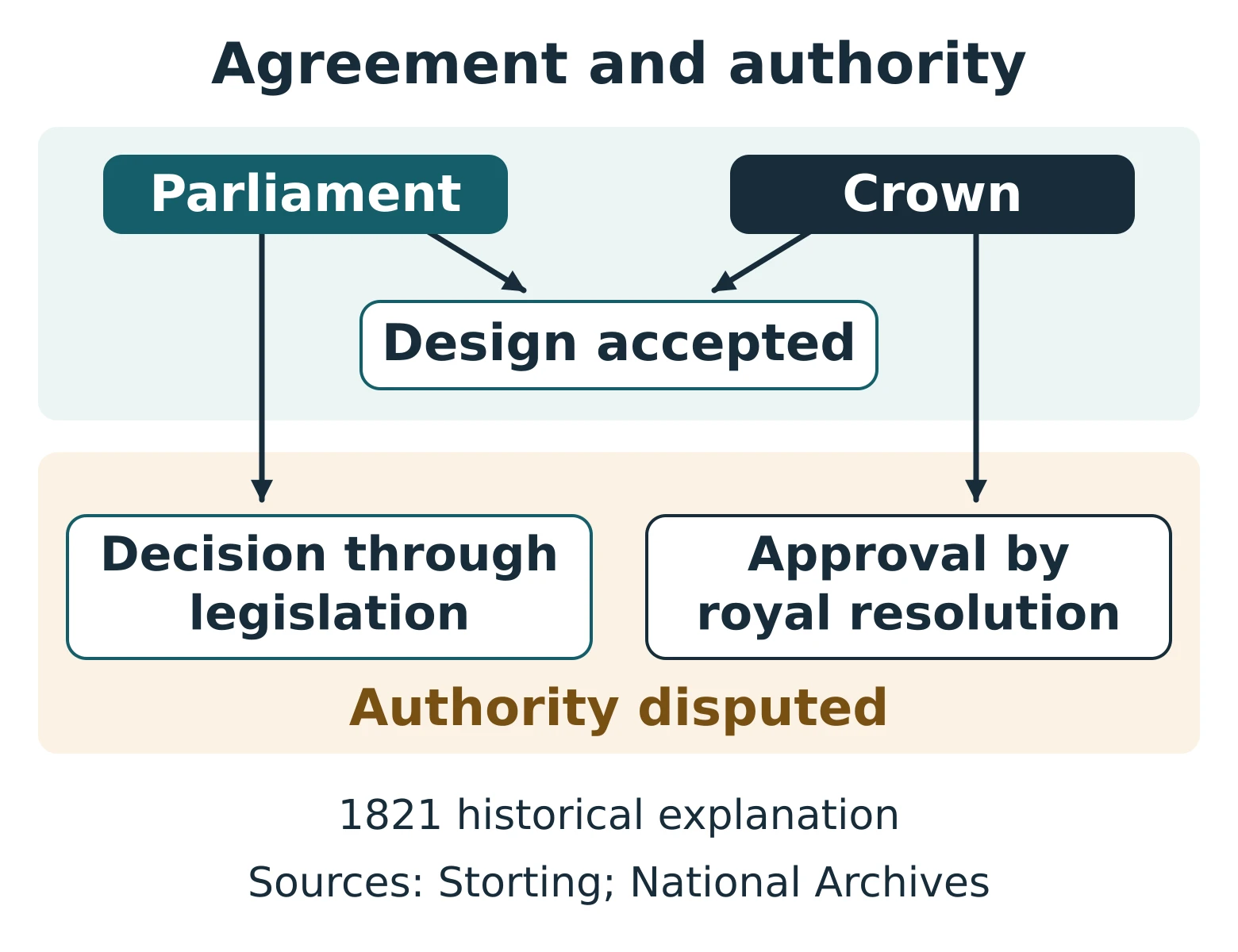
In 1821, Norway’s parliament and king accepted the flag’s design while disputing who could determine it.
Agreement on appearance left authority contested
The Storting’s English history explains the distinction: Carl Johan refused assent to parliament’s law but approved its proposed flag by royal decree.
Petitions brought a choice before parliament
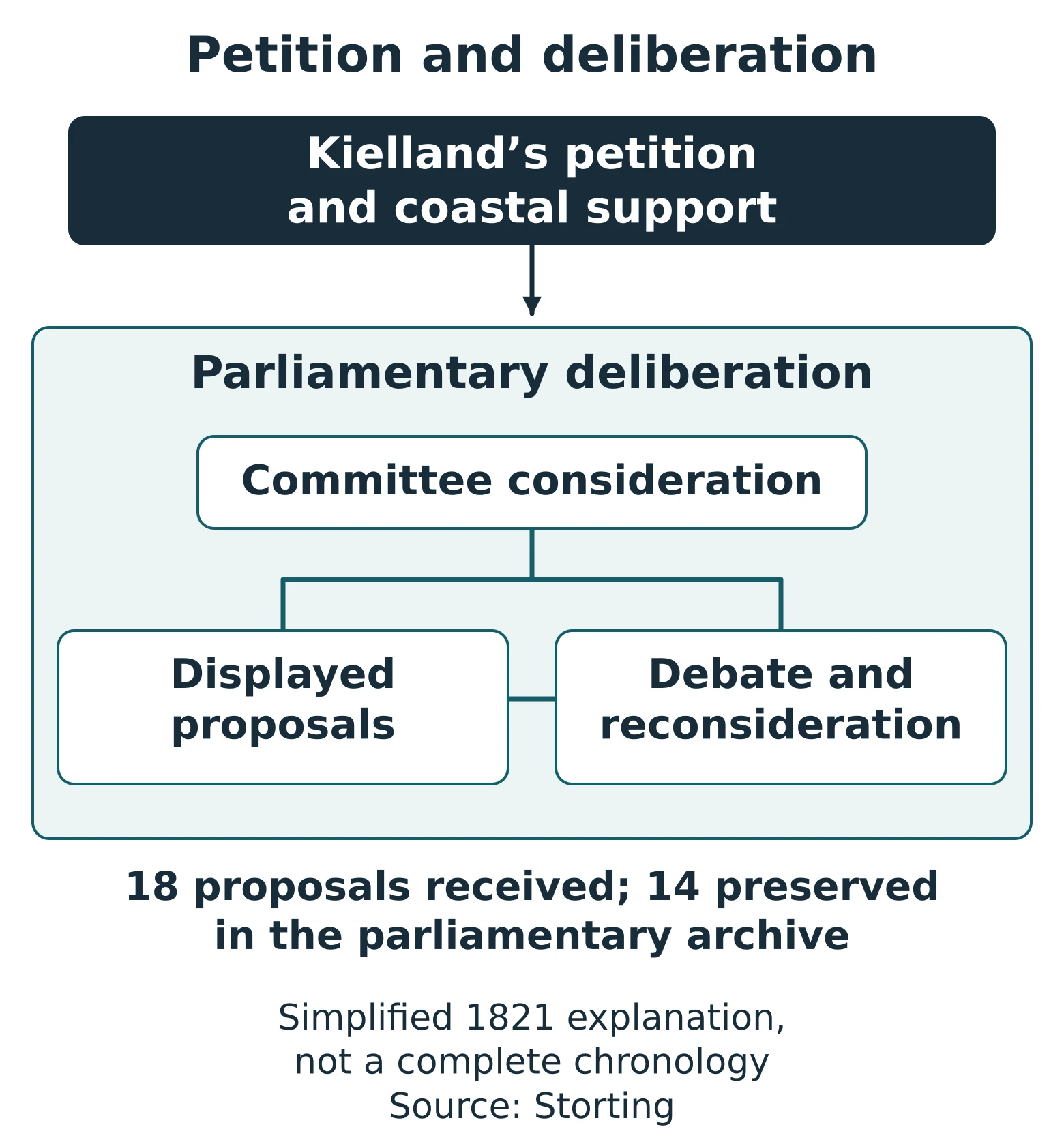
Gabriel Schanche Kielland petitioned the Storting in autumn 1820 and sought coastal support. Proposals followed in the 1821 session.
The Storting’s history of the flag as a union-era symbol records 18 submitted proposals, of which 14 survive in its archive. Numbered designs were displayed in the assembly room. A committee initially favored a proposal from Grimstad, so Meltzer’s design was one option within a contested parliamentary discussion.
Those numbers describe submissions and preservation, respectively. They should not make the surviving archive look like the complete set of choices, or turn a committee preference into an earlier official flag.
Meltzer argued for a workable symbol
In the Storting’s account of the design debate, Meltzer challenged a committee proposal that included a lion and five stars. He thought its divided arrangement resembled signal flags and questioned the suitability of a lion for a commercial flag used on private ships and property. He also raised the difficulty of rendering the animal.
These were arguments made by a participant, not timeless rules for flag design. Meltzer favored a cross and associated red, white and blue together with liberty, drawing on other national examples. His reasoning combined a recognizable form, practical execution and political associations. It does not establish a separate fixed meaning for each color.
Royal approval preserved the disagreement
The official 1821 chronology keeps the parliamentary stages distinct. May 4 included referral back to committee; further action followed on May 11, and Lagtinget considered Odelstinget’s May 11 decision on May 16. May 4 should therefore not stand alone as the completed enactment.
The National Archives confirms the July 13 resolution and the king’s reservation about parliament’s authority.
The resolution’s commercial-use permission was geographically qualified. The Storting’s chronology describes nearby waters, with further specification to follow, and records that constitutional questions were postponed in August.
Recent Posts
-
Norway’s Flag in 1821: Agreement on Design, Disagreement on Authority
In 1821, Norway’s parliament and king accepted the flag’s design while disputing who could determine …Nov 5th 2026 -
Reading Beach Warning Flags: Check the Local Sign, Not Just the Color
A beach warning flag is easier to recognize than to interpret. You may remember a color from anothe …Nov 5th 2026 -
New Zealand’s Flag: From the 1869 Ensign to 1902 Confirmation
New Zealand’s flag history has a maritime beginning and a later milestone in recognition on land. T …Nov 5th 2026