
Dannebrog: The 1219 Legend and the Evidence Behind Denmark’s Flag
Denmark's red flag with a white cross has a memorable origin story: a banner falls from the sky and turns a battle toward victory. The story belongs to Dannebrog's cultural history. It is not the same thing as a contemporary record proving when the flag was first used. Keeping that distinction makes the history more interesting, not less: it allows a medieval symbol, a later legend and a modern national tradition to be understood on their own terms.
What the 1219 story says
The Danish Ministry of Foreign Affairs' account places the legend at the battle of Lyndanise, in present-day Tallinn, on June 15, 1219. In the story, Valdemar II's army faces defeat before the red-and-white banner descends from heaven and is interpreted as a divine sign. The ministry presents this explicitly as a legend. It also explains the connection with Valdemarsdag on June 15 and recalls Queen Margrethe II's visit to Tallinn for the 2019 anniversary celebrations. Source: Danish Ministry of Foreign Affairs, the legend of Dannebrog.
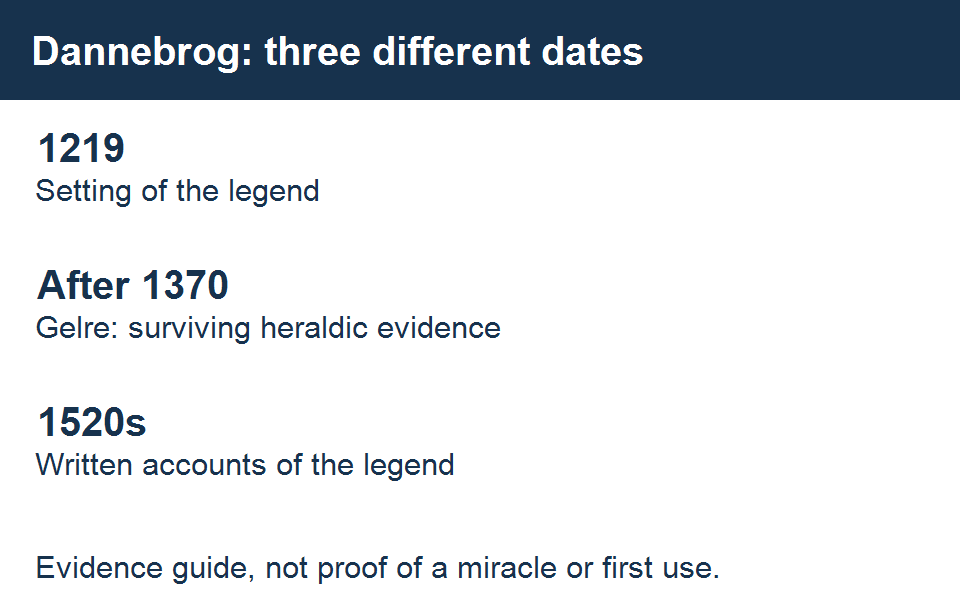
An anniversary can commemorate a traditional story without proving its miraculous event. The date of the battle, the date assigned to the legend and the date of a surviving account are separate questions. Calling the story an eyewitness report would erase that distinction.
What survives from the Middle Ages
The Danish reference work Lex identifies a red banner with a white cross in the Gelre armorial, made after 1370, as the earliest known coloured representation of Dannebrog. It appears with the arms of Valdemar IV. That is a documented heraldic appearance, rather than a surviving flag from the 1219 battlefield. Source: Nils Georg Bartholdy, Dannebrog, Lex.
The same account identifies the legend in Christiern Pedersen's chronicle from the early 1520s and in Peder Olsen's writing around 1527. Those accounts are centuries later than the traditional battle date. Lex also records a different early date associated with Olsen's account. The familiar version was not a fixed eyewitness narrative carried unchanged from the battlefield.
Why “the oldest flag” needs care
Denmark's official cultural website describes Dannebrog as one of the world's oldest national flags in continuous use. Its longer history places the design's Danish association around the middle of the fourteenth century and notes that red banners with white crosses also existed outside Denmark. That context is more useful than treating the legend as a certificate of invention. Source: Denmark.dk, the story of the Danish flag.
A claim about a design's longevity is not a claim that an original piece of cloth survives. Nor does a familiar cross design, on its own, identify a particular medieval army. Readers comparing flag histories should ask what is being dated: a design, a name, a depiction, a physical object or a tradition.
From royal symbol to everyday celebration
Denmark.dk describes a flag once associated with royalty becoming widely used by ordinary people. Its examples include small paper flags on birthday food, Christmas decorations and flags used by football supporters. These settings help explain how a national symbol can carry personal meanings as well as official ones. They should not be confused with evidence for its medieval origin.
Dannebrog's cross also belongs to the history of royal heraldry. The Royal House explains that the cross has divided the royal arms since the time of Erik of Pomerania, and that its form developed under Christian IV. Its account distinguishes this heraldic use from the ordinary national flag. The royal arms themselves are reserved to the monarch, Royal House and Court; they are not decorative artwork to add to a commercial flag illustration. Source: The Royal House, the royal coat of arms.
For readers exploring more flag histories, the FORTISVEX storefront is a starting point for browsing the site's flag information and categories. When choosing a flag, keep the historical story separate from the listing's actual size, material and intended use. A modern product need not be presented as a replica of a medieval banner to have a meaningful connection to Danish heritage.
Recent Posts
-
South Korea’s Taegeukgi: Check the Four Trigrams and Artwork Orientation
The South Korea flag, known as the Taegeukgi, is a good example of why artwork review should go beyo …Nov 2nd 2026 -
Brazil Flag Artwork: Check the Star Map Before Approving the Proof
The blue globe on a Brazil flag rewards a closer look. When buying a flag or reviewing a production …Nov 2nd 2026 -
Mexico Flag: The Eagle Is Part of the Design, Not an Optional Logo
A Mexico flag can look familiar at a glance while still needing a closer artwork check. When compari …Nov 2nd 2026