
FORTISVEX
FORTISVEX Wisconsin State Flag 8x12 Feet Nylon - Made in USA with Rope and Thimbles
- MPN:
- FPAMSTWINYL8x12D
- Availability:
- Free Shipping* https://fortisvex.com/shipping-returns-terms/
- Shipping:
- Calculated at Checkout


Description
This is an institutional size. Ninety six square feet of flag, flown on a forty to fifty foot flagpole outside a civic building, a campus, a large commercial site — nobody buys this size without meaning to.
This is the Wisconsin state flag at 8x12 Feet (96 square feet) in nylon, made in the United States and finished with a sewn rope and plated steel thimbles.
Built to the Wisconsin flag specification
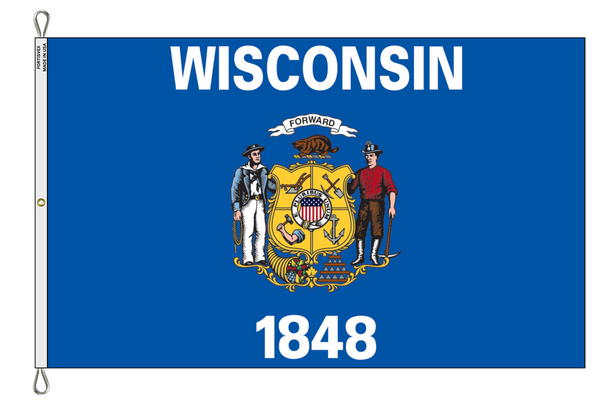
The Wisconsin flag is set out in Wisconsin Statutes Section 1.08, at a two to three proportion. It is the state coat of arms on royal blue, with the word Wisconsin above and the date 1848 below.
Originally 1863 and standardized in 1913; the word Wisconsin and the date 1848 were added by Chapter 286, Laws of 1979, mandatory for flags made on or after May 1, 1981.
What the statute here fixes is the design, the colors and the seal or emblem; it does not fix a size for an outdoor flag to hit. That is the position in most of the country, and it is the reason every manufacturer settles on the same standard sizes.
What we build is a faithful reproduction of that design, sized to the standard outdoor sizes every manufacturer uses and the states themselves order in. On an outdoor flag, the colors, the seal and the emblems are what has to be right, and here they are.
The law that defines it, in its own words
Wisconsin Statutes Section 1.08 reads:
(1) The Wisconsin state flag consists of the following features: (a) Relative dimensions of 2 to 3, hoist to fly. (b) A background of royal blue cloth. (c) The state coat of arms, as described under s. 1.07, in material of appropriate colors, applied on each side in the center of the field, of such size that, if placed in a circle whose diameter is equal to 50 percent of the hoist, those portions farthest from the center of the field would meet, but not cross, the boundary of the circle. (d) The word "WISCONSIN" in white, capital, condensed Gothic letters, one-eighth of the hoist in height, centered above the coat of arms, midway between the uppermost part of the coat of arms and the top edge of the flag. (e) The year "1848" in white, condensed Gothic numbers, one-eighth of the hoist in height, centered below the coat of arms, midway between the lowermost part of the coat of arms and the bottom edge of the flag. (f) Optional trim on the edges consisting of yellow knotted fringe. (2) The department of administration shall ensure that all official state flags that are manufactured on or after May 1, 1981 conform to the requirements of this section. State flags manufactured before May 1, 1981 may continue to be used as state flags.
The emblem itself is defined by reference to the coat of arms at Section 1.07, so these words are the frame and not the whole picture.
You do not have to take our word for any of that. Read Wisconsin Statutes Section 1.08 in full at the Wisconsin Legislature, and check what we sell against it.
This is the flag we make. Not an approximation of it.
What is on it and what it means
A sailor and a miner represent labor on water and on land. The shield quarters agriculture, mining, manufacturing and navigation. The crest is a badger and the motto is Forward.
Worth knowing about this flag
The lettering was added for a specific reason. Without it the flag was nearly indistinguishable from several other blue seal flags at a distance, and that is why the 1979 act required it.
Where the Wisconsin flag flies
The Acuity Insurance flagpole in Sheboygan is the tallest flagpole in the United States at four hundred feet, erected in 2014. It weighs approximately four hundred and twenty thousand pounds, uses three pendulum style tuned mass dampers to reduce movement and vibration, and is designed to withstand a low temperature of minus forty two degrees. The current flag is seventy by one hundred and forty feet. The original was sixty by one hundred and twenty. Flags fly about a hundred and twenty to a hundred and thirty days before retirement, and a heavier flag is used in harsh weather.
Fly it on Wisconsin’s birthday
Wisconsin became the 30th state on May 29, 1848. Under the United States Flag Code as amended July 7, 1976, a state flag flown on the state’s birthday takes its place beneath the United States flag, and that day is the one date every year the Wisconsin flag has an official reason to go up.
Buy it now and it is on the flagpole for the day. The full list of state birthdays is on our state birthdays page.
Nylon or polyester in Wisconsin
Nylon inland at Madison. Polyester on the Lake Michigan shore at Milwaukee and Green Bay.
For scale, the National Weather Service ultraviolet index forecast for Milwaukee on July 23, 2026 was 9 at solar noon, in the very high band. That is the sun this flag has to survive.
At ninety six square feet the flag loads its flagpole in earnest. On the exposed sites above, polyester is not a preference but the only sensible choice, and the flagpole and truck need to be rated for it.
What you have here is the nylon, appropriate for the sheltered and moderate wind sites listed above, for any house bracket, and for anywhere the flag is brought down during storms. Two things decide it: it is light, flying on an ordinary breeze rather than going limp, and it dries fast, which is the defense against mildew in humidity. The trade is ultraviolet durability — nylon’s amide bonds break under sun, fading and weakening faster than polyester, and it loses about a tenth of its strength wet. For an exposed site on the list above, the polyester version is worth a look instead.
One more thing that decides it, and it is the part people only learn after buying twice: a nylon flag flies on days a polyester flag will not. If the flag matters to you on a still morning, on a holiday, at a funeral, at a ceremony, that is an argument for this one even on a site where the polyester would last longer. A flag that hangs is not doing its job either.
The figure most institutions use is from the American Legion, citing the United States government's expectation of about ninety days for a flag flown daily from sunrise to sunset, and roughly a quarter of that around the clock. Retailers see three to six months in practice for nylon flown daily, four to eight for polyester, and one to three years when flown occasionally. These are practical figures, not a guarantee, and real-world exposure shifts them considerably.
How the 8x12 Feet is built
The fly end carries six rows of lock stitching, and the corners use zig zag stitching rather than a straight seam, because a straight corner seam works loose under wind over a season.
The math comes to 96 square feet of nylon at roughly two ounces a square yard. In a thirty mile an hour wind, the fly end moves faster than the wind that is driving it, since the wave headed for the tip speeds up as it travels — which explains why the tip wears out first and why fly-end stitching count is worth checking on any listing.
Whether folding on the ground or clipping onto the flagpole, this is two person work. Ninety six square feet in a gust can knock a lone worker off balance.
Each lock stitch knots into the one beside it, so a broken thread stays broken right where it snapped instead of unraveling the whole seam. 6 rows is not 6 times the strength — it is 5 backups. This size drops grommets entirely. The heading carries a nylon rope its full length, ending in plated steel thimbles, so the load runs through the rope instead of two vulnerable points.
Commercial grade nylon is the material in this flag. Light enough to catch a gentle breeze, it sheds water rather than holding onto it and dries fast, which keeps a flag from staying heavy and stressing its seams. The ink is UV resistant and field tested, since sun exposure is what determines how long the color lasts.
Why this flag is harder to make than most
Two human figures, a quartered shield, a badger crest and two lines of added lettering. The lettering is what makes it identifiable and it is also more to print.
For what it is worth, the North American Vexillological Association surveyed 72 state, provincial and territorial flags in 2001 and rated them from zero to ten. The Wisconsin flag placed 65, at 3.16 out of 10.
Will it fit my flagpole?
Forty to fifty feet of in-ground flagpole, on a truck and halyard rather than a bracket, is the right fit.
Questions about the 8x12 Feet
What size flagpole for an 8x12 foot flag? Forty to fifty feet, on a truck and halyard rated for the load. This is an institutional flag.
What are the thimbles for? The rope sewn through the heading ends in two plated steel thimbles. The halyard snaps clip to the thimbles, so the pull runs through the rope along the whole hoist rather than tearing at two grommets.
Can an 8x12 foot flag fly around the clock? It can, on a lit flagpole, but a flag flown twenty four hours lasts roughly a quarter as long as one flown sunrise to sunset. Budget for that.
Why the grommets disappear
Concentrating ninety six square feet of pull onto two brass rings does not hold, which is why a rope runs the full length of the heading, spreading the load across the whole hoist and letting thimbles carry the attachment point. It costs more to build, but it is the only construction that survives at this size.
Specifications
- Size: 8x12 Feet
- Area: 96 square feet
- Material: 100 percent nylon
- Fly end: 6 rows of lock stitching
- Heading: heavy duty white, reinforced, 2 inch
- Finish: Rope and Thimbles
- Ink: UV resistant, field tested
- Made in the United States by FORTISVEX
Which size do I need?
Underneath both tables is a single ratio: a flag a quarter to a third the flagpole’s height. When you land between two rows, that is a real choice, not a rounding error — smaller flies more often, bigger reads further.
If you know your flagpole height, start here.
- 6 Feet house bracket: 2x3 Feet or 3x5 Feet
- 15 to 20 Feet flagpole: 3x5 Feet or 4x6 Feet
- 20 to 25 Feet flagpole: 4x6 Feet or 5x8 Feet
- 25 to 35 Feet flagpole: 5x8 Feet or 6x10 Feet
- 35 to 45 Feet flagpole: 6x10 Feet or 8x12 Feet
- 45 to 60 Feet flagpole: 8x12 Feet or 10x15 Feet
- 60 to 80 Feet flagpole: 10x15 Feet or 12x18 Feet
- 80 to 100 Feet flagpole: 12x18 Feet or 15x25 Feet
- 100 to 120 Feet flagpole: 15x25 Feet or 20x30 Feet
- 120 to 150 Feet flagpole: 20x30 Feet or 20x38 Feet
- 150 to 200 Feet flagpole: 20x38 Feet or 30x50 Feet
- 200 to 240 Feet flagpole: 30x50 Feet or 30x60 Feet
- 240 Feet and above: 30x60 Feet or 50x80 Feet, engineered to the flagpole
If you know your flag size, start here.
- 2x3 Feet: 4 to 8 Feet bracket or garden flagpole
- 3x5 Feet: 6 Feet bracket, or 15 to 20 Feet in-ground flagpole
- 4x6 Feet: 18 to 25 Feet in-ground flagpole
- 5x8 Feet: 25 to 35 Feet flagpole
- 6x10 Feet: 30 to 40 Feet flagpole
- 8x12 Feet: 40 to 50 Feet flagpole
- 10x15 Feet: 50 to 60 Feet flagpole
- 12x18 Feet: 60 to 80 Feet flagpole
- 15x25 Feet: 80 to 100 Feet flagpole
- 20x30 Feet: 100 to 120 Feet flagpole
- 20x38 Feet: 120 to 150 Feet flagpole. This is the garrison size under Executive Order 10834, at a one to one point nine ratio rather than the two to three of the commercial sizes, and it is the size flown at the White House and the Capitol
- 30x50 Feet: 150 to 200 Feet flagpole
- 30x60 Feet: 200 to 240 Feet flagpole. This is the largest standard commercial size
- 50x80 Feet: 240 Feet and above, engineered to the flagpole
Push the flagpole past a hundred feet and the same ratio still applies, but it stops being a simple lookup: the flag, the truck, the halyard, the foundation and the wind load need to be engineered as a unit, and skipping that step damages the flagpole before it damages the flag. A number of famous large flags deliberately break the rule of thumb, on an engineer’s word rather than a table’s.
The full range is available to order even where a size is not shown on the site. If what you need is not listed here, ask and we can still get it made.
About the back of the flag
It is normal for a printed flag to read backward from behind — almost every flag flown in America works this way. A flag that reads correctly from both sides is double sided: two flags sewn together with a liner, at roughly double the weight and cost. Single sided stays the standard and the right choice except where a state’s own law requires the double sided build.
Flying it with the United States flag
Section 7 of Title 4, the United States Flag Code, addresses this directly: the United States flag is never outranked in position, staying above every other flag and to the right at the same level, which reads as the viewer’s left. Same-height flagpoles put the United States flag on the viewer’s left with matching flag sizes; different heights put it on the taller pole; one flagpole with two flags puts it at the top. There is no legal penalty for civilians under the Flag Code, but it is what every institution follows anyway.
Buy two and they both last longer
Two flags, alternated month to month, beat three flags flown until they fall apart, because the material recovers on its days off and the fly end is not worked in the same place every day. Severe weather is the one time to take it down; a real windstorm can cost more in one night than six ordinary months of flying. Fraying starts at the fly end, not the middle, and a few minutes with a needle there adds a season.
For cities, counties, schools and agencies
State flags go out to municipalities, school districts, fire and police departments, courthouses and state agencies as a matter of course. Tax exempt purchasing runs through the tax exempt page, and anything involving quantity, a replacement schedule or a size we do not list goes through the contact page.
Why buy it from us
Small and American describes this company, and we stock what we list. Every flag is made in the United States, printed with UV resistant ink, and finished to the construction described above rather than to a price target. We’d rather sell one flag that holds up than three that don’t. Free shipping on orders over twenty five dollars.
Videos
View AllClose
Additional Information
Material Type: |
Commercial Nylon |
Flag Size: |
8x12 Feet |
Made in: |
USA |
Finish: |
Rope and Thimbles |
Related Products
Related Products

FORTISVEX Illinois State Flag 8x12 Feet Nylon - Made in USA with Rope and Thimbles
FORTISVEX
FORTISVEX Georgia State Flag 8x12 Feet Nylon - Made in USA with Rope and Thimbles
FORTISVEX

FORTISVEX Oklahoma State Flag 8x12 Feet Nylon - Made in USA with Rope and Thimbles
FORTISVEX

FORTISVEX Pennsylvania State Flag 8x12 Feet Nylon - Made in USA with Rope and Thimbles
FORTISVEX
FORTISVEX Ohio State Flag 8x12 Feet Nylon - Made in USA with Rope and Thimbles
FORTISVEX