
FORTISVEX
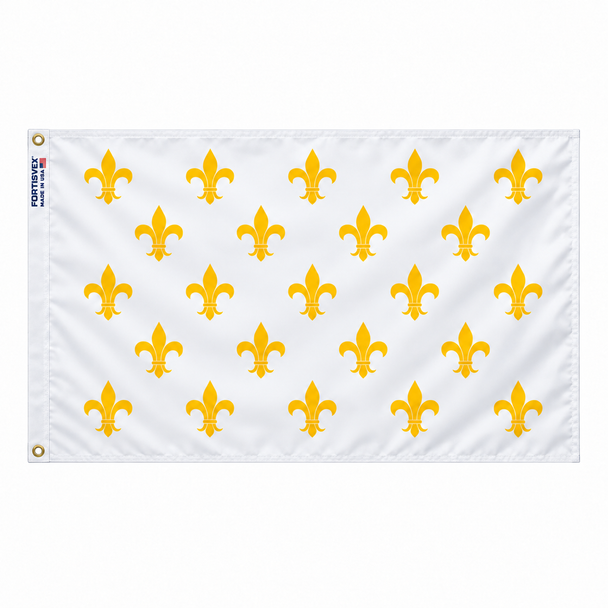
FORTISVEX White Twenty-three Fleur-de-lis Flag 3x5 Feet Nylon - Made in USA with Brass Grommets
- MPN:
- Z060564
- Shipping:
- Calculated at Checkout

Description
This FORTISVEX White Twenty-three Fleur-de-lis Flag presents twenty-three gold fleurs-de-lis in staggered rows across a white field. The design recalls French royal decoration, but its exact flower count is a feature of this modern pattern, not a verified official historical code. No central royal coat of arms is shown.
History Behind the White Twenty-three Fleur-de-lis Design
A white field covered with gold fleurs-de-lis evokes the ceremonial imagery of royal France. This version contains twenty-three flowers in five staggered rows, a different composition from the three-flower royal arms. The number identifies this product’s arrangement; it should not be treated as a proven historical code or an official count prescribed for every French royal standard. No exact period attribution for this particular twenty-three-flower layout has been established in the institutional sources cited here. Its history is best explained through the documented traditions it recalls.
The meaning of a repeated floral field
Repeated fleurs-de-lis were part of royal imagery before the compact three-flower arms became established. The Bibliothèque nationale de France’s discussion of a medieval royal armorial describes the scattered-flower pattern as an expression of majesty, sacred associations, and sovereignty. That example uses blue, not white. It supplies context for the motif, not proof that a later white-field arrangement is the same medieval banner.
Reading the complete design is essential. A repeated field of flowers, a shield bearing three flowers, a crown, and the surrounding insignia are different parts of a heraldic composition. Removing the central shield from a royal standard changes what is being reproduced, even when the background still looks recognizably French. This distinction helps prevent a modern decorative adaptation from acquiring an unsupported story about an individual monarch or campaign.
What a surviving period flag reference shows
A useful historical comparison is the Royal Naval Flag-Fan at Royal Museums Greenwich. Dated by the museum to approximately 1790–1794, this folding paper fan presents more than seventy naval and merchant flags. Its French royal standard has the royal coat of arms over a field of fleurs-de-lis, while a separate French national flag includes a tricolour canton. The object captures an era when old royal symbolism and revolutionary forms appeared together in a practical guide to recognizing flags.
The fan also illustrates why historical flag research requires more than finding familiar flowers. Its royal standard includes a central coat of arms that this twenty-three-flower product does not. The museum record supports the existence of the decorated royal-standard family, but it does not identify this product’s exact count, proportions, or arrangement as a documented eighteenth-century specification.
Royal standards were not ordinary colonial flags
Decorated royal standards must also be separated from the flags commonly associated with New France. Canadian Military Heritage, Volume 1 contrasts the plain white flags used at colonial posts with elaborate standards connected to the king’s presence. It also records exceptions in diplomatic practice, including a white flag bearing royal arms given by La Vérendrye to the Mandans in 1738. Those distinctions do not support labeling every white fleur-de-lis flag the standard flown above all French forts. A ceremonial, naval, military, and diplomatic flag could have different roles.
Royal white in the age of political change
The association of white with monarchy remained politically charged after the Revolution. The French presidency’s flag history describes royal white’s return during the Bourbon Restoration and the tricolour’s return in 1830. A more tangible example appears in the Musée de l’Armée’s account of the Vendôme Column: after the earlier Napoleon statue was removed in 1814, a white fleur-de-lis flag took its place. Louis-Philippe’s government subsequently installed another Napoleon statue in 1833. The changing monument demonstrates how a flag could assert a new regime’s identity in public space.
This twenty-three-flower design can therefore introduce a substantial history of monarchy, ceremony, and contested political symbols. Its most accurate description remains a modern historical-style rendering of the white fleur-de-lis tradition, not a certified replica of the Vendôme flag, a particular royal standard, or a universal flag of New France.
About This Flag
The outdoor nylon flag has a heavy duty white heading with two brass grommets for compatible clips or snaps. Four rows of lock stitching reinforce the fly end. This is the grommet-finished version, not an indoor sleeve or fringed flag.
Specifications
- Flag size: 3x5 Feet
- Material: Nylon
- Use: Outdoor display
- Attachment: Two brass grommets
- Heading: Heavy duty white heading
- Fly end: Four rows of lock stitching
- Country of origin: United States
What Is Included
One White Twenty-three Fleur-de-lis flag measuring 3x5 Feet. A flagpole, bracket, clips, and other mounting hardware are not included.
Display and Care
Confirm that the flagpole and hardware are rated for the intended flag area and conditions. Leave room for the full fly length, away from branches, wires, and abrasive surfaces. Inspect stitching and attachment points regularly, remove the flag in severe weather, and let it dry before storage.
Which size do I need?
These general references cover flag sizes through 50x80 Feet. They are not a list of variants offered by this listing. Follow the flagpole manufacturer's flag-area and wind-load limits. Large displays require an engineered flagpole, foundation and hardware selection.
If you know your flag size, start here
| Flag size | Flagpole height |
|---|---|
| 2x3 Feet | 4 to 8 Feet bracket-mounted or garden flagpole |
| 3x5 Feet | 6 Feet house-mounted flagpole; 15 to 20 Feet in-ground flagpole |
| 4x6 Feet | 18 to 25 Feet |
| 5x8 Feet | 25 to 35 Feet |
| 6x10 Feet | 30 to 40 Feet |
| 8x12 Feet | 40 to 50 Feet |
| 10x15 Feet | 50 to 60 Feet |
| 12x18 Feet | 60 to 80 Feet |
| 15x25 Feet | 80 to 100 Feet |
| 20x30 Feet | 100 to 120 Feet |
| 20x38 Feet | 120 to 150 Feet |
| 30x50 Feet | 150 to 200 Feet |
| 30x60 Feet | 200 to 240 Feet |
| 50x80 Feet | 240 Feet and above; engineered installation |
If you know your flagpole height, start here
| Flagpole height | Flag size |
|---|---|
| 6 Feet house-mounted flagpole | 2x3 Feet or 3x5 Feet |
| 15 to 20 Feet | 3x5 Feet or 4x6 Feet |
| 20 to 25 Feet | 4x6 Feet or 5x8 Feet |
| 25 to 35 Feet | 5x8 Feet or 6x10 Feet |
| 35 to 45 Feet | 6x10 Feet or 8x12 Feet |
| 45 to 60 Feet | 8x12 Feet or 10x15 Feet |
| 60 to 80 Feet | 10x15 Feet or 12x18 Feet |
| 80 to 100 Feet | 12x18 Feet or 15x25 Feet |
| 100 to 120 Feet | 15x25 Feet or 20x30 Feet |
| 120 to 150 Feet | 20x30 Feet or 20x38 Feet |
| 150 to 200 Feet | 20x38 Feet or 30x50 Feet |
| 200 to 240 Feet | 30x50 Feet or 30x60 Feet |
| 240 Feet and above | 30x60 Feet or 50x80 Feet; engineered installation |
Related Products
Related Products
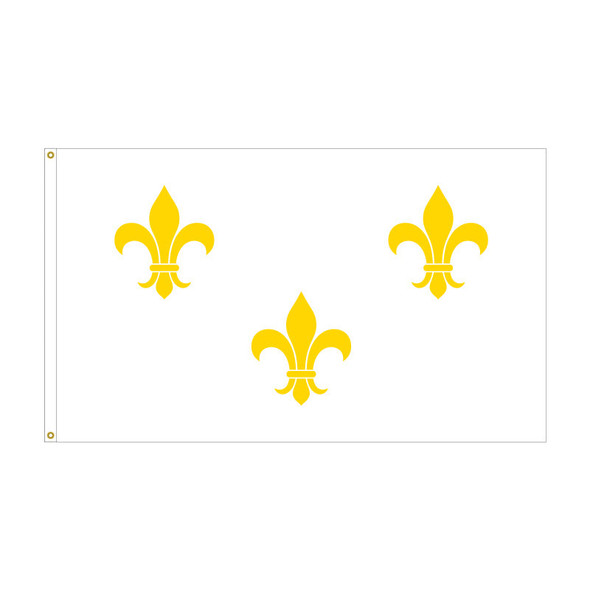
FORTISVEX White Three Fleur-de-lis Flag 3x5 Feet Nylon - Made in USA with Brass Grommets
FORTISVEX

FORTISVEX Blue Three Fleur-de-lis Flag 3x5 Feet Nylon - Made in USA with Brass Grommets
FORTISVEX

FORTISVEX Columbus Flag 3x5 Feet Nylon - Made in USA with Brass Grommets
FORTISVEX FLAGPOLE HARDWARE

FORTISVEX Alamo Flag 3x5 Feet Nylon - Made in USA with Brass Grommets
FORTISVEX FLAGPOLE HARDWARE

FORTISVEX Continental Flag 3x5 Feet Nylon - Made in USA with Brass Grommets
FORTISVEX