
FORTISVEX
FORTISVEX Blue Three Fleur-de-lis Flag 3x5 Feet Nylon - Made in USA with Brass Grommets

- MPN:
- Z060562
- Shipping:
- Calculated at Checkout

Description
This FORTISVEX Blue Three Fleur-de-lis Flag displays three gold fleurs-de-lis on a blue field, arranged two above one. The pattern follows the royal banner tradition of France. This is a modern historical rendering, not the modern French national flag or a claim that one design served every French colonial use.
History of the Blue Three Fleur-de-lis Flag
Three gold fleurs-de-lis on blue identify one of the best-known emblems of the French monarchy. This design translates the royal arms into a banner: the blue field carries two flowers above a third, without a separate shield or surrounding ornaments. The Canadian Heraldic Authority records this arrangement as the Royal Banner of France. It belongs to a royal heraldic tradition, rather than to the history of the modern French tricolour. The distinction matters because French kings, armies, ships, and trading interests did not always use the same flag.
From a field of flowers to three royal emblems
The earlier royal arms scattered gold fleurs-de-lis over blue. The Bibliothèque nationale de France places the change to three flowers near the end of Charles V’s reign, approximately 1377–1380. Its Grand Armorial illustration of the French king demonstrates that older and newer forms could coexist in art: the rider wears the repeated-flower pattern while an angel holds a three-flower shield. The library also cautions that the original choice of flower and blue remains uncertain. Stories connecting the emblem with an angel and Clovis are legends, not a documented adoption history for this flag.
The emblem extended beyond cloth banners. A stained-glass panel in the Louvre, cataloged broadly to the sixteenth or seventeenth century, presents three gold fleurs-de-lis on a blue shield beneath a flowered crown. Objects like this help explain the design’s familiarity: the same royal identity could be expressed on a shield, in architectural decoration, or across a banner. They also remind us that evidence for an emblem is not automatically evidence for every modern flag made from it.
The banner and the history of New France
The royal fleurs-de-lis crossed the Atlantic with French claims and settlements. Canadian Heritage’s Symbols of Canada associates the emblem with Jacques Cartier’s 1534 claim at Gaspé in the name of Francis I. It describes the blue banner with three gold flowers at Pierre Du Gua de Monts’s settlement on Île Sainte-Croix in 1604, and a swallow-tailed fleur-de-lis flag at Champlain’s Québec habitation in 1608. These accounts connect the design family with early French colonization; they should not be read as establishing that this rectangular commercial version reproduces every detail of those early flags.
Later colonial usage requires another distinction. The White Flag of the French Navy is recorded separately by the Canadian Heraldic Authority as a plain white field. Canadian Heritage notes that the white naval flag became widely used in New France. The three-flower blue banner therefore should not be labeled the single flag flown everywhere throughout the entire French colonial period.
A continuing heraldic legacy
Royal France’s blue and gold survive in later heraldry. The arms of Québec adopted in 1939 place three gold fleurs-de-lis on blue in the upper section, representing the French period of the province’s history. Québec’s flag is a different design, with a white cross and four white fleurs-de-lis. Comparing those symbols shows how an old royal emblem could acquire a later role in expressing cultural and historical identity without making the designs interchangeable. This blue three-flower flag is best understood as a modern rendering of the royal banner tradition, with its historical significance rooted in the monarchy’s arms and their Atlantic legacy.
About This Flag
The outdoor nylon flag has a heavy duty white heading with two brass grommets for compatible clips or snaps. Four rows of lock stitching reinforce the fly end. This is the grommet-finished version, not an indoor sleeve or fringed flag.
Specifications
- Flag size: 3x5 Feet
- Material: Nylon
- Use: Outdoor display
- Attachment: Two brass grommets
- Heading: Heavy duty white heading
- Fly end: Four rows of lock stitching
- Country of origin: United States
What Is Included
One Blue Three Fleur-de-lis flag measuring 3x5 Feet. A flagpole, bracket, clips, and other mounting hardware are not included.
Display and Care
Confirm that the flagpole and hardware are rated for the intended flag area and conditions. Leave room for the full fly length, away from branches, wires, and abrasive surfaces. Inspect stitching and attachment points regularly, remove the flag in severe weather, and let it dry before storage.
Which size do I need?
These general references cover flag sizes through 50x80 Feet. They are not a list of variants offered by this listing. Follow the flagpole manufacturer's flag-area and wind-load limits. Large displays require an engineered flagpole, foundation and hardware selection.
If you know your flag size, start here
| Flag size | Flagpole height |
|---|---|
| 2x3 Feet | 4 to 8 Feet bracket-mounted or garden flagpole |
| 3x5 Feet | 6 Feet house-mounted flagpole; 15 to 20 Feet in-ground flagpole |
| 4x6 Feet | 18 to 25 Feet |
| 5x8 Feet | 25 to 35 Feet |
| 6x10 Feet | 30 to 40 Feet |
| 8x12 Feet | 40 to 50 Feet |
| 10x15 Feet | 50 to 60 Feet |
| 12x18 Feet | 60 to 80 Feet |
| 15x25 Feet | 80 to 100 Feet |
| 20x30 Feet | 100 to 120 Feet |
| 20x38 Feet | 120 to 150 Feet |
| 30x50 Feet | 150 to 200 Feet |
| 30x60 Feet | 200 to 240 Feet |
| 50x80 Feet | 240 Feet and above; engineered installation |
If you know your flagpole height, start here
| Flagpole height | Flag size |
|---|---|
| 6 Feet house-mounted flagpole | 2x3 Feet or 3x5 Feet |
| 15 to 20 Feet | 3x5 Feet or 4x6 Feet |
| 20 to 25 Feet | 4x6 Feet or 5x8 Feet |
| 25 to 35 Feet | 5x8 Feet or 6x10 Feet |
| 35 to 45 Feet | 6x10 Feet or 8x12 Feet |
| 45 to 60 Feet | 8x12 Feet or 10x15 Feet |
| 60 to 80 Feet | 10x15 Feet or 12x18 Feet |
| 80 to 100 Feet | 12x18 Feet or 15x25 Feet |
| 100 to 120 Feet | 15x25 Feet or 20x30 Feet |
| 120 to 150 Feet | 20x30 Feet or 20x38 Feet |
| 150 to 200 Feet | 20x38 Feet or 30x50 Feet |
| 200 to 240 Feet | 30x50 Feet or 30x60 Feet |
| 240 Feet and above | 30x60 Feet or 50x80 Feet; engineered installation |
Related Products
Related Products
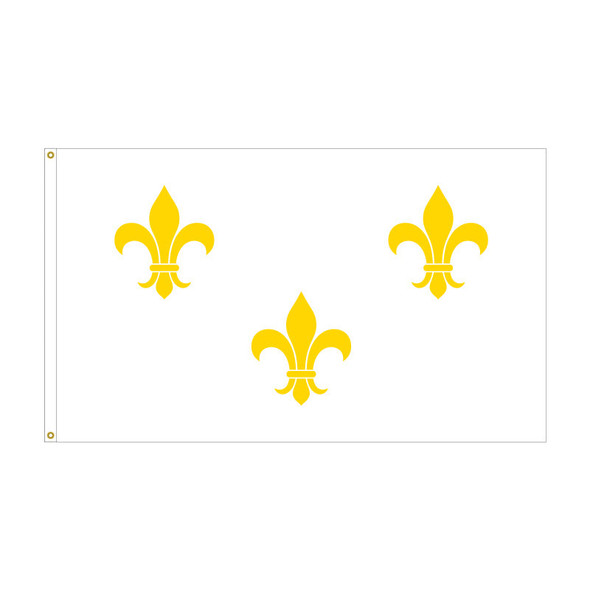
FORTISVEX White Three Fleur-de-lis Flag 3x5 Feet Nylon - Made in USA with Brass Grommets
FORTISVEX

FORTISVEX White Twenty-three Fleur-de-lis Flag 3x5 Feet Nylon - Made in USA with Brass Grommets
FORTISVEX

FORTISVEX Columbus Flag 3x5 Feet Nylon - Made in USA with Brass Grommets
FORTISVEX FLAGPOLE HARDWARE

FORTISVEX Serapis Flag 3x5 Feet Nylon - Made in USA with Brass Grommets
FORTISVEX

FORTISVEX Alamo Flag 3x5 Feet Nylon - Made in USA with Brass Grommets
FORTISVEX FLAGPOLE HARDWARE