
FORTISVEX
FORTISVEX Washington State Flag 8x12 Feet Nylon - Made in USA with Rope and Thimbles

- MPN:
- FPAMSTWANYL8x12D
- Availability:
- Free Shipping* https://fortisvex.com/shipping-returns-terms/
- Shipping:
- Calculated at Checkout

Description
An 8x12 foot flag is institutional. Ninety six square feet goes on a forty to fifty foot flagpole outside a civic building, a campus, a large commercial site. It is not a flag anybody buys by accident.
This is the Washington state flag at 8x12 Feet (96 square feet) in nylon, made in the United States and finished with a sewn rope and plated steel thimbles.
Built to the Washington flag specification
The Washington flag is set out in Revised Code of Washington 1.20.010. It is a dark green field with the state seal carrying a portrait of George Washington.
Adopted in 1923 and standardized in 1967.
Washington regulates by ratio rather than by size. WAC 434-04-017 sets a one to one point six flag ratio with seal diameters given for the 3x5 foot, 4x6 foot and 5x8 foot sizes, and the state runs a competitive bid to that specification. The law is written around the standard commercial sizes rather than against them.
We build a faithful reproduction of that design at the standard outdoor sizes the industry uses, the same sizes states order for themselves. Correct colors, seal and emblems are what an outdoor flag has to get right, and that is what this one gets right.
The law that defines it, in its own words
Revised Code of Washington 1.20.010 reads:
The official flag of the state of Washington shall be of dark green silk or bunting and shall bear in its center a reproduction of the seal of the state of Washington embroidered, printed, painted or stamped thereon. The edges of the flag may, or may not, be fringed. If a fringe is used the same shall be of gold or yellow color of the same shade as the seal. The dimensions of the flag may vary.
Washington Administrative Code 434-04-017 adds the sizing rule: identical seals on each side, a 19 inch seal on a 3x5 foot flag, 25 inches on a 4x6 foot flag, 31 inches on a 5x8 foot flag, and in all other cases a seal one third the flag length on a flag with a height to width ratio of one to one point six.
You do not have to take our word for any of that. Read Revised Code of Washington 1.20.010 in full at the Washington State Legislature, and check what we sell against it.
This is the flag we make. Not an approximation of it.
What is on it and what it means
The seal portrait is based on a Gilbert Stuart painting. The seal itself was designed in 1889 by the Olympia jeweler Charles Talcott.
Worth knowing about this flag
A bill directs a redesign recommendation by July 1, 2028, subject to referendum. Nothing has changed yet, and the green field with the Washington portrait remains the flag.
It is the only state flag with a green field, and the only one depicting a United States president.
Where the Washington flag flies
An eighty by forty foot flag flies on a hundred and twenty foot pole at a recreational vehicle consignment business in Burlington along Interstate 5. Regional rather than a claimed state record. A historic episode worth using: at Camp Lewis in Pierce County in 1918 a three hundred and fourteen foot Douglas fir pole and a sixty by ninety foot flag attempted a world record, and the pole broke.
Fly it on Washington’s birthday
Washington became the 42nd state on November 11, 1889. Under the United States Flag Code as amended July 7, 1976, a state flag flown on the state’s birthday takes its place beneath the United States flag, and that day is the one date every year the Washington flag has an official reason to go up.
Have it on hand before the date arrives and it is on the flagpole in time. The full state-by-state list is on our state birthdays page.
Nylon or polyester in Washington
Nylon in the sheltered Puget Sound lowland at Seattle and the Spokane interior. Polyester on the Pacific coast and in the wind prone Columbia Basin.
This size, ninety six square feet, puts real load on a flagpole. On the exposed sites above polyester is not optional — it is the only sensible call, and the hardware needs to be rated for it.
This listing is the nylon. It is the right choice for the sheltered and moderate wind sites named above, on any house bracket, and anywhere the flag comes down in storms. Two things decide that. Nylon is light, so it flies on the breeze most yards actually get instead of hanging limp, and it dries fast, which is what fights mildew in a humid climate. What it gives up is ultraviolet life: nylon’s amide bonds absorb ultraviolet and break, so under hard sun it loses strength and color faster than polyester, and it loses roughly a tenth of its strength while it is wet. If your site is one of the exposed ones above, look at the polyester version of this flag instead.
Here is the part usually learned the hard way, after a second purchase: nylon catches wind on days polyester simply will not move. When the flag needs to be visibly flying — a quiet morning, a holiday, a funeral, a ceremony — that argues for nylon even on a site where polyester would technically last longer. A flag that just hangs there is not doing its job either.
The figure most institutions use is from the American Legion, citing the United States government's expectation of about ninety days for a flag flown daily from sunrise to sunset, and roughly a quarter of that around the clock. Retailers see three to six months in practice for nylon flown daily, four to eight for polyester, and one to three years when flown occasionally. These are practical figures, not a guarantee, and real-world exposure shifts them considerably.
How the 8x12 Feet is built
The fly end carries six rows of lock stitching, and the corners use zig zag stitching rather than a straight seam, because a straight corner seam works loose under wind over a season.
The math comes to 96 square feet of nylon at roughly two ounces a square yard. In a thirty mile an hour wind, the fly end moves faster than the wind that is driving it, since the wave headed for the tip speeds up as it travels — which explains why the tip wears out first and why fly-end stitching count is worth checking on any listing.
Handling this size, on the ground or at the flagpole, is a two person job. A gust can take one person off balance while clipping ninety six square feet onto the halyard.
With lock stitching, every stitch knots into its neighbor, so damage stays contained at the break instead of running down the seam. Read 6 rows not as 6 times the strength but as 5 backups. This size drops grommets entirely. The heading carries a nylon rope its full length, ending in plated steel thimbles, so the load runs through the rope instead of two vulnerable points.
Nylon, commercial grade, is what this flag is made from. It is light enough to move in a gentle breeze, sheds rather than soaks up water, and dries quickly — a wet flag is a heavier flag, harder on its own seams. The ink is UV resistant and field tested, because sun exposure is what actually fades a flag.
Why this flag is harder to make than most
A recognizable human portrait printed on both faces of a green flag. It is the most expensive state flag to reproduce accurately, because a portrait that is slightly off does not look approximate, it looks wrong.
For what it is worth, the North American Vexillological Association surveyed 72 state, provincial and territorial flags in 2001 and rated them from zero to ten. The Washington flag placed 47, at 4.53 out of 10.
Will it fit my flagpole?
Forty to fifty feet of in-ground flagpole, on a truck and halyard rather than a bracket, is the right fit.
Questions about the 8x12 Feet
What size flagpole for an 8x12 foot flag? Forty to fifty feet, on a truck and halyard rated for the load. This is an institutional flag.
What are the thimbles for? The rope sewn through the heading ends in two plated steel thimbles. The halyard snaps clip to the thimbles, so the pull runs through the rope along the whole hoist rather than tearing at two grommets.
Can an 8x12 foot flag fly around the clock? It can, on a lit flagpole, but a flag flown twenty four hours lasts roughly a quarter as long as one flown sunrise to sunset. Budget for that.
Why the grommets disappear
Two grommets concentrate ninety six square feet of pull onto two small brass rings. A rope sewn the length of the heading spreads that load across the entire hoist and lets the thimbles take the attachment. It is more expensive to build and it is the only way a flag this size survives.
Specifications
- Size: 8x12 Feet
- Area: 96 square feet
- Material: 100 percent nylon
- Fly end: 6 rows of lock stitching
- Heading: heavy duty white, reinforced, 2 inch
- Finish: Rope and Thimbles
- Ink: UV resistant, field tested
- Made in the United States by FORTISVEX
Which size do I need?
Both tables come down to one ratio: the flag’s length wants to be a quarter to a third of the flagpole’s height. When a size sits on the border between two rows, the smaller flag will fly on more days and outlast the bigger one, while the bigger flag is the one people notice from further off.
If you know your flagpole height, start here.
- 6 Feet house bracket: 2x3 Feet or 3x5 Feet
- 15 to 20 Feet flagpole: 3x5 Feet or 4x6 Feet
- 20 to 25 Feet flagpole: 4x6 Feet or 5x8 Feet
- 25 to 35 Feet flagpole: 5x8 Feet or 6x10 Feet
- 35 to 45 Feet flagpole: 6x10 Feet or 8x12 Feet
- 45 to 60 Feet flagpole: 8x12 Feet or 10x15 Feet
- 60 to 80 Feet flagpole: 10x15 Feet or 12x18 Feet
- 80 to 100 Feet flagpole: 12x18 Feet or 15x25 Feet
- 100 to 120 Feet flagpole: 15x25 Feet or 20x30 Feet
- 120 to 150 Feet flagpole: 20x30 Feet or 20x38 Feet
- 150 to 200 Feet flagpole: 20x38 Feet or 30x50 Feet
- 200 to 240 Feet flagpole: 30x50 Feet or 30x60 Feet
- 240 Feet and above: 30x60 Feet or 50x80 Feet, engineered to the flagpole
If you know your flag size, start here.
- 2x3 Feet: 4 to 8 Feet bracket or garden flagpole
- 3x5 Feet: 6 Feet bracket, or 15 to 20 Feet in-ground flagpole
- 4x6 Feet: 18 to 25 Feet in-ground flagpole
- 5x8 Feet: 25 to 35 Feet flagpole
- 6x10 Feet: 30 to 40 Feet flagpole
- 8x12 Feet: 40 to 50 Feet flagpole
- 10x15 Feet: 50 to 60 Feet flagpole
- 12x18 Feet: 60 to 80 Feet flagpole
- 15x25 Feet: 80 to 100 Feet flagpole
- 20x30 Feet: 100 to 120 Feet flagpole
- 20x38 Feet: 120 to 150 Feet flagpole. This is the garrison size under Executive Order 10834, at a one to one point nine ratio rather than the two to three of the commercial sizes, and it is the size flown at the White House and the Capitol
- 30x50 Feet: 150 to 200 Feet flagpole
- 30x60 Feet: 200 to 240 Feet flagpole. This is the largest standard commercial size
- 50x80 Feet: 240 Feet and above, engineered to the flagpole
The proportion still applies past a hundred feet, but the decision changes character: the flagpole, the truck, the halyard, the foundation and the wind load stop being separate line items and become one engineered whole, and ordering a flag without confirming the flagpole rating puts the flagpole at risk first. A few famous flags fly deliberately larger than the rule suggests, and all of them do it with engineering behind the choice.
What is on the website is not the limit of what we carry. Any size in the tables above can be ordered, listed or not.
About the back of the flag
The back of a printed flag shows the design reversed, not missing. That is true of almost every flag in the country, and it is normal rather than a flaw. Getting both sides to read correctly means sewing two flags together with a liner between them, which roughly doubles the cost and the weight. Single sided is standard practice, and the right choice unless a particular state’s law says otherwise.
Flying it with the United States flag
Section 7 of Title 4, the United States Flag Code, addresses this directly: the United States flag is never outranked in position, staying above every other flag and to the right at the same level, which reads as the viewer’s left. Same-height flagpoles put the United States flag on the viewer’s left with matching flag sizes; different heights put it on the taller pole; one flagpole with two flags puts it at the top. There is no legal penalty for civilians under the Flag Code, but it is what every institution follows anyway.
Buy two and they both last longer
The simplest way to make a flag last is to own two and rotate them monthly — that alone outlasts three flags flown to failure, because rest lets the fabric recover and the fly end is not hammered day after day. Take it down ahead of real storms, since one bad night of wind can undo six good months. Watch the fly end, where fraying starts, and a quick repair there is worth a whole extra season.
For cities, counties, schools and agencies
State flags go out to municipalities, school districts, fire and police departments, courthouses and state agencies as a matter of course. Tax exempt purchasing runs through the tax exempt page, and anything involving quantity, a replacement schedule or a size we do not list goes through the contact page.
Why buy it from us
A small American company runs this store, and everything listed here is something we actually stock. Every flag is made in the United States, printed in UV resistant ink, and built to the construction described above rather than built down to a price. We would rather one flag last than sell three that fail early. Free shipping kicks in over twenty five dollars.
Additional Information
Material Type: |
Commercial Nylon |
Flag Size: |
8x12 Feet |
Made in: |
USA |
Finish: |
Rope and Thimbles |
Related Products
Related Products

FORTISVEX Oklahoma State Flag 8x12 Feet Nylon - Made in USA with Rope and Thimbles
FORTISVEX

FORTISVEX Pennsylvania State Flag 8x12 Feet Nylon - Made in USA with Rope and Thimbles
FORTISVEX

FORTISVEX Illinois State Flag 8x12 Feet Nylon - Made in USA with Rope and Thimbles
FORTISVEX
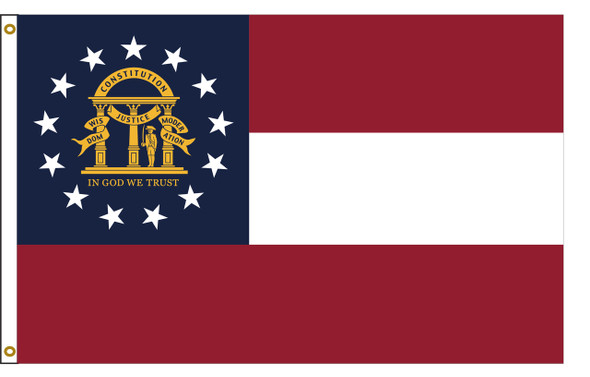
FORTISVEX Georgia State Flag 8x12 Feet Nylon - Made in USA with Rope and Thimbles
FORTISVEX


FORTISVEX Tennessee State Flag 8x12 Feet Nylon - Made in USA with Rope and Thimbles
FORTISVEX