
FORTISVEX
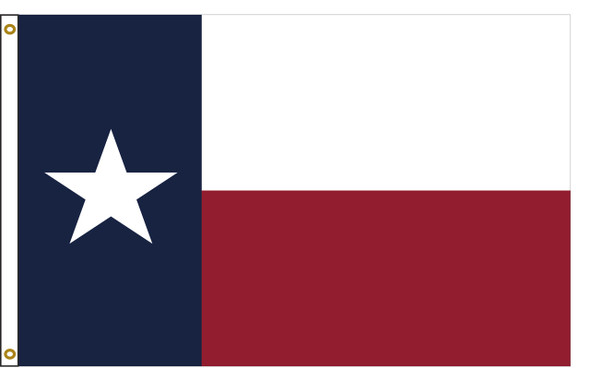
FORTISVEX Texas State Flag 6x10 Feet Nylon - Made in USA Lone Star Flag with Brass Grommets

- MPN:
- FPAMSTTXNYL6x10G
- Availability:
- Free Shipping* https://fortisvex.com/shipping-returns-terms/
- Shipping:
- Calculated at Checkout

Description
Once you reach 6x10 feet you have left house flags behind. Sixty square feet is commercial size for a commercial flagpole, and this is the last size built with grommets before the construction switches to rope.
This is the Texas state flag at 6x10 Feet (60 square feet) in nylon, made in the United States and finished with brass grommets.
Built to the Texas flag specification
The Texas flag is set out in Texas Government Code Chapter 3100, at a two to three proportion, with the statute giving precise star geometry. It is a blue vertical hoist stripe one third the length carrying a white five-pointed star, with white over red horizontal stripes.
This was the 1839 national flag of the Republic of Texas, drawn by Peter Krag and approved by President Lamar January 25, 1839; it became the state flag at annexation in 1845 and was re-adopted August 31, 1933 after a period with no active flag statute.
Texas is precise about proportion rather than size. Government Code Chapter 3100 requires a width to length ratio of two to three, which a 4x6 foot flag, an 8x12 foot flag and a 10x15 foot flag all match exactly. A 3x5 foot flag is a three to five ratio and is therefore slightly deeper than the statute describes.
We build a faithful reproduction of that design at the standard outdoor sizes the industry uses, the same sizes states order for themselves. Correct colors, seal and emblems are what an outdoor flag has to get right, and that is what this one gets right.
The law that defines it, in its own words
Texas Government Code Section 3100.002, Description: In General reads:
(a) The state flag is a rectangle that: (1) has a width to length ratio of two to three; and (2) contains: (A) one blue vertical stripe that has a width equal to one-third the length of the flag; (B) two equal horizontal stripes, the upper stripe white, the lower stripe red, each having a length equal to two-thirds the length of the flag; and (C) one white, regular five-pointed star: (i) located in the center of the blue stripe; (ii) oriented so that one point faces upward; and (iii) sized so that the diameter of a circle passing through the five points of the star is equal to three-fourths the width of the blue stripe. (b) The red and blue of the state flag are: (1) the same colors used in the United States flag; and (2) defined as numbers 193 (red) and 281 (dark blue) of the Pantone Matching System. (c) The red, white, and blue of the state flag represent, respectively, bravery, purity, and loyalty.
Section 3100.001 separately states that the state flag is the 1839 national flag of the Republic of Texas.
You do not have to take our word for any of that. Read Texas Government Code Section 3100.002 in full at the Texas Legislature, and check what we sell against it.
That is the flag as we build it. Nothing about it is approximate.
What is on it and what it means
The lone star stands for Texas unity, one for God, State and Country. Chapter 3100 assigns the colors directly: blue is loyalty, white is purity, red is bravery.
Worth knowing about this flag
For most of the late nineteenth and early twentieth century Texas had no flag statute in force. The 1933 act put the Lone Star Flag back into law.
With Hawaii, it is one of only two state flags that previously served as the flag of a sovereign nation.
Where the Texas flag flies
The original Battle Flag of San Jacinto has hung in the Texas House of Representatives at the State Capitol in Austin since 1933, with a reproduction displayed when the House is not in session to protect the fragile original. The World's Largest Texas Flag, one hundred by one hundred and fifty feet, was made by Dixie Flag and Banner of San Antonio and is unfurled at Longhorns football games.
Fly it on Texas’s birthday
Texas became the 28th state on December 29, 1845. Under the United States Flag Code as amended July 7, 1976, a state flag flown on the state’s birthday takes its place beneath the United States flag, and that day is the one date every year the Texas flag has an official reason to go up.
Order ahead and this flag is ready for the day. The complete list of state birthdays lives on our state birthdays page.
Nylon or polyester in Texas
Polyester across the wind and ultraviolet Panhandle and West. Amarillo at 13.5 and Lubbock at 12.4 miles per hour are among the very windiest American stations, and El Paso for ultraviolet. Polyester also on the Gulf Coast at Houston and Corpus Christi. Nylon acceptable in the sheltered central metros at Austin, San Antonio and the Dallas interior.
This is a commercial flag at sixty square feet, and on the exposed sites named above, material choice separates a one-season flag from a three-season one.
This listing is nylon, right for the sheltered and moderate wind sites above, for a standard house bracket, and for anywhere you take the flag down before a storm. Two things make it the pick. It flies on the breeze most yards actually see instead of hanging flat, being light, and it dries fast, which fights mildew where humidity is high. What it sacrifices is ultraviolet resistance: nylon’s amide bonds absorb and break under sun, losing strength and color faster than polyester, plus roughly a tenth of its strength while wet. For an exposed site from the list above, the polyester version is the better choice.
One more thing that decides it, and it is the part people only learn after buying twice: a nylon flag flies on days a polyester flag will not. If the flag matters to you on a still morning, on a holiday, at a funeral, at a ceremony, that is an argument for this one even on a site where the polyester would last longer. A flag that hangs is not doing its job either.
The figure most institutions use is from the American Legion, citing the United States government's expectation of about ninety days for a flag flown daily from sunrise to sunset, and roughly a quarter of that around the clock. Retailers see three to six months in practice for nylon flown daily, four to eight for polyester, and one to three years when flown occasionally. These are practical figures, not a guarantee, and real-world exposure shifts them considerably.
How the 6x10 Feet is built
Four rows of stitching is enough for a house flag; sixty square feet is not a house flag, and the fly end needs six rows to handle the force it actually generates.
The arithmetic behind that: 60 square feet of nylon at roughly two ounces a square yard. In a thirty mile an hour wind the fly end of a flag this size travels faster than the wind itself, because the wave running out to the tip accelerates as it goes. That is why the tip wears out first and why the stitching count at that end is the number worth reading on any listing.
Proper folding at this size needs two people and clear ground. Sixty square feet is too much fabric for a tailgate fold.
With lock stitching, every stitch knots into its neighbor, so damage stays contained at the break instead of running down the seam. Read 6 rows not as 6 times the strength but as 5 backups. At sixty square feet, the heading takes the most sustained strain of any part of the flag, which is why it runs two inches of reinforced heavy duty white with brass grommets and tooth washers.
This flag is commercial grade nylon, light enough to move in a gentle breeze, and it sheds water instead of soaking it up, drying fast — which matters, since a wet flag is a heavy flag that works its own seams harder. UV resistant, field tested ink is what stands between the flag and the sun, since sun is what fades a flag over time.
A design that reproduces cleanly
Three colors and one star. It is among the cheapest state flags to build properly and among the longest lived, because there is no fine detail to fail.
For what it is worth, the North American Vexillological Association surveyed 72 state, provincial and territorial flags in 2001 and rated them from zero to ten. The Texas flag placed 2, at 8.13 out of 10.
Will it fit my flagpole?
It suits an in-ground flagpole of thirty to forty feet.
Questions about the 6x10 Feet
What size flagpole for a 6x10 foot flag? Thirty to forty feet. At this size the flag is commercial and the flagpole has to be an in-ground pole with a truck and halyard.
Why does the 6x10 foot flag have grommets when the 8x12 foot flag has a rope? Sixty square feet is the most two brass grommets can be asked to carry. Above this the load is spread along a rope sewn the length of the heading.
Does a 6x10 foot flag need a heavier flagpole? A sixty square foot flag in a gust loads a flagpole hard. If the pole was sold for a 4x6 foot or 5x8 foot flag, check its rating before stepping up.
The last size on grommets
Everything above this is finished with a rope sewn the full length of the heading rather than two grommets, because two points can no longer carry the load. The 6x10 foot flag sits right at that boundary, which is why it runs six rows of stitching and a two inch heading while still using grommets.
Specifications
- Size: 6x10 Feet
- Area: 60 square feet
- Material: 100 percent nylon
- Fly end: 6 rows of lock stitching
- Heading: heavy duty white, reinforced, 2 inch
- Finish: Brass Grommets
- Ink: UV resistant, field tested
- Made in the United States by FORTISVEX
Which size do I need?
Underneath both tables is a single ratio: a flag a quarter to a third the flagpole’s height. When you land between two rows, that is a real choice, not a rounding error — smaller flies more often, bigger reads further.
If you know your flagpole height, start here.
- 6 Feet house bracket: 2x3 Feet or 3x5 Feet
- 15 to 20 Feet flagpole: 3x5 Feet or 4x6 Feet
- 20 to 25 Feet flagpole: 4x6 Feet or 5x8 Feet
- 25 to 35 Feet flagpole: 5x8 Feet or 6x10 Feet
- 35 to 45 Feet flagpole: 6x10 Feet or 8x12 Feet
- 45 to 60 Feet flagpole: 8x12 Feet or 10x15 Feet
- 60 to 80 Feet flagpole: 10x15 Feet or 12x18 Feet
- 80 to 100 Feet flagpole: 12x18 Feet or 15x25 Feet
- 100 to 120 Feet flagpole: 15x25 Feet or 20x30 Feet
- 120 to 150 Feet flagpole: 20x30 Feet or 20x38 Feet
- 150 to 200 Feet flagpole: 20x38 Feet or 30x50 Feet
- 200 to 240 Feet flagpole: 30x50 Feet or 30x60 Feet
- 240 Feet and above: 30x60 Feet or 50x80 Feet, engineered to the flagpole
If you know your flag size, start here.
- 2x3 Feet: 4 to 8 Feet bracket or garden flagpole
- 3x5 Feet: 6 Feet bracket, or 15 to 20 Feet in-ground flagpole
- 4x6 Feet: 18 to 25 Feet in-ground flagpole
- 5x8 Feet: 25 to 35 Feet flagpole
- 6x10 Feet: 30 to 40 Feet flagpole
- 8x12 Feet: 40 to 50 Feet flagpole
- 10x15 Feet: 50 to 60 Feet flagpole
- 12x18 Feet: 60 to 80 Feet flagpole
- 15x25 Feet: 80 to 100 Feet flagpole
- 20x30 Feet: 100 to 120 Feet flagpole
- 20x38 Feet: 120 to 150 Feet flagpole. This is the garrison size under Executive Order 10834, at a one to one point nine ratio rather than the two to three of the commercial sizes, and it is the size flown at the White House and the Capitol
- 30x50 Feet: 150 to 200 Feet flagpole
- 30x60 Feet: 200 to 240 Feet flagpole. This is the largest standard commercial size
- 50x80 Feet: 240 Feet and above, engineered to the flagpole
The proportion still applies past a hundred feet, but the decision changes character: the flagpole, the truck, the halyard, the foundation and the wind load stop being separate line items and become one engineered whole, and ordering a flag without confirming the flagpole rating puts the flagpole at risk first. A few famous flags fly deliberately larger than the rule suggests, and all of them do it with engineering behind the choice.
The full range is available to order even where a size is not shown on the site. If what you need is not listed here, ask and we can still get it made.
About the back of the flag
Hold a printed flag up to the light and the reverse side shows the design in mirror image. That is not a defect — it is how nearly every flag flown in America is made. A flag correct on both sides is a double sided flag, two flags sewn together around a liner, and it runs roughly double the price and double the weight. Unless a state’s own statute calls for it, single sided is standard and it is the right call.
Flying it with the United States flag
Section 7 of Title 4, the United States Flag Code, addresses this directly: the United States flag is never outranked in position, staying above every other flag and to the right at the same level, which reads as the viewer’s left. Same-height flagpoles put the United States flag on the viewer’s left with matching flag sizes; different heights put it on the taller pole; one flagpole with two flags puts it at the top. There is no legal penalty for civilians under the Flag Code, but it is what every institution follows anyway.
Buy two and they both last longer
One flag flown month after month wears faster at the same point every time; two flags rotated monthly outlast three run to failure, because rest lets fabric recover. Bring the flag in ahead of severe weather — a hard storm overnight can outdo six normal months. And check the fly end first, since that is where fraying starts, and a small stitch repair there is worth a full extra season.
For cities, counties, schools and agencies
We regularly supply state flags to cities, school districts, fire and police departments, courthouses and state agencies. Tax exempt accounts run through the tax exempt page. Quantity pricing, replacement schedules, or a size that is not listed all go through the contact page.
Why buy it from us
We run a small American company and stock the flags we sell. Each one is made in the United States, printed in UV resistant ink, and built to the construction described above instead of built to hit a lower price. One durable flag beats three that fail, in our view. Free shipping applies to orders over twenty five dollars.
Additional Information
Material Type: |
Commercial Nylon |
Flag Size: |
6x10 Feet |
Made in: |
USA |
Finish: |
Brass Grommets |
Related Products
Related Products

FORTISVEX Texas State Flag 6x10 Feet Polyester - Made in USA Lone Star Flag with Brass Grommets
FORTISVEX

FORTISVEX Texas State Flag 3x5 Feet Nylon - Made in USA Lone Star Flag with Brass Grommets
FORTISVEX
FORTISVEX Texas State Flag 4x6 Feet Nylon - Made in USA Lone Star Flag with Brass Grommets
FORTISVEX

FORTISVEX Texas State Flag 5x8 Feet Nylon - Made in USA Lone Star Flag with Brass Grommets
FORTISVEX

FORTISVEX Nebraska State Flag 6x10 Feet Nylon - Made in USA with Brass Grommets
FORTISVEX