
FORTISVEX
FORTISVEX Oklahoma State Flag 6x10 Feet Nylon - Made in USA with Brass Grommets

- MPN:
- FPAMSTOKNYL6x10G
- Availability:
- Free Shipping* https://fortisvex.com/shipping-returns-terms/
- Shipping:
- Calculated at Checkout




Description
Residential ends here. A 6x10 foot flag is sixty square feet of commercial flag for a commercial flagpole — and the last size still finished with grommets rather than a sewn rope.
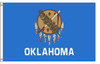
This is the Oklahoma state flag at 6x10 Feet (60 square feet) in nylon, made in the United States and finished with brass grommets.
Built to the Oklahoma flag specification
The Oklahoma flag is set out in Oklahoma Statutes, Title 25, Section 91, at a two to three ratio. It is a sky blue field, described in the statute as French Blue, with an Osage buffalo hide war shield carrying seven eagle feathers, overlaid by a calumet crossed with an olive branch.
Designed by Louise Funk Fluke through a Daughters of the American Revolution contest and adopted April 2, 1925, making it Oklahoma’s fourteenth flag; colors were standardized in 2006 and the word Oklahoma added in 1941.
What the statute here fixes is the design, the colors and the seal or emblem; it does not fix a size for an outdoor flag to hit. That is the position in most of the country, and it is the reason every manufacturer settles on the same standard sizes.
What we build is a faithful reproduction of that design, sized to the standard outdoor sizes every manufacturer uses and the states themselves order in. On an outdoor flag, the colors, the seal and the emblems are what has to be right, and here they are.
The law that defines it, in its own words
Oklahoma Statutes, Title 25, Section 91 reads:
A. The banner, or flag, of the design prescribed by Senate Concurrent Resolution No. 25, Third Legislature of the State of Oklahoma shall be, and it hereby is superseded and replaced by one of the following design, to wit: A sky blue field with a circular rawhide shield of an American Indian Warrior, decorated with six painted crosses on the face thereof, the lower half of the shield to be fringed with seven pendant eagle feathers and superimposed upon the face of the shield a calumet or peace pipe, crossed at right angles by an olive branch, as illustrated by the design accompanying this resolution, and underneath said shield or design in white letters shall be placed the word "Oklahoma", and the same is hereby adopted as the official flag and banner of the State of Oklahoma. B. The standard design and colors in the state flag shall be as follows: 1. The Osage Indian warrior's circular rawhide shield of amber buckskin is center upon a field of French Blue. On the face of the shield shall be six small gold brown crosses that match the thongs lacing the edge of the shield. The width of the horizontal bar shall be seventy-five percent (75%) of the vertical bar; 2. The edge of the lower half of the shield shall be fringed with seven pendant eagle feathers of white tipped with gold brown; 3. Across the face of the shield at right angle shall be a calumet or Indian pipe of peace, which shall have a ruby red bowl, flesh stem and be decorated with a ruby red tassel at the end. Above the calumet, lying at a right angle shall be an olive branch of Dartmouth green; and 4. The name Oklahoma in white letters shall appear under the shield on the face of the flag. C. The standard colors used in production of the state flag shall be: 1. Pantone Matching System, Pantone Inc., latest edition: a. field: French Blue PMS 285c, b. shield: amber PMS 465c, c. feathers shading: flesh and gold brown combination PMS 486c and PMS 174c, d. crosses and thongs: gold brown PMS 174c, and e. calumet: stem of pipe flesh PMS 486c, body of pipe and tassel ruby red PMS 195c, and olive branch Dartmouth green PMS 554c; and 2. Colors shall be colorfast and shall not bleed one into another.
Section 91a, added in 2006, makes it the duty of every state agency and board of education to display the flag in these standard colors. Ours is printed to them.
You do not have to take our word for any of that. Read Oklahoma Statutes in full at Justia, and check what we sell against it.
That is the flag we build, not a rough version of it.
What is on it and what it means
The shield is defense. The six crosses on it are Native symbols for stars and high ideals. The calumet, a peace pipe, crossed with an olive branch represents peace between Native American and European peoples.
Worth knowing about this flag
This was Oklahoma’s fourteenth flag. The thirteen before it came and went, which is why the 1925 adoption was treated as settling the question.
Where the Oklahoma flag flies
Oklahomans obtain United States Capitol flags through congressional offices, restricted to Oklahoma residents with four weeks' notice.
Fly it on Oklahoma’s birthday
Oklahoma became the 46th state on November 16, 1907. Under the United States Flag Code as amended July 7, 1976, a state flag flown on the state’s birthday takes its place beneath the United States flag, and that day is the one date every year the Oklahoma flag has an official reason to go up.
Have it on hand before the date arrives and it is on the flagpole in time. The full state-by-state list is on our state birthdays page.
Nylon or polyester in Oklahoma
Polyester is the default. Oklahoma City and Tulsa sit in the heart of tornado alley with high sustained wind.
For scale, the National Weather Service ultraviolet index forecast for Oklahoma City on July 23, 2026 was 11 at solar noon, in the extreme band. That is the sun this flag has to survive.
Sixty square feet makes this a commercial flag, and on an exposed site from the list above, the right material is the difference between one season and three.
What you have here is the nylon, appropriate for the sheltered and moderate wind sites listed above, for any house bracket, and for anywhere the flag is brought down during storms. Two things decide it: it is light, flying on an ordinary breeze rather than going limp, and it dries fast, which is the defense against mildew in humidity. The trade is ultraviolet durability — nylon’s amide bonds break under sun, fading and weakening faster than polyester, and it loses about a tenth of its strength wet. For an exposed site on the list above, the polyester version is worth a look instead.
This is the detail people usually only figure out after buying twice: nylon will fly on a day too calm for polyester to move at all. If flying on a still morning, a holiday, at a funeral, or at a ceremony matters to you, that is reason enough to choose nylon even where polyester would survive longer. A motionless flag fails at its purpose regardless of how durable it is.
Most institutions work from the same benchmark, reported by the American Legion: the United States government's expectation is roughly ninety days for a flag flown daily sunrise to sunset, and about a quarter of that for one flown around the clock. In practice, retailers report three to six months for nylon flown daily, four to eight for polyester, and one to three years for a flag flown only on occasions. These are working numbers, not a guarantee, and exposure can move them substantially either way.
How the 6x10 Feet is built
Six rows of lock stitching replace four at this size, because sixty square feet generates far more force at the fly end than any house flag experiences. Four rows would not hold.
Here is the arithmetic: 60 square feet of nylon at roughly two ounces a square yard. A thirty mile an hour wind sends the fly end moving faster than the wind itself, since the wave traveling toward the tip picks up speed as it goes — which is why the tip wears out first, and why the fly end's stitching count is the figure to check on any listing.
Two people to fold properly, and a clear patch of ground or a clean surface. Sixty square feet does not fold on a tailgate.
With lock stitching, every stitch knots into its neighbor, so damage stays contained at the break instead of running down the seam. Read 6 rows not as 6 times the strength but as 5 backups. This size puts the most sustained strain on the heading of anything on the flag, so it is built two inches wide, heavy duty white and reinforced, with brass grommets and tooth washers.
This flag is commercial grade nylon, light enough to move in a gentle breeze, and it sheds water instead of soaking it up, drying fast — which matters, since a wet flag is a heavy flag that works its own seams harder. UV resistant, field tested ink is what stands between the flag and the sun, since sun is what fades a flag over time.
Why this flag is harder to make than most
A hide shield with seven feathers, a pipe and an olive branch. The feather detail and the shield texture are both fine work.
For what it is worth, the North American Vexillological Association surveyed 72 state, provincial and territorial flags in 2001 and rated them from zero to ten. The Oklahoma flag placed 39, at 4.78 out of 10.
Will it fit my flagpole?
An in-ground flagpole thirty to forty feet tall suits this flag.
Questions about the 6x10 Feet
What size flagpole for a 6x10 foot flag? Thirty to forty feet. At this size the flag is commercial and the flagpole has to be an in-ground pole with a truck and halyard.
Why does the 6x10 foot flag have grommets when the 8x12 foot flag has a rope? Sixty square feet is the most two brass grommets can be asked to carry. Above this the load is spread along a rope sewn the length of the heading.
Does a 6x10 foot flag need a heavier flagpole? A sixty square foot flag in a gust loads a flagpole hard. If the pole was sold for a 4x6 foot or 5x8 foot flag, check its rating before stepping up.
The last size on grommets
Past this size, construction shifts entirely to a sewn rope the length of the heading, since two grommets cannot carry the load any further. The 6x10 Feet sits exactly at that boundary — six rows of stitching, a two inch heading, and still grommets.
Specifications
- Size: 6x10 Feet
- Area: 60 square feet
- Material: 100 percent nylon
- Fly end: 6 rows of lock stitching
- Heading: heavy duty white, reinforced, 2 inch
- Finish: Brass Grommets
- Ink: UV resistant, field tested
- Made in the United States by FORTISVEX
Which size do I need?
Both tables follow the same logic. A flagpole reads best with a flag whose length falls between a quarter and a third of its height. Where a size could go either way, smaller means more flying days and a longer life, bigger means more visibility at range.
If you know your flagpole height, start here.
- 6 Feet house bracket: 2x3 Feet or 3x5 Feet
- 15 to 20 Feet flagpole: 3x5 Feet or 4x6 Feet
- 20 to 25 Feet flagpole: 4x6 Feet or 5x8 Feet
- 25 to 35 Feet flagpole: 5x8 Feet or 6x10 Feet
- 35 to 45 Feet flagpole: 6x10 Feet or 8x12 Feet
- 45 to 60 Feet flagpole: 8x12 Feet or 10x15 Feet
- 60 to 80 Feet flagpole: 10x15 Feet or 12x18 Feet
- 80 to 100 Feet flagpole: 12x18 Feet or 15x25 Feet
- 100 to 120 Feet flagpole: 15x25 Feet or 20x30 Feet
- 120 to 150 Feet flagpole: 20x30 Feet or 20x38 Feet
- 150 to 200 Feet flagpole: 20x38 Feet or 30x50 Feet
- 200 to 240 Feet flagpole: 30x50 Feet or 30x60 Feet
- 240 Feet and above: 30x60 Feet or 50x80 Feet, engineered to the flagpole
If you know your flag size, start here.
- 2x3 Feet: 4 to 8 Feet bracket or garden flagpole
- 3x5 Feet: 6 Feet bracket, or 15 to 20 Feet in-ground flagpole
- 4x6 Feet: 18 to 25 Feet in-ground flagpole
- 5x8 Feet: 25 to 35 Feet flagpole
- 6x10 Feet: 30 to 40 Feet flagpole
- 8x12 Feet: 40 to 50 Feet flagpole
- 10x15 Feet: 50 to 60 Feet flagpole
- 12x18 Feet: 60 to 80 Feet flagpole
- 15x25 Feet: 80 to 100 Feet flagpole
- 20x30 Feet: 100 to 120 Feet flagpole
- 20x38 Feet: 120 to 150 Feet flagpole. This is the garrison size under Executive Order 10834, at a one to one point nine ratio rather than the two to three of the commercial sizes, and it is the size flown at the White House and the Capitol
- 30x50 Feet: 150 to 200 Feet flagpole
- 30x60 Feet: 200 to 240 Feet flagpole. This is the largest standard commercial size
- 50x80 Feet: 240 Feet and above, engineered to the flagpole
Nothing about the ratio breaks above a hundred feet, but the purchase does: the flag, the flagpole, the truck, the halyard and the foundation become one system that has to be specified together, and skipping that check risks the flagpole before it risks the flag. Some of the largest flags flown in the country are deliberately oversized for their rule-of-thumb flagpole, always on an engineer’s sign-off.
What is on the website is not the limit of what we carry. Any size in the tables above can be ordered, listed or not.
About the back of the flag
The reverse of a printed flag mirrors the front, which is ordinary and true of nearly every flag in the country. To have both faces read correctly requires a double sided construction: two flags joined with a liner in between, at about twice the material and twice the price. Single sided is the industry standard, and the sensible pick unless a state’s statute says otherwise.
Flying it with the United States flag
Governing this is Title 4, Section 7 of the United States Flag Code, which keeps the United States flag in the position of honor: never below another flag, never to the right of one at the same level, meaning never right of the viewer’s left. Two flagpoles at equal height put the United States flag at the viewer’s left with equal-sized flags; unequal heights put it on the taller pole; a single flagpole with two flags carries it at the top. No penalty attaches for private citizens under the Code, but it is what institutions follow as standard practice.
Buy two and they both last longer
The simplest way to make a flag last is to own two and rotate them monthly — that alone outlasts three flags flown to failure, because rest lets the fabric recover and the fly end is not hammered day after day. Take it down ahead of real storms, since one bad night of wind can undo six good months. Watch the fly end, where fraying starts, and a quick repair there is worth a whole extra season.
For cities, counties, schools and agencies
Fire and police departments, school districts, courthouses, municipalities and state agencies are all regular buyers of our state flags. Tax exempt purchasing is set up through the tax exempt page, and quantities, replacement schedules or an unlisted size are handled through the contact page.
Why buy it from us
We are a small American company and we stock what we sell. Every flag here is made in the United States, printed in UV resistant ink, and finished to the construction described above rather than to a price point. We would rather sell you one flag that lasts than three that do not. Free shipping on orders over twenty five dollars.
Additional Information
Material Type: |
Commercial Nylon |
Flag Size: |
6x10 Feet |
Made in: |
USA |
Finish: |
Brass Grommets |
Related Products
Related Products

FORTISVEX Idaho State Flag 6x10 Feet Nylon - Made in USA with Brass Grommets
FORTISVEX

FORTISVEX Arizona State Flag 6x10 Feet Nylon - Made in USA with Brass Grommets
FORTISVEX
FORTISVEX Michigan State Flag 6x10 Feet Nylon - Made in USA with Brass Grommets
FORTISVEX

FORTISVEX Utah State Flag 6x10 Feet Nylon - Made in USA with Brass Grommets
FORTISVEX

FORTISVEX Nebraska State Flag 6x10 Feet Nylon - Made in USA with Brass Grommets
FORTISVEX