
FORTISVEX
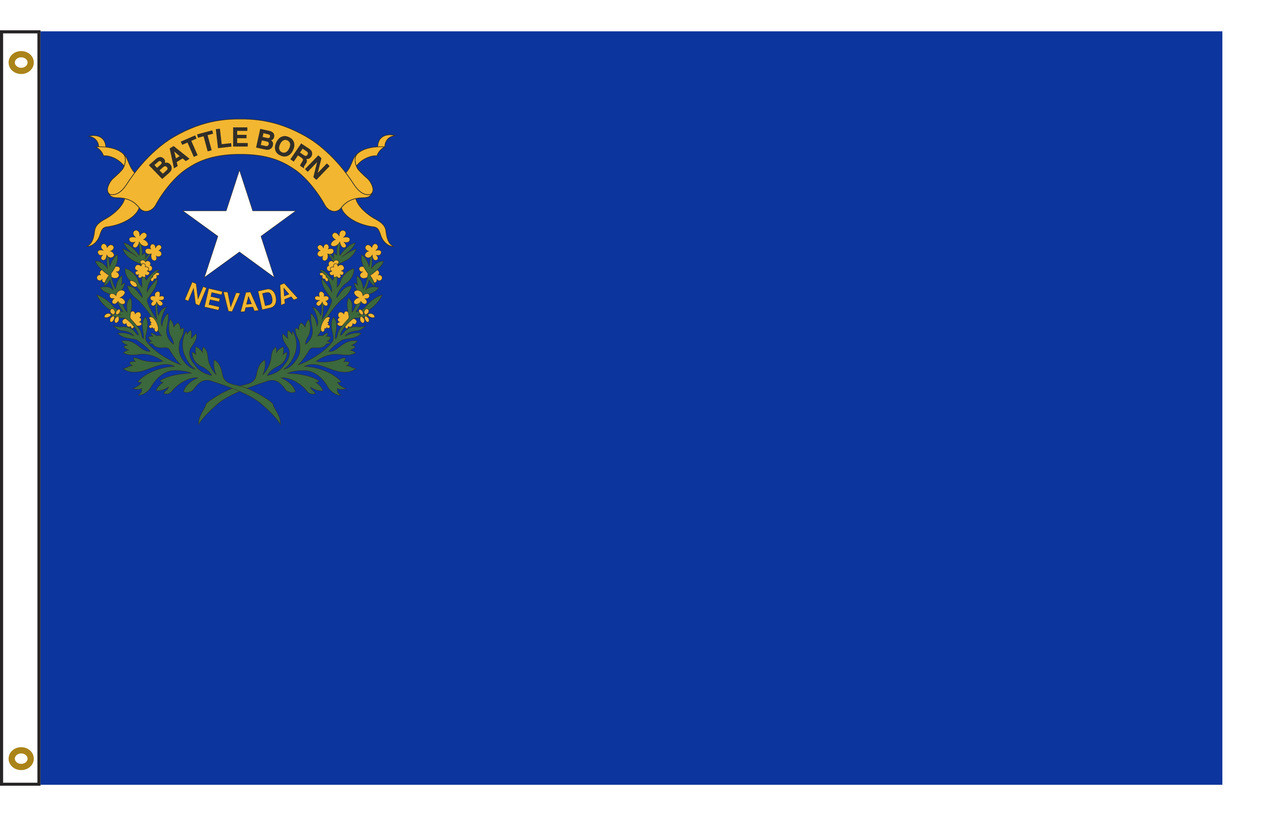
FORTISVEX Nevada State Flag 6x10 Feet Nylon - Made in USA with Brass Grommets

- MPN:
- FPAMSTNVNYL6x10G
- Availability:
- Free Shipping* https://fortisvex.com/shipping-returns-terms/
- Shipping:
- Calculated at Checkout
Description
This is the size where a state flag leaves residential territory behind. Sixty square feet is commercial, flown on a commercial flagpole, and it is the last size built with grommets before rope takes over.
This is the Nevada state flag at 6x10 Feet (60 square feet) in nylon, made in the United States and finished with brass grommets.
Built to the Nevada flag specification
The Nevada flag is set out in Nevada Revised Statutes 235.020. It is a cobalt blue field with an upper hoist emblem of crossed sagebrush sprays, a silver five-pointed star, the word Nevada in gold and a Battle Born scroll.
Adopted in 1929 from a winning contest design by Louis Shellback the Third, and revised in 1991 when the word Nevada moved below the star.
What the statute here fixes is the design, the colors and the seal or emblem; it does not fix a size for an outdoor flag to hit. That is the position in most of the country, and it is the reason every manufacturer settles on the same standard sizes.
The reproduction here is faithful to the design, in the standard outdoor sizes used industry wide and bought by the states themselves. On an outdoor flag, correct colors, seal and emblems are what counts, and that is what you get.
The law that defines it, in its own words
Nevada Revised Statutes 235.020 reads:
The official flag of the State of Nevada is hereby created. The body of the flag must be of solid cobalt blue. On the field in the upper left quarter thereof must be two sprays of Sagebrush with the stems crossed at the bottom to form a half wreath. Within the sprays must be a five-pointed silver star with one point up. The word "Nevada" must also be inscribed below the star and above the sprays, in a semicircular pattern with the letters spaced apart in equal increments, in the same style of letters as the words "Battle Born." Above the wreath, and touching the tips thereof, must be a scroll bearing the words "Battle Born." The scroll and the word "Nevada" must be golden-yellow. The lettering on the scroll must be black-colored sans serif gothic capital letters.
You do not have to take our word for any of that. Read Nevada Revised Statutes 235.020 in full at Justia, and check what we sell against it.
That is the flag we build, not a rough version of it.
What is on it and what it means
Battle Born marks Nevada’s admission during the Civil War, in 1864. Sagebrush is the state plant. The silver star is mining.
What most listings get wrong
Nevada is often described as the only state that criminalizes flag desecration. That is wrong. Several states retain such statutes and all of them have been unenforceable since Texas against Johnson in 1989.
Where the Nevada flag flies
The state program is narrowly targeted. The Governor's State Flag Program, administered by the Nevada Department of Veterans Services, lets family and friends request a Nevada State flag authenticated as flown over the Nevada State Capitol, but only to be shipped to a Nevada service member or unit deployed abroad. Other requests cannot be fulfilled under the governing executive order. A distinctive history: on Nevada Day 1964 a Marine Corps honor guard marched the newly adopted county flags into the west portico of the Carson City capitol and presented them to Governor Grant Sawyer. The present capitol was built from 1869 to 1871.
A Las Vegas dealership's thirty by sixty foot flag was the subject of a 2009 Nevada Supreme Court ruling siding with neighbors, which is a legal footnote rather than a record. The Superflag was draped over Hoover Dam's downstream face on the Nevada and Arizona border on May 1, 1996 for the Olympic torch relay, which is an event rather than an installation.
Fly it on Nevada’s birthday
Nevada became the 36th state on October 31, 1864. Under the United States Flag Code as amended July 7, 1976, a state flag flown on the state’s birthday takes its place beneath the United States flag, and that day is the one date every year the Nevada flag has an official reason to go up.
Nevada Day is the last Friday in October, an official paid state holiday with a Carson City parade held since 1938. In 2026 it is October 30.
Get it now so it is flying on the day itself. See every state’s birthday on our state birthdays page.
Nylon or polyester in Nevada
Polyester statewide for extreme desert ultraviolet and dust at Las Vegas, Reno and Henderson. Nylon only for shaded or short term display.
At sixty square feet, firmly commercial territory, the material choice on an exposed site above decides between one season and three.
You are looking at the nylon here, the right pick for the sheltered and moderate wind sites named above, for any house bracket, and for anywhere the flag gets brought in during storms. Two things make that case. It is light enough to move on the breeze most yards actually get rather than hang limp, and it dries fast, which keeps mildew away in a humid climate. What it trades away is ultraviolet durability — nylon’s amide bonds break down under ultraviolet light, losing strength and color faster than polyester, and it loses roughly a tenth of its strength while wet. For one of the exposed sites named above, the polyester version is the better fit.
One more thing that decides it, and it is the part people only learn after buying twice: a nylon flag flies on days a polyester flag will not. If the flag matters to you on a still morning, on a holiday, at a funeral, at a ceremony, that is an argument for this one even on a site where the polyester would last longer. A flag that hangs is not doing its job either.
Institutions commonly cite the American Legion’s figure: the federal government expects about ninety days from a flag flown daily sunrise to sunset, and roughly a quarter of that flown around the clock. On the ground, retailers report three to six months for nylon flown daily, four to eight for polyester, and one to three years for occasional flying. Take these as working estimates, not warranties — exposure can move them a long way in either direction.
How the 6x10 Feet is built
At sixty square feet the force at the fly end outstrips anything a house flag sees, which is why the stitching steps up to six rows here instead of four.
Here is the arithmetic: 60 square feet of nylon at roughly two ounces a square yard. A thirty mile an hour wind sends the fly end moving faster than the wind itself, since the wave traveling toward the tip picks up speed as it goes — which is why the tip wears out first, and why the fly end's stitching count is the figure to check on any listing.
Folding this properly takes two people and clear ground or a clean surface — sixty square feet will not fold neatly on a tailgate.
With lock stitching, every stitch knots into its neighbor, so damage stays contained at the break instead of running down the seam. Read 6 rows not as 6 times the strength but as 5 backups. Two inches of reinforced heavy duty white heading carries brass grommets and tooth washers here — the part of the flag under the most sustained strain at this size.
This is commercial grade nylon: light enough to fly in a light wind, quick to shed water instead of holding it, and fast to dry, which matters because a waterlogged flag is a heavier flag putting more strain on its seams. UV resistant, field tested ink is what fights the sun, which is the real driver of color loss over time.
A design that reproduces cleanly
A single hoist emblem with sagebrush detail and two lines of lettering, on an otherwise plain field. Middling cost and reasonable durability.
For what it is worth, the North American Vexillological Association surveyed 72 state, provincial and territorial flags in 2001 and rated them from zero to ten. The Nevada flag placed 55, at 3.88 out of 10.
Will it fit my flagpole?
It suits an in-ground flagpole of thirty to forty feet.
Questions about the 6x10 Feet
What size flagpole for a 6x10 foot flag? Thirty to forty feet. At this size the flag is commercial and the flagpole has to be an in-ground pole with a truck and halyard.
Why does the 6x10 foot flag have grommets when the 8x12 foot flag has a rope? Sixty square feet is the most two brass grommets can be asked to carry. Above this the load is spread along a rope sewn the length of the heading.
Does a 6x10 foot flag need a heavier flagpole? A sixty square foot flag in a gust loads a flagpole hard. If the pole was sold for a 4x6 foot or 5x8 foot flag, check its rating before stepping up.
The last size on grommets
Past this size, construction shifts entirely to a sewn rope the length of the heading, since two grommets cannot carry the load any further. The 6x10 Feet sits exactly at that boundary — six rows of stitching, a two inch heading, and still grommets.
Specifications
- Size: 6x10 Feet
- Area: 60 square feet
- Material: 100 percent nylon
- Fly end: 6 rows of lock stitching
- Heading: heavy duty white, reinforced, 2 inch
- Finish: Brass Grommets
- Ink: UV resistant, field tested
- Made in the United States by FORTISVEX
Which size do I need?
One rule sits under both tables: the flag should run about a quarter to a third the height of the flagpole. On the border between two rows, the smaller flag flies more and lasts longer; the larger one is the one you can see from the road.
If you know your flagpole height, start here.
- 6 Feet house bracket: 2x3 Feet or 3x5 Feet
- 15 to 20 Feet flagpole: 3x5 Feet or 4x6 Feet
- 20 to 25 Feet flagpole: 4x6 Feet or 5x8 Feet
- 25 to 35 Feet flagpole: 5x8 Feet or 6x10 Feet
- 35 to 45 Feet flagpole: 6x10 Feet or 8x12 Feet
- 45 to 60 Feet flagpole: 8x12 Feet or 10x15 Feet
- 60 to 80 Feet flagpole: 10x15 Feet or 12x18 Feet
- 80 to 100 Feet flagpole: 12x18 Feet or 15x25 Feet
- 100 to 120 Feet flagpole: 15x25 Feet or 20x30 Feet
- 120 to 150 Feet flagpole: 20x30 Feet or 20x38 Feet
- 150 to 200 Feet flagpole: 20x38 Feet or 30x50 Feet
- 200 to 240 Feet flagpole: 30x50 Feet or 30x60 Feet
- 240 Feet and above: 30x60 Feet or 50x80 Feet, engineered to the flagpole
If you know your flag size, start here.
- 2x3 Feet: 4 to 8 Feet bracket or garden flagpole
- 3x5 Feet: 6 Feet bracket, or 15 to 20 Feet in-ground flagpole
- 4x6 Feet: 18 to 25 Feet in-ground flagpole
- 5x8 Feet: 25 to 35 Feet flagpole
- 6x10 Feet: 30 to 40 Feet flagpole
- 8x12 Feet: 40 to 50 Feet flagpole
- 10x15 Feet: 50 to 60 Feet flagpole
- 12x18 Feet: 60 to 80 Feet flagpole
- 15x25 Feet: 80 to 100 Feet flagpole
- 20x30 Feet: 100 to 120 Feet flagpole
- 20x38 Feet: 120 to 150 Feet flagpole. This is the garrison size under Executive Order 10834, at a one to one point nine ratio rather than the two to three of the commercial sizes, and it is the size flown at the White House and the Capitol
- 30x50 Feet: 150 to 200 Feet flagpole
- 30x60 Feet: 200 to 240 Feet flagpole. This is the largest standard commercial size
- 50x80 Feet: 240 Feet and above, engineered to the flagpole
That same ratio keeps working past a hundred feet, but at that point the flag and the flagpole are no longer separate purchases — the truck, the halyard, the foundation and the wind load all have to be sized together, and a flag chosen without checking the flagpole first damages the pole rather than itself. A handful of well known installations deliberately run past the rule of thumb, and every one of them did it with an engineer, not a chart.
We supply the whole range shown above, whether or not a given size currently has its own listing on the site. Ask if you do not see it.
About the back of the flag
It is normal for a printed flag to read backward from behind — almost every flag flown in America works this way. A flag that reads correctly from both sides is double sided: two flags sewn together with a liner, at roughly double the weight and cost. Single sided stays the standard and the right choice except where a state’s own law requires the double sided build.
Flying it with the United States flag
Title 4, Section 7 of the Flag Code is the source for this. The United States flag is never subordinate in position — nothing flies above it, and nothing takes its place at the viewer’s left when flags are level with each other. On matched flagpoles, the United States flag takes the viewer’s left and the flags should be sized the same; on unequal flagpoles, it goes on the taller one; and on a single pole flying two flags, it goes at the top. There is no penalty for civilians who do not follow the Code, but institutions treat it as the standard regardless.
Buy two and they both last longer
Keep two flags and swap them monthly. That single habit will outlast three flags run to destruction, since resting fabric recovers and the fly end is spared the repeated wear of constant flying. Take the flag down ahead of severe weather, since one bad storm night can outdo six calm months. Watch the fly end rather than the center; a little stitching early saves a whole season.
For cities, counties, schools and agencies
We supply state flags to municipalities, school districts, fire and police departments, courthouses and state agencies. Tax exempt accounts are handled through the tax exempt page. For quantities, replacement schedules or sizes not listed, use the contact page.
Why buy it from us
This company is small and American, and what is on the site is in stock. Every flag here is made in the United States, uses UV resistant ink, and is built to the construction described above rather than priced down to a cheaper build. We would rather you buy one flag that lasts than replace three that do not. Orders over twenty five dollars get free shipping.
Additional Information
Material Type: |
Commercial Nylon |
Flag Size: |
6x10 Feet |
Made in: |
USA |
Finish: |
Brass Grommets |
Related Products
Related Products
FORTISVEX Massachusetts State Flag 6x10 Feet Nylon - Made in USA with Brass Grommets
FORTISVEX

FORTISVEX Georgia State Flag 6x10 Feet Nylon - Made in USA with Brass Grommets
FORTISVEX


FORTISVEX Alabama State Flag 6x10 Feet Nylon - Made in USA with Brass Grommets
FORTISVEX


FORTISVEX Florida State Flag 6x10 Feet Nylon - Made in USA with Brass Grommets
FORTISVEX
FORTISVEX Connecticut State Flag 6x10 Feet Nylon - Made in USA with Brass Grommets
FORTISVEX