
FORTISVEX
FORTISVEX Indiana State Flag 4x6 Feet Nylon - Made in USA with Brass Grommets
- SKU:
- FPAMSTINNYL4x6G
- MPN:
- FPAMSTINNYL4x6G
- Availability:
- Free Shipping* https://fortisvex.com/shipping-returns-terms/
- Shipping:
- Calculated at Checkout








Description
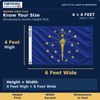
This 4-by-6-foot flag covers 24 square feet. Before ordering, confirm that your pole and mounting hardware manufacturers specify support for a 4-by-6-foot flag and that the flag can swing clear of walls, eaves and other obstructions.
This is the Indiana state flag at 4x6 Feet (24 square feet) in nylon, made in the United States and finished with brass grommets.
Built to the Indiana flag specification
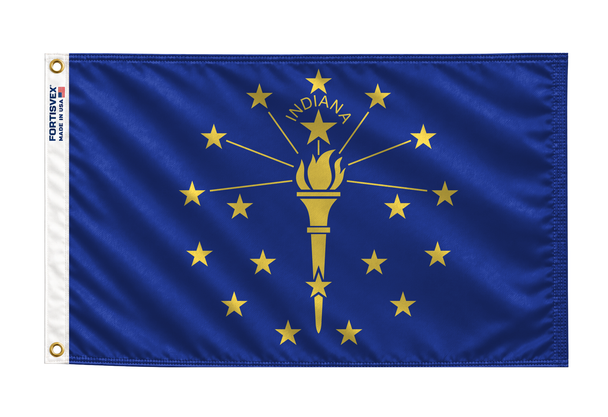
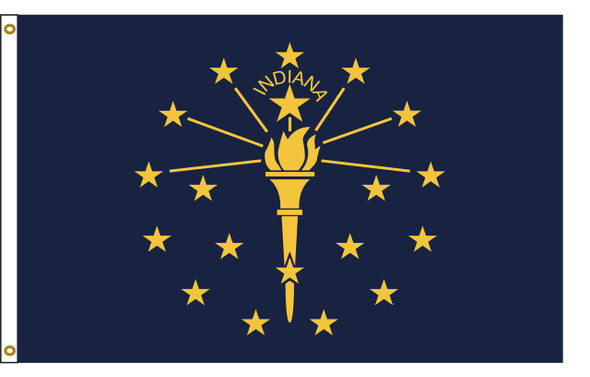
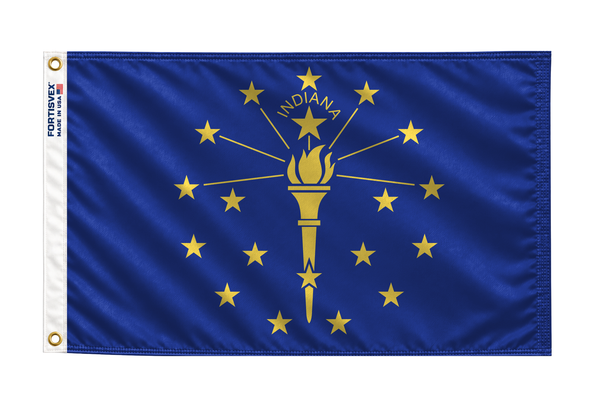
The Indiana flag is set out in Indiana Code Section 1-2-2-1. It is a gold torch surrounded by nineteen stars on blue, with the word Indiana above.
Designed by Paul Hadley through a Daughters of the American Revolution contest and adopted May 31, 1917 as the state banner for the 1916 centennial; the legislature’s only change to Hadley’s design was adding the word Indiana.
Indiana Code § 1-2-2-1 sets both the design and the proportions. It allows a fly-to-hoist ratio of 3:2 or 5:3 at any proportional size. This flag is 6 feet wide by 4 feet high, so it matches the 3:2 proportion.
We hold to a faithful reproduction of that design, at the standard outdoor sizes the industry uses and the states themselves buy. What matters on a flag that flies outdoors is accurate colors, seal and emblems, and that is exactly what this one has.
The law that defines it, in its own words
Indiana Code Section 1-2-2-1 reads:
A state flag is hereby adopted, and the same shall be of the following design and dimensions, to-wit: Its dimensions shall be three (3) feet fly by two (2) feet hoist; or five (5) feet fly by three (3) feet hoist; or any size proportionate to either of those dimensions. The field of the flag shall be blue with nineteen (19) stars and a flaming torch in gold or buff. Thirteen (13) stars shall be arranged in an outer circle, representing the original thirteen (13) states; five (5) stars shall be arranged in a half circle below the torch and inside the outer circle of stars, representing the states admitted prior to Indiana; and the nineteenth star, appreciably larger than the others and representing Indiana shall be placed above the flame of the torch. The outer circle of stars shall be so arranged that one (1) star shall appear directly in the middle at the top of the circle, and the word "Indiana" shall be placed in a half circle over and above the star representing Indiana and midway between it and the star in the center above it. Rays shall be shown radiating from the torch to the three (3) stars on each side of the star in the upper center of the circle.
You do not have to take our word for any of that. Read Indiana Code Section 1-2-2-1 in full at the Indiana Historical Bureau, and check what we sell against it.
That is the flag we build, not a rough version of it.
What is on it and what it means
The torch is liberty and enlightenment and its rays are a far-reaching influence. The thirteen outer stars are the original states. The five inner stars are the next five admitted. The single large star above the torch marks Indiana as the nineteenth state.
What most listings get wrong
Indiana adopted Paul Hadley’s design as the state banner in 1917. The General Assembly renamed it the state flag in 1955. Indiana Code § 1-2-2-2 still calls it the “banner” when describing militia and official use.
Where the Indiana flag flies
Glenbrook Dodge in Fort Wayne. The original pole of about two hundred and thirty one feet, raised in 2001, snapped in a storm on December 23, 2022. A two hundred and thirteen foot replacement was raised on July 2, 2024, flying a fifty by eighty foot flag. The installer called the original the second tallest flagpole in the United States,.
Fly it on Indiana’s birthday
Indiana became the 19th state on December 11, 1816. Its statehood anniversary is an occasion to display the state flag, not the only official display occasion. The Indiana Historical Bureau’s state flag page reproduces code provisions calling for a new and different state flag to be displayed at the State Capitol each day whenever practicable and feasible, and for institutions supported wholly or partly by state funds to display the state flag prominently on their property. These are specified government and institutional settings, not a universal display requirement for private homes.
Indiana Day is December 11, a legal holiday under which the Indiana Code directs the governor to issue an annual proclamation and state schools to hold commemorative events.
Buy it in time and it goes up on the day it matters. Every state’s date is on our state birthdays page.
Nylon or polyester in Indiana
Nylon statewide at Indianapolis, Fort Wayne and Evansville, except polyester in the open storm prone northwest near the lake.
At this size, twenty four square feet, wind load starts to count, and the material verdict above applies with more force than at house flag size.
What you have here is the nylon, appropriate for sheltered and moderate wind sites when your pole and mounting hardware manufacturers specify support for a 4-by-6-foot flag. Two things decide it: it is light, flying on an ordinary breeze rather than going limp, and it dries fast, which is the defense against mildew in humidity. The trade is ultraviolet durability — nylon’s amide bonds break under sun, fading and weakening faster than polyester, and it loses about a tenth of its strength wet. For an exposed site on the list above, the polyester version is worth a look instead.
One more consideration, learned by most people only after a repeat purchase: a nylon flag moves in conditions where polyester hangs still. If the flag needs to actually be flying — a calm morning, a holiday, a funeral, a ceremony — that is an argument for nylon even on a site where polyester would technically outlast it. A flag that just hangs there has failed just as much as one that frays.
The figure most institutions use is from the American Legion, citing the United States government's expectation of about ninety days for a flag flown daily from sunrise to sunset, and roughly a quarter of that around the clock. Retailers see three to six months in practice for nylon flown daily, four to eight for polyester, and one to three years when flown occasionally. These are practical figures, not a guarantee, and real-world exposure shifts them considerably.
How the 4x6 Feet is built
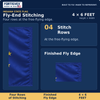
A 4x6 foot flag carries well over half again the area of a 3x5 foot flag, so it catches proportionally more wind and the fly end works harder for it. Four rows of lock stitching, and it needs all four.
Work the numbers and you get 24 square feet of nylon at roughly two ounces a square yard. At thirty miles an hour, the fly end actually outpaces the wind, because the wave running to the tip accelerates along the way — the reason the tip fails first, and the reason fly-end stitching count is the number that matters.
Still a one person job, but you will notice the difference the first windy day you try to take it down alone. Do it before the weather, not during it.
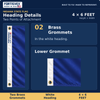
A lock stitch ties into the stitch next to it, so one broken thread does not unzip the whole seam — it just stops. 4 rows is not 4 times the strength; it is 3 backups. The heading is heavy duty white and reinforced, an inch and a half wide, with two solid brass grommets and tooth washers. At twenty four square feet the load on those two points is real.
This is commercial grade nylon: light enough to fly in a light wind, quick to shed water instead of holding it, and fast to dry, which matters because a waterlogged flag is a heavier flag putting more strain on its seams. UV resistant, field tested ink is what fights the sun, which is the real driver of color loss over time.
A design that reproduces cleanly
A torch, nineteen stars and lettering, but no seal. That puts it well ahead of most states for durability and cost.
For what it is worth, the North American Vexillological Association surveyed 72 state, provincial and territorial flags in 2001 and rated them from zero to ten. The Indiana flag placed 32, at 5.77 out of 10.
Will it fit my flagpole?
Confirm that the manufacturer specifies support for a 4-by-6-foot flag on your pole model. For wall mounting, also check the bracket’s supported flag size and make sure the flag can swing clear of nearby surfaces. Bracket length alone does not establish fit.
Questions about the 4x6 Feet
What flagpole does a 4-by-6-foot flag need? Use a pole and mounting hardware whose manufacturers specify support for a 4-by-6-foot flag. Pole height alone does not establish fit.
Should I choose a 4-by-6-foot or a 3-by-5-foot flag? A 4-by-6-foot flag has 24 square feet of fabric versus 15 for a 3-by-5-foot flag. Choose the larger flag only if your manufacturers specify support for it and the flag has room to fly without striking nearby surfaces.
Can I fly a 4x6 foot state flag with a 4x6 foot United States flag? Yes, and on two flagpoles of equal height that is the correct pairing, with the United States flag to the viewer’s left.
Where the step up starts to cost you
The move from 3x5 Feet to 4x6 Feet is where cutting corners becomes expensive. More area means more force at the fly end and more load on the grommets, so a cheaply built 4x6 Feet fails faster than a cheaply built 3x5 Feet. This size is where construction quality actually matters.
Specifications
- Size: 4x6 Feet
- Area: 24 square feet
- Material: 100 percent nylon
- Fly end: 4 rows of lock stitching
- Heading: heavy duty white, reinforced, 1-1/2 inch
- Finish: Brass Grommets
- Ink: UV resistant, field tested
- Made in the United States by FORTISVEX
Which size do I need?
Both lists are size examples, not compatibility or load ratings. Check your pole and mounting hardware manufacturers’ specifications for the exact flag size before ordering.
If you know your flagpole height, start here.
- House bracket: check the manufacturer’s supported flag size and clearances for the specific bracket and pole.
- Eder SS20 example: this 20-foot freestanding pole package comes with a 3-by-5-foot nylon flag.
- Eder SS25 example: this 25-foot freestanding pole package comes with a 4-by-6-foot nylon flag.
- Eder sizing-guide examples: a 5-by-8-foot flag on a 30-foot pole and a 6-by-10-foot flag on a 35-foot pole.
- 35 to 45 Feet flagpole: 6x10 Feet or 8x12 Feet
- 45 to 60 Feet flagpole: 8x12 Feet or 10x15 Feet
- 60 to 80 Feet flagpole: 10x15 Feet or 12x18 Feet
- 80 to 100 Feet flagpole: 12x18 Feet or 15x25 Feet
- 100 to 120 Feet flagpole: 15x25 Feet or 20x30 Feet
- 120 to 150 Feet flagpole: 20x30 Feet or 20x38 Feet
- 150 to 200 Feet flagpole: 20x38 Feet or 30x50 Feet
- 200 to 240 Feet flagpole: 30x50 Feet or 30x60 Feet
- 240 Feet and above: 30x60 Feet or 50x80 Feet, engineered to the flagpole
If you know your flag size, start here.
- 2-by-3-foot flag: use a pole and mounting hardware specified for this flag size.
- 3-by-5-foot flag: use a pole and mounting hardware specified for this flag size.
- 4-by-6-foot flag: choose a pole and mounting hardware whose manufacturers specify support for a 4-by-6-foot flag.
- 5-by-8-foot flag: Eder’s Hurricane sizing guide shows a 30-foot pole example. Check the manufacturer’s specifications for your exact pole model.
- 6x10 Feet: 30 to 40 Feet flagpole
- 8x12 Feet: 40 to 50 Feet flagpole
- 10x15 Feet: 50 to 60 Feet flagpole
- 12x18 Feet: 60 to 80 Feet flagpole
- 15x25 Feet: 80 to 100 Feet flagpole
- 20x30 Feet: 100 to 120 Feet flagpole
- 20x38 Feet: 120 to 150 Feet flagpole. This is the garrison size under Executive Order 10834, at a one to one point nine ratio rather than the two to three of the commercial sizes, and it is the size flown at the White House and the Capitol
- 30x50 Feet: 150 to 200 Feet flagpole
- 30x60 Feet: 200 to 240 Feet flagpole. This is the largest standard commercial size
- 50x80 Feet: 240 Feet and above, engineered to the flagpole
The proportion still applies past a hundred feet, but the decision changes character: the flagpole, the truck, the halyard, the foundation and the wind load stop being separate line items and become one engineered whole, and ordering a flag without confirming the flagpole rating puts the flagpole at risk first. A few famous flags fly deliberately larger than the rule suggests, and all of them do it with engineering behind the choice.
What is on the website is not the limit of what we carry. Any size in the tables above can be ordered, listed or not.
About the back of the flag
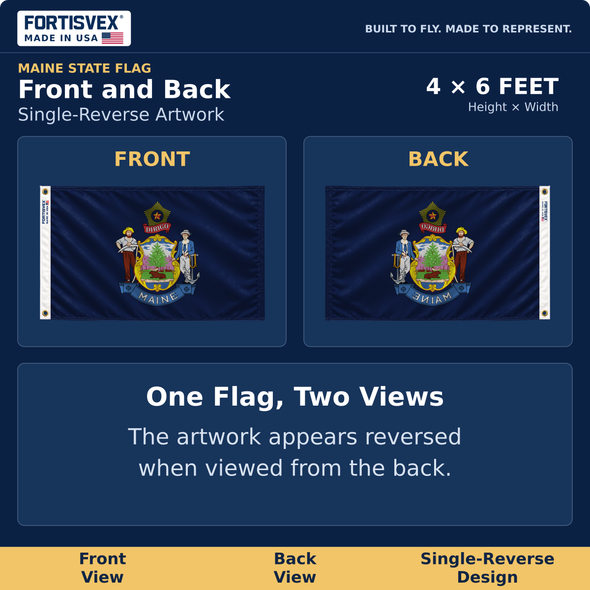
A printed flag reads correctly from the front and reversed from the back. That is normal and it is true of almost every flag flown in the country. A flag that reads correctly from both sides is a double sided flag, built as two flags sewn together with a liner between them, and it costs roughly twice as much and weighs roughly twice as much. Unless the statute for a particular state requires it, single sided is the standard and the right choice.
Flying it with the United States flag
The United States Flag Code, at Title 4, Section 7, sets this out: the United States flag holds the position of honor, never below another flag and never displaced from the viewer’s left when flags fly level. With two flagpoles of matching height, the United States flag takes the viewer’s left and the flags match in size; with unequal heights, it goes on the taller pole; on a single pole carrying two flags, it is at the top. The Code has no penalty attached for civilians, but it remains the standard every institution follows.
Buy two and they both last longer
Keep two flags and swap them monthly. That single habit will outlast three flags run to destruction, since resting fabric recovers and the fly end is spared the repeated wear of constant flying. Take the flag down ahead of severe weather, since one bad storm night can outdo six calm months. Watch the fly end rather than the center; a little stitching early saves a whole season.
For cities, counties, schools and agencies
Cities, school districts, fire and police departments, courthouses and state agencies buy state flags from us as a matter of routine. The tax exempt page is where a tax exempt account is set up; the contact page is where quantity orders, replacement schedules, and sizes not shown here get handled.
Why buy it from us
This company is small and American, and what is on the site is in stock. Every flag here is made in the United States, uses UV resistant ink, and is built to the construction described above rather than priced down to a cheaper build. We would rather you buy one flag that lasts than replace three that do not. Orders of fifty dollars or more get free shipping.
Additional Information
Material Type: |
Commercial Nylon |
Flag Size: |
4x6 Feet |
Made in: |
USA |
Finish: |
Brass Grommets |
Related Products
Related Products
FORTISVEX Indiana State Flag 6x10 Feet Nylon - Made in USA with Brass Grommets
FORTISVEX

FORTISVEX Indiana State Flag 5x8 Feet Nylon - Made in USA with Brass Grommets
FORTISVEX

FORTISVEX Maine State Flag 4x6 Feet Nylon - Made in USA with Brass Grommets
FORTISVEX

FORTISVEX Wisconsin State Flag 4x6 Feet Nylon - Made in USA with Brass Grommets
FORTISVEX

FORTISVEX Michigan State Flag 4x6 Feet Nylon - Made in USA with Brass Grommets
FORTISVEX