
FORTISVEX
FORTISVEX Idaho State Flag 3x5 Feet Nylon - Made in USA with Brass Grommets

- MPN:
- FPAMSTIDNYL3x5G
- Availability:
- Free Shipping*
- Shipping:
- Calculated at Checkout

Description
This is the default: the size that fits the bracket already on the house, and the size Americans replace more than any other. When someone says flag without qualifying it, this is what they mean.
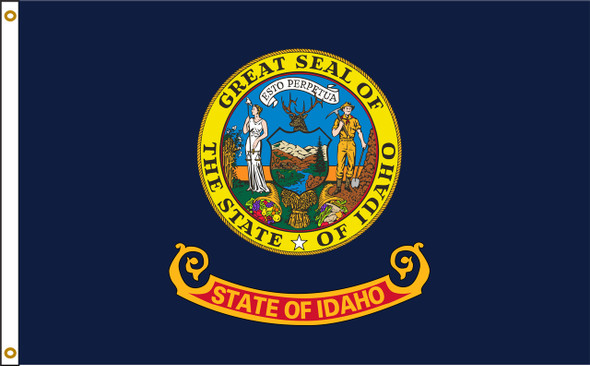
This is the Idaho state flag at 3x5 Feet (15 square feet) in nylon, made in the United States and finished with brass grommets.
Built to the Idaho flag specification
The Idaho flag is set out in Idaho Code Section 46-801. It is the state seal on a blue field with a red and gold band reading State of Idaho. The statute describes a silk ceremonial color, five feet six inches by four feet four inches with gilt fringe, which is the pattern flag the state keeps rather than the size anyone flies outdoors.
Adopted in 1907.
Idaho Code Section 46-801 describes a silk flag five feet six inches by four feet four inches on a pike with two and a half inch gilt fringe and a twenty one inch seal. Those are the dimensions of a ceremonial parade color from 1907, not of an outdoor flag, and no manufacturer in the country stocks that size.
We hold to a faithful reproduction of that design, at the standard outdoor sizes the industry uses and the states themselves buy. What matters on a flag that flies outdoors is accurate colors, seal and emblems, and that is exactly what this one has.
The law that defines it, in its own words
Idaho Code Section 46-801, State Flag reads:
A state flag for the state of Idaho is hereby adopted, the same to be as follows: A silk flag, blue field, five (5) feet six (6) inches fly, and four (4) feet four (4) inches on pike, bordered with gilt fringe two and one-half (2 1/2) inches in width, with state seal of Idaho twenty-one (21) inches in diameter, in colors, in the center of a blue field. The words "State of Idaho" are embroidered in with block letters, two (2) inches in height on a red band three (3) inches in width by twenty-nine (29) inches in length, the band being in gold and placed about eight and one-half (8 1/2) inches from the lower border of fringe and parallel with the same.
You do not have to take our word for any of that. Read Idaho Code Section 46-801 in full at the Idaho Legislature, and check what we sell against it.
That is the flag as we build it. Nothing about it is approximate.
What is on it and what it means
The seal shows a miner and a woman representing liberty, justice and equality, and reflects mining, forestry, farming and the state’s wildlife.
What most listings get wrong
The seal on this flag is the only state seal in the country designed by a woman, Emma Edwards Green, in 1891. Almost nobody selling this flag mentions her. Note also that the words State of Idaho appear both on the red and gold band and again inside the seal itself. That is not a printing mistake, it is the flag as Idaho Code Section 46-801 specifies it.
Emma Edwards Green designed the seal in 1891. No other state seal was designed by a woman.
Where the Idaho flag flies
Idahoans obtain United States Capitol flags through the congressional delegation. Idaho Code Section 67-820 provides that when the flag is flown at half staff at the capitol for a line of duty death, the flag flown over the capitol building in honor of the deceased shall be presented to the family. The Idaho State Historical Society documents that the copper eagle atop the Capitol dome was fabricated from parts of the battleship Idaho and was re-gilded with gold leaf during the 2005 to 2010 restoration. The state flag descends from the battle flag of the First Idaho Infantry carried in the Philippines in 1899.
Fly it on Idaho’s birthday
Idaho became the 43rd state on July 3, 1890. Under the United States Flag Code as amended July 7, 1976, a state flag flown on the state’s birthday takes its place beneath the United States flag, and that day is the one date every year the Idaho flag has an official reason to go up.
Get it now so it is flying on the day itself. See every state’s birthday on our state birthdays page.
Nylon or polyester in Idaho
Nylon in the sheltered Treasure Valley at Boise, Nampa and Meridian. Polyester across the wind exposed Snake River Plain and Magic Valley at Twin Falls, Pocatello and Idaho Falls.
For scale, the National Weather Service ultraviolet index forecast for Boise on July 23, 2026 was 10 at solar noon, in the very high band. That is the sun this flag has to survive.
This is a house flag, fifteen square feet, where the material determines whether it flies in a light breeze and how fast it dries once it rains.
The nylon is what you are looking at here — the right choice for the sheltered and moderate wind sites named above, for a house bracket, and for anywhere the flag comes down ahead of storms. Two things settle it. It is light enough to fly on an ordinary yard’s breeze rather than sag, and it dries fast, fighting mildew in humid conditions. What it gives up is resistance to ultraviolet — nylon’s amide bonds break under sun, costing strength and color faster than polyester, and it loses roughly a tenth of its strength while wet. If the site is one of the exposed ones above, the polyester version fits better.
Here is the part usually learned the hard way, after a second purchase: nylon catches wind on days polyester simply will not move. When the flag needs to be visibly flying — a quiet morning, a holiday, a funeral, a ceremony — that argues for nylon even on a site where polyester would technically last longer. A flag that just hangs there is not doing its job either.
The figure most institutions use is from the American Legion, citing the United States government's expectation of about ninety days for a flag flown daily from sunrise to sunset, and roughly a quarter of that around the clock. Retailers see three to six months in practice for nylon flown daily, four to eight for polyester, and one to three years when flown occasionally. These are practical figures, not a guarantee, and real-world exposure shifts them considerably.
How the 3x5 Feet is built
The fly end is where this size gives out, and it gives out sooner than it should on most flags people buy, because the 3x5 foot flag is bought on price more than any other size. Four rows of lock stitching on the fly end is the difference between one season and three.
The arithmetic behind that: 15 square feet of nylon at roughly two ounces a square yard. In a thirty mile an hour wind the fly end of a flag this size travels faster than the wind itself, because the wave running out to the tip accelerates as it goes. That is why the tip wears out first and why the stitching count at that end is the number worth reading on any listing.
This is a one person job to raise or lower, folding down to drawer size. Rotating two flags monthly costs you a minute at this size, nothing more.
A lock stitch ties into the stitch next to it, so one broken thread does not unzip the whole seam — it just stops. 4 rows is not 4 times the strength; it is 3 backups. An inch and a half wide, heavy duty white and reinforced, this heading carries two solid brass grommets. Fifteen square feet is enough sail area to work them hard in any real wind.
This flag is commercial grade nylon, light enough to move in a gentle breeze, and it sheds water instead of soaking it up, drying fast — which matters, since a wet flag is a heavy flag that works its own seams harder. UV resistant, field tested ink is what stands between the flag and the sun, since sun is what fades a flag over time.
Why this flag is harder to make than most
A highly detailed painterly seal with two human figures. This is among the most expensive state flags to reproduce accurately and the fine detail is what separates a good one from a cheap one.
For what it is worth, the North American Vexillological Association surveyed 72 state, provincial and territorial flags in 2001 and rated them from zero to ten. The Idaho flag placed 64, at 3.17 out of 10.
Will it fit my flagpole?
A five or six foot house bracket or a fifteen to twenty foot in-ground flagpole both suit this size — the most common residential pairing in the country, and this is the size built for it.
Questions about the 3x5 Feet
What size flagpole does a 3x5 foot flag need? A six foot house bracket, or an in-ground flagpole of fifteen to twenty feet. It is the most common residential pairing in the country.
How long does a 3x5 foot nylon flag last outside? The federal working figure is about ninety days for a flag flown daily from sunrise to sunset, and about a quarter of that flown around the clock. Retailers commonly see three to six months in daily use and one to three years flown on occasions only.
Is this flag printed or sewn? The design is printed in UV resistant ink on one side and reads through in reverse on the back, which is how nearly every state flag sold in the country is made. The construction, the heading, the stitching and the grommets are sewn.
Why this size gets replaced most
There is nothing weaker about the 3x5 foot flag itself — it is just the size most often bought on price, and built to match. A cheap one with one or two rows of stitching on the fly end frays inside a season and is six inches shorter within two. The construction is what separates the two.
Specifications
- Size: 3x5 Feet
- Area: 15 square feet
- Material: 100 percent nylon
- Fly end: 4 rows of lock stitching
- Heading: heavy duty white, reinforced, 1-1/2 inch
- Finish: Brass Grommets
- Ink: UV resistant, field tested
- Made in the United States by FORTISVEX
Which size do I need?
Both tables follow the same logic. A flagpole reads best with a flag whose length falls between a quarter and a third of its height. Where a size could go either way, smaller means more flying days and a longer life, bigger means more visibility at range.
If you know your flagpole height, start here.
- 6 Feet house bracket: 2x3 Feet or 3x5 Feet
- 15 to 20 Feet flagpole: 3x5 Feet or 4x6 Feet
- 20 to 25 Feet flagpole: 4x6 Feet or 5x8 Feet
- 25 to 35 Feet flagpole: 5x8 Feet or 6x10 Feet
- 35 to 45 Feet flagpole: 6x10 Feet or 8x12 Feet
- 45 to 60 Feet flagpole: 8x12 Feet or 10x15 Feet
- 60 to 80 Feet flagpole: 10x15 Feet or 12x18 Feet
- 80 to 100 Feet flagpole: 12x18 Feet or 15x25 Feet
- 100 to 120 Feet flagpole: 15x25 Feet or 20x30 Feet
- 120 to 150 Feet flagpole: 20x30 Feet or 20x38 Feet
- 150 to 200 Feet flagpole: 20x38 Feet or 30x50 Feet
- 200 to 240 Feet flagpole: 30x50 Feet or 30x60 Feet
- 240 Feet and above: 30x60 Feet or 50x80 Feet, engineered to the flagpole
If you know your flag size, start here.
- 2x3 Feet: 4 to 8 Feet bracket or garden flagpole
- 3x5 Feet: 6 Feet bracket, or 15 to 20 Feet in-ground flagpole
- 4x6 Feet: 18 to 25 Feet in-ground flagpole
- 5x8 Feet: 25 to 35 Feet flagpole
- 6x10 Feet: 30 to 40 Feet flagpole
- 8x12 Feet: 40 to 50 Feet flagpole
- 10x15 Feet: 50 to 60 Feet flagpole
- 12x18 Feet: 60 to 80 Feet flagpole
- 15x25 Feet: 80 to 100 Feet flagpole
- 20x30 Feet: 100 to 120 Feet flagpole
- 20x38 Feet: 120 to 150 Feet flagpole. This is the garrison size under Executive Order 10834, at a one to one point nine ratio rather than the two to three of the commercial sizes, and it is the size flown at the White House and the Capitol
- 30x50 Feet: 150 to 200 Feet flagpole
- 30x60 Feet: 200 to 240 Feet flagpole. This is the largest standard commercial size
- 50x80 Feet: 240 Feet and above, engineered to the flagpole
Push the flagpole past a hundred feet and the same ratio still applies, but it stops being a simple lookup: the flag, the truck, the halyard, the foundation and the wind load need to be engineered as a unit, and skipping that step damages the flagpole before it damages the flag. A number of famous large flags deliberately break the rule of thumb, on an engineer’s word rather than a table’s.
The full range is available to order even where a size is not shown on the site. If what you need is not listed here, ask and we can still get it made.
About the back of the flag
Hold a printed flag up to the light and the reverse side shows the design in mirror image. That is not a defect — it is how nearly every flag flown in America is made. A flag correct on both sides is a double sided flag, two flags sewn together around a liner, and it runs roughly double the price and double the weight. Unless a state’s own statute calls for it, single sided is standard and it is the right call.
Flying it with the United States flag
The United States Flag Code, Title 4, Section 7, governs this. No other flag goes above the United States flag, or to its right when on the same level, which is the viewer’s left. On two flagpoles of the same height the United States flag takes the viewer’s left and both flags should be the same size. If the flagpoles differ in height, the United States flag goes on the taller one. On a single flagpole carrying two flags the United States flag goes at the top. The Flag Code is advisory for civilians and carries no penalty, but it is the standard every institution follows.
Buy two and they both last longer
One flag flown month after month wears faster at the same point every time; two flags rotated monthly outlast three run to failure, because rest lets fabric recover. Bring the flag in ahead of severe weather — a hard storm overnight can outdo six normal months. And check the fly end first, since that is where fraying starts, and a small stitch repair there is worth a full extra season.
For cities, counties, schools and agencies
This is a flag we sell to municipalities, school districts, fire and police departments, courthouses and state agencies as standard business. Use the tax exempt page for a tax exempt account, and the contact page for quantity orders, a replacement schedule, or a size not shown on this listing.
Why buy it from us
Small and American describes this company, and we stock what we list. Every flag is made in the United States, printed with UV resistant ink, and finished to the construction described above rather than to a price target. We’d rather sell one flag that holds up than three that don’t. Free shipping on orders over twenty five dollars.
Additional Information
Material Type: |
Commercial Nylon |
Flag Size: |
3x5 Feet |
Made in: |
USA |
Finish: |
Brass Grommets |
Related Products
Related Products

FORTISVEX Idaho State Flag 4x6 Feet Nylon - Made in USA with Brass Grommets
FORTISVEX
FORTISVEX Idaho State Flag 5x8 Feet Nylon - Made in USA with Brass Grommets
FORTISVEX
FORTISVEX Nebraska State Flag 3x5 Feet Nylon - Made in USA with Brass Grommets
FORTISVEX

FORTISVEX Connecticut State Flag 3x5 Feet Nylon - Made in USA with Brass Grommets
FORTISVEX
FORTISVEX Tennessee State Flag 3x5 Feet Nylon - Made in USA with Brass Grommets
FORTISVEX