
FORTISVEX
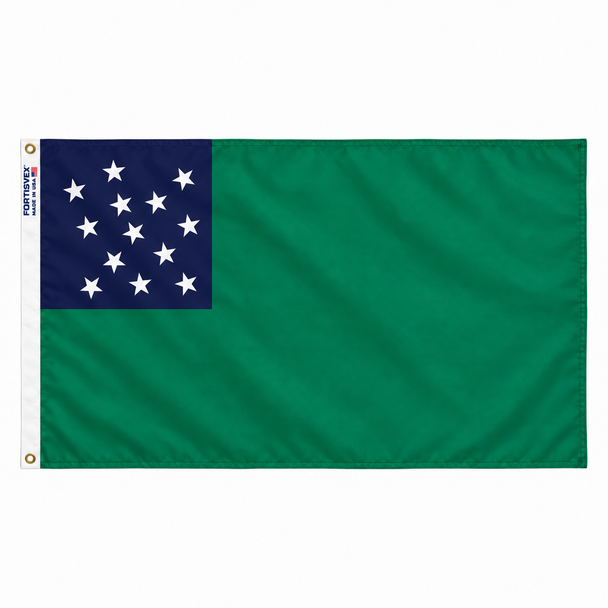
FORTISVEX Green Mountain Boys Flag 3x5 Feet Nylon - Made in USA with Brass Grommets
- MPN:
- Z060570
- Shipping:
- Calculated at Checkout

Description
This FORTISVEX Green Mountain Boys Flag shows a green field and a blue canton with thirteen white stars. It is a modern reproduction of the familiar historical pattern, with the distinctions between the militia, later regiment and surviving flag evidence explained below.
Green Mountain Boys Flag History: Vermont's Revolutionary Legacy
With its green field, blue canton, and thirteen scattered white stars, the Green Mountain Boys flag recalls the independent spirit of the people who helped secure America's freedom. This modern reproduction follows the familiar commemorative design. Its appeal rests on both the Revolutionary story and the generations who have kept that story alive. Understanding the flag means distinguishing the documented achievements of the Green Mountain Boys from the less certain history of the banner associated with them.
Land, Liberty, and the Green Mountain Boys
The Green Mountain Boys emerged from the dispute over the New Hampshire Grants, land that would become Vermont. Settlers holding New Hampshire titles resisted New York's competing claims and attempts to enforce them. The Vermont Historical Society describes organized resistance in 1771 and use of the Green Mountain Boys name by 1772. Ethan Allen and Remember Baker were prominent leaders. This struggle could involve intimidation and violence; it began as a dispute over land and authority before becoming connected to the larger Revolutionary cause.
Ticonderoga: A Victory, Not Proof of a Particular Flag
On May 10, 1775, American forces including the Green Mountain Boys captured British-held Fort Ticonderoga. Ethan Allen and Benedict Arnold shared leadership of the operation, although command became a point of disagreement. Contemporary accounts reproduced by Fort Ticonderoga describe the surprise capture and name its leaders. They establish the men's participation, but do not identify this green-and-blue design as their flag. The famous raid belongs in the Green Mountain Boys' history without turning a familiar modern banner into a proven eyewitness artifact.
Bennington and the Citizen-Soldier Tradition
In August 1777, British General John Burgoyne's army needed supplies. A force sent toward Bennington met American resistance across the border in New York. On August 16, General John Stark's force won a major victory, with Seth Warner and his arriving regiment helping repel enemy reinforcements. The National Park Service's account explains how this setback weakened Burgoyne before his defeat at Saratoga. It also describes volunteers arriving from farms and towns, often carrying their own firearms. Their service gives this history an enduring connection to citizens taking responsibility for defending their communities and independence.
What Survives of the Stark Flag
The historical object behind the modern design is a fragment associated with John Stark, preserved by the Bennington Museum. In her Smithsonian study, Thirteen-Star Flags, textile historian Grace Rogers Cooper described a light-blue silk canton with thirteen irregularly placed painted stars and narrow remnants of green silk. She considered it likely to be a surviving period regimental flag. The account connecting it to the Battle of Bennington came through Stark's descendants and nineteenth-century reporting. Because most of the flag is missing, the complete original appearance cannot be recovered with certainty. Its association with Stark should not be confused with proof that Ethan Allen's men carried the familiar reconstruction in 1775.
A Living Symbol of Service
The Vermont Air National Guard's published history acknowledges uncertainty about the original design while documenting the banner's modern place in Vermont military identity. It describes renewed prominence around the nation's Bicentennial and use with deploying Guardsmen in 2004. Today, displaying this design can honor Vermont's Revolutionary heritage, citizen service, and American liberty while keeping the historical claims honest. It is a commemorative reproduction, not an authenticated Ticonderoga battle flag or a documented official flag of the Vermont Republic.
About This Flag
This outdoor nylon flag has a heavy duty white heading and two brass grommets for compatible clips or snaps. Four rows of lock stitching reinforce the fly end. This is the grommet-finished version, not a sleeve-mounted or fringed indoor flag.
Specifications
- Flag size: 3x5 Feet
- Material: Nylon
- Use: Outdoor display
- Attachment: Two brass grommets
- Heading: Heavy duty white heading
- Fly end: Four rows of lock stitching
- Country of origin: United States
What Is Included
One Green Mountain Boys flag measuring 3x5 Feet. Flagpole, bracket, clips and other mounting hardware are not included.
Display and Care
Check the flagpole and hardware manufacturer's permitted flag area and wind-load limits. Leave room for the full fly length, clear of branches, wires and abrasive surfaces. Inspect the seams and attachment points regularly, remove the flag during severe weather, and allow it to dry before storage.
Which size do I need?
These general references cover flag sizes through 50x80 Feet. They are not a list of variants offered by this listing. Follow the flagpole manufacturer's flag-area and wind-load limits. Large displays require an engineered flagpole, foundation and hardware selection.
If you know your flag size, start here
| Flag size | Flagpole height |
|---|---|
| 2x3 Feet | 4 to 8 Feet bracket-mounted or garden flagpole |
| 3x5 Feet | 6 Feet house-mounted flagpole; 15 to 20 Feet in-ground flagpole |
| 4x6 Feet | 18 to 25 Feet |
| 5x8 Feet | 25 to 35 Feet |
| 6x10 Feet | 30 to 40 Feet |
| 8x12 Feet | 40 to 50 Feet |
| 10x15 Feet | 50 to 60 Feet |
| 12x18 Feet | 60 to 80 Feet |
| 15x25 Feet | 80 to 100 Feet |
| 20x30 Feet | 100 to 120 Feet |
| 20x38 Feet | 120 to 150 Feet |
| 30x50 Feet | 150 to 200 Feet |
| 30x60 Feet | 200 to 240 Feet |
| 50x80 Feet | 240 Feet and above; engineered installation |
If you know your flagpole height, start here
| Flagpole height | Flag size |
|---|---|
| 6 Feet house-mounted flagpole | 2x3 Feet or 3x5 Feet |
| 15 to 20 Feet | 3x5 Feet or 4x6 Feet |
| 20 to 25 Feet | 4x6 Feet or 5x8 Feet |
| 25 to 35 Feet | 5x8 Feet or 6x10 Feet |
| 35 to 45 Feet | 6x10 Feet or 8x12 Feet |
| 45 to 60 Feet | 8x12 Feet or 10x15 Feet |
| 60 to 80 Feet | 10x15 Feet or 12x18 Feet |
| 80 to 100 Feet | 12x18 Feet or 15x25 Feet |
| 100 to 120 Feet | 15x25 Feet or 20x30 Feet |
| 120 to 150 Feet | 20x30 Feet or 20x38 Feet |
| 150 to 200 Feet | 20x38 Feet or 30x50 Feet |
| 200 to 240 Feet | 30x50 Feet or 30x60 Feet |
| 240 Feet and above | 30x60 Feet or 50x80 Feet; engineered installation |
Related Products
Related Products

FORTISVEX Taunton Flag 3x5 Feet Nylon - Made in USA with Brass Grommets
FORTISVEX

FORTISVEX Alamo Flag 3x5 Feet Nylon - Made in USA with Brass Grommets
FORTISVEX FLAGPOLE HARDWARE

FORTISVEX Culpeper Flag 3x5 Feet Nylon - Made in USA with Brass Grommets
FORTISVEX

FORTISVEX Raven Flag 3x5 Feet Nylon - Made in USA with Brass Grommets
FORTISVEX

FORTISVEX Columbus Flag 3x5 Feet Nylon - Made in USA with Brass Grommets
FORTISVEX FLAGPOLE HARDWARE