
FORTISVEX
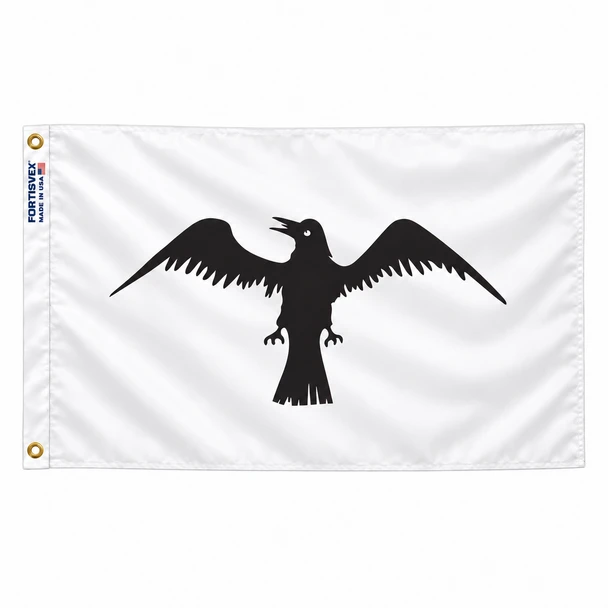
FORTISVEX Raven Flag 3x5 Feet Nylon - Made in USA with Brass Grommets
- MPN:
- Z060575
- Shipping:
- Calculated at Checkout

Description
A black raven with outstretched wings stands against white in this interpretation of a symbol found in Viking-age records, coins, and later Norse storytelling.
Raven Flag History
The Raven Flag centers a black bird on an unbroken white field. Its wings spread broadly, its feet extend below its body, and its open beak points toward the hoist. The contrast makes the figure immediately recognizable. As a historical design, it evokes the raven banners described in medieval accounts of Scandinavian warfare. The precise drawing and rectangular layout shown here are best understood as a modern interpretation of that tradition, not a documented facsimile of a surviving Viking-age banner.
An important written reference appears in the Anglo-Saxon Chronicle. In its account of the year 878, the chronicle describes a Danish force arriving in Devonshire and suffering defeat. Among the things captured was a war flag called the Raven. The text, available through Yale University’s Avalon Project, supplies evidence that a named raven standard belonged to the world of ninth-century warfare. It does not provide a complete visual specification for the flag or establish the particular artwork used in this reproduction.
A surviving object gives the bird a more definite place in Viking-age imagery. The British Museum holds a silver penny minted at York during the rule of Anlaf Guthfrithsson, dated 939–941. A raven with outstretched wings appears on one side. The museum identifies the raven as a favored Viking symbol and connects it with the banner recorded as captured in 878. Coin and chronicle are different kinds of evidence, but together they show that the raven motif was more than a later invention.
Ravens also belonged to the religious imagination of the Norse world. The National Museum of Denmark identifies Hugin and Munin as Odin’s ravens, who observe events on earth and bring him knowledge of what is happening. That mythological association helps explain why a raven can suggest watchfulness and supernatural knowledge in a Norse-themed display. It should not be used to assign one exclusive religious meaning to every bird pictured in medieval art or on every historical banner.
Later medieval narratives made raven standards especially memorable by describing them as omens. The University of Chicago’s discussion of flags in the Bayeux Tapestry summarizes traditions in which a raven appeared active before victory and drooped before defeat. It also notes accounts linking the banner with Cnut and the battle at Ashingdon in 1016. These are valuable parts of the symbol’s literary history, but stories about a banner foretelling battle belong to the record of belief and legend, not to verified supernatural events.
This design can therefore introduce several connected subjects: Viking-age kingship, conflict in early medieval Britain, coin imagery, and Norse myth. It is not presented as a universal national flag used by all Vikings or as the proven flag of an individual explorer. Keeping that distinction clear allows the raven’s well-attested historical importance to stand on its own, without adding a specific voyage or owner that the evidence does not establish.
Historical Sources
About This Flag
This outdoor nylon flag has a heavy duty white heading and two brass grommets for compatible clips or snaps. Four rows of lock stitching reinforce the fly end. This is the grommet-finished version, not a sleeve-mounted or fringed indoor flag.
Specifications
- Flag size: 3x5 Feet
- Material: Nylon
- Use: Outdoor display
- Attachment: Two brass grommets
- Heading: Heavy duty white heading
- Fly end: Four rows of lock stitching
- Country of origin: United States
What Is Included
One Raven flag measuring 3x5 Feet. Flagpole, bracket, clips and other mounting hardware are not included.
Display and Care
Check the flagpole and hardware manufacturer's permitted flag area and wind-load limits. Leave room for the full fly length, clear of branches, wires and abrasive surfaces. Inspect the seams and attachment points regularly, remove the flag during severe weather, and allow it to dry before storage.
Which size do I need?
These general references cover flag sizes through 50x80 Feet. They are not a list of variants offered by this listing. Follow the flagpole manufacturer's flag-area and wind-load limits. Large displays require an engineered flagpole, foundation and hardware selection.
If you know your flag size, start here
| Flag size | Flagpole height |
|---|---|
| 2x3 Feet | 4 to 8 Feet bracket-mounted or garden flagpole |
| 3x5 Feet | 6 Feet house-mounted flagpole; 15 to 20 Feet in-ground flagpole |
| 4x6 Feet | 18 to 25 Feet |
| 5x8 Feet | 25 to 35 Feet |
| 6x10 Feet | 30 to 40 Feet |
| 8x12 Feet | 40 to 50 Feet |
| 10x15 Feet | 50 to 60 Feet |
| 12x18 Feet | 60 to 80 Feet |
| 15x25 Feet | 80 to 100 Feet |
| 20x30 Feet | 100 to 120 Feet |
| 20x38 Feet | 120 to 150 Feet |
| 30x50 Feet | 150 to 200 Feet |
| 30x60 Feet | 200 to 240 Feet |
| 50x80 Feet | 240 Feet and above; engineered installation |
If you know your flagpole height, start here
| Flagpole height | Flag size |
|---|---|
| 6 Feet house-mounted flagpole | 2x3 Feet or 3x5 Feet |
| 15 to 20 Feet | 3x5 Feet or 4x6 Feet |
| 20 to 25 Feet | 4x6 Feet or 5x8 Feet |
| 25 to 35 Feet | 5x8 Feet or 6x10 Feet |
| 35 to 45 Feet | 6x10 Feet or 8x12 Feet |
| 45 to 60 Feet | 8x12 Feet or 10x15 Feet |
| 60 to 80 Feet | 10x15 Feet or 12x18 Feet |
| 80 to 100 Feet | 12x18 Feet or 15x25 Feet |
| 100 to 120 Feet | 15x25 Feet or 20x30 Feet |
| 120 to 150 Feet | 20x30 Feet or 20x38 Feet |
| 150 to 200 Feet | 20x38 Feet or 30x50 Feet |
| 200 to 240 Feet | 30x50 Feet or 30x60 Feet |
| 240 Feet and above | 30x60 Feet or 50x80 Feet; engineered installation |
Related Products
Related Products

FORTISVEX Taunton Flag 3x5 Feet Nylon - Made in USA with Brass Grommets
FORTISVEX

FORTISVEX Alamo Flag 3x5 Feet Nylon - Made in USA with Brass Grommets
FORTISVEX FLAGPOLE HARDWARE

FORTISVEX Cowpens Flag 3x5 Feet Nylon - Made in USA with Brass Grommets
FORTISVEX

FORTISVEX Continental Flag 3x5 Feet Nylon - Made in USA with Brass Grommets
FORTISVEX FLAGPOLE HARDWARE

FORTISVEX Columbus Flag 3x5 Feet Nylon - Made in USA with Brass Grommets
FORTISVEX FLAGPOLE HARDWARE