
FORTISVEX
FORTISVEX Grand Union Flag 3x5 Feet Nylon - Made in USA with Brass Grommets

- MPN:
- Z060568
- Shipping:
- Calculated at Checkout

Description
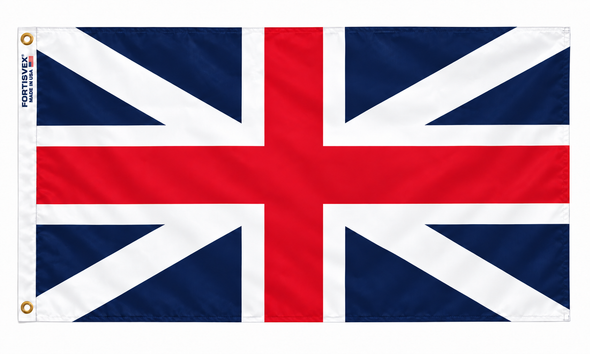
This FORTISVEX Grand Union Flag combines thirteen red and white stripes with the pre-1801 British Union design in the canton. Also known as the Continental Colors, this early Revolutionary pattern connects the history of the Continental Navy with the later Stars and Stripes. This is a modern historical reproduction, not an original artifact.
History of the Grand Union Flag
The Grand Union flag brings together two unmistakable elements: thirteen alternating red and white stripes and the earlier British Union flag in the upper corner. That canton combines the crosses of St. George and St. Andrew, without the red diagonal cross added to the British design in 1801. Also commonly called the Continental Colors, the design belongs to the opening years of the American Revolution. It provides a striking visual contrast with the later Stars and Stripes: the striped field is familiar, but the corner still contains a British emblem rather than stars. The U.S. District Court's Historical Flag Project describes the design and its names.
The Continental Navy Connection
One of the flag's clearest historical associations is with the Continental ship Alfred. Built at Philadelphia in 1774 as the merchant vessel Black Prince, the ship was acquired and converted for naval service as Congress assembled an American fleet. The conversion involved strengthening the vessel and creating gunports, turning a commercial ship into a warship during a period of urgent military need. Naval History and Heritage Command recounts the ship's beginnings.
The Navy's history records that Lieutenant John Paul Jones raised the Grand Union flag aboard Alfred at Philadelphia when the ship was commissioned on December 3, 1775. Captain Dudley Saltonstall commanded the vessel, which became Commodore Esek Hopkins's flagship. This naval setting is central to the flag's significance: it connects the design with the practical creation of an American armed force before the Declaration of Independence, rather than only with a later ceremonial account of the nation's founding. The National Museum of the U.S. Navy also documents this association.
Prospect Hill: A Tradition with Important Uncertainty
A famous story identifies the Grand Union as the flag raised near George Washington's headquarters at Prospect Hill at the beginning of 1776. That identification should not be presented as settled fact. A detailed National Park Service study examines Washington's letter and other contemporary accounts and concludes that their references to a Union flag do not securely establish the striped design familiar today. The study also traces the later Grand Union terminology to nineteenth-century historical writing. The episode remains important to the flag's remembered history, but the evidence does not justify claiming that Washington unquestionably raised this exact pattern there. Read the NPS discussion, printed pages 384–386.
From a Union Canton to a Constellation
On June 14, 1777, the Continental Congress resolved that the United States flag should have thirteen alternating red and white stripes and thirteen white stars on blue in its union. That documented decision is the clear milestone for the Stars and Stripes. Compared with the Grand Union, the distinctive change is in the canton: stars replace the combined British crosses while the thirteen-stripe arrangement remains. The National Archives reproduces the substance of the 1777 resolution.
The Grand Union is consequently best understood as an early Continental flag associated with the transition toward an independent American identity, not simply as the modern U.S. flag in an older form. Its design makes that transition visible. This modern historical reproduction presents the familiar striped-and-Union pattern for study and display; it is not an original Revolutionary-era artifact, proof of one disputed flag-raising, or a claim that Congress formally adopted it through the same 1777 resolution that established the Stars and Stripes.
About This Flag
The outdoor nylon flag has a heavy duty white heading with two brass grommets for compatible clips or snaps. Four rows of lock stitching reinforce the fly end. This is the grommet-finished version, not an indoor sleeve or fringed flag.
Specifications
- Flag size: 3x5 Feet
- Material: Nylon
- Use: Outdoor display
- Attachment: Two brass grommets
- Heading: Heavy duty white heading
- Fly end: Four rows of lock stitching
- Country of origin: United States
What Is Included
One Grand Union flag measuring 3x5 Feet. A flagpole, bracket, clips, and other mounting hardware are not included.
Display and Care
Confirm that the flagpole and hardware are rated for the intended flag area and conditions. Leave room for the full fly length, away from branches, wires, and abrasive surfaces. Inspect stitching and attachment points regularly, remove the flag in severe weather, and let it dry before storage.
Which size do I need?
These general references cover flag sizes through 50x80 Feet. They are not a list of variants offered by this listing. Follow the flagpole manufacturer's flag-area and wind-load limits. Large displays require an engineered flagpole, foundation and hardware selection.
If you know your flag size, start here
| Flag size | Flagpole height |
|---|---|
| 2x3 Feet | 4 to 8 Feet bracket-mounted or garden flagpole |
| 3x5 Feet | 6 Feet house-mounted flagpole; 15 to 20 Feet in-ground flagpole |
| 4x6 Feet | 18 to 25 Feet |
| 5x8 Feet | 25 to 35 Feet |
| 6x10 Feet | 30 to 40 Feet |
| 8x12 Feet | 40 to 50 Feet |
| 10x15 Feet | 50 to 60 Feet |
| 12x18 Feet | 60 to 80 Feet |
| 15x25 Feet | 80 to 100 Feet |
| 20x30 Feet | 100 to 120 Feet |
| 20x38 Feet | 120 to 150 Feet |
| 30x50 Feet | 150 to 200 Feet |
| 30x60 Feet | 200 to 240 Feet |
| 50x80 Feet | 240 Feet and above; engineered installation |
If you know your flagpole height, start here
| Flagpole height | Flag size |
|---|---|
| 6 Feet house-mounted flagpole | 2x3 Feet or 3x5 Feet |
| 15 to 20 Feet | 3x5 Feet or 4x6 Feet |
| 20 to 25 Feet | 4x6 Feet or 5x8 Feet |
| 25 to 35 Feet | 5x8 Feet or 6x10 Feet |
| 35 to 45 Feet | 6x10 Feet or 8x12 Feet |
| 45 to 60 Feet | 8x12 Feet or 10x15 Feet |
| 60 to 80 Feet | 10x15 Feet or 12x18 Feet |
| 80 to 100 Feet | 12x18 Feet or 15x25 Feet |
| 100 to 120 Feet | 15x25 Feet or 20x30 Feet |
| 120 to 150 Feet | 20x30 Feet or 20x38 Feet |
| 150 to 200 Feet | 20x38 Feet or 30x50 Feet |
| 200 to 240 Feet | 30x50 Feet or 30x60 Feet |
| 240 Feet and above | 30x60 Feet or 50x80 Feet; engineered installation |
Related Products
Related Products
FORTISVEX British Union Flag 3x5 Feet Nylon - Made in USA with Brass Grommets
FORTISVEX

FORTISVEX Continental Flag 3x5 Feet Nylon - Made in USA with Brass Grommets
FORTISVEX

FORTISVEX Cowpens Flag 3x5 Feet Nylon - Made in USA with Brass Grommets
FORTISVEX

FORTISVEX Culpeper Flag 3x5 Feet Nylon - Made in USA with Brass Grommets
FORTISVEX

FORTISVEX Raven Flag 3x5 Feet Nylon - Made in USA with Brass Grommets
FORTISVEX