
Why a Flag Emoji Can Appear as Two Letters
You send a country flag in a message, but another person sees two letters or a missing symbol. Before treating that as a mistake in the flag itself, separate the text you sent from the picture their software draws. A flag emoji is a digital character sequence. It is not a photograph of a flag, an artwork file or a description of a physical product.
Two regional indicators, one intended symbol
Unicode defines an emoji flag sequence as two Regional Indicator characters. These are special characters, not an ordinary pair of typed alphabet letters. A valid pair identifies a region. Software may render that pair as a flag picture; when a specific flag glyph is unavailable, Unicode describes alternatives including separate letter symbols or a missing-flag glyph. A single Regional Indicator is not a well-formed flag sequence.
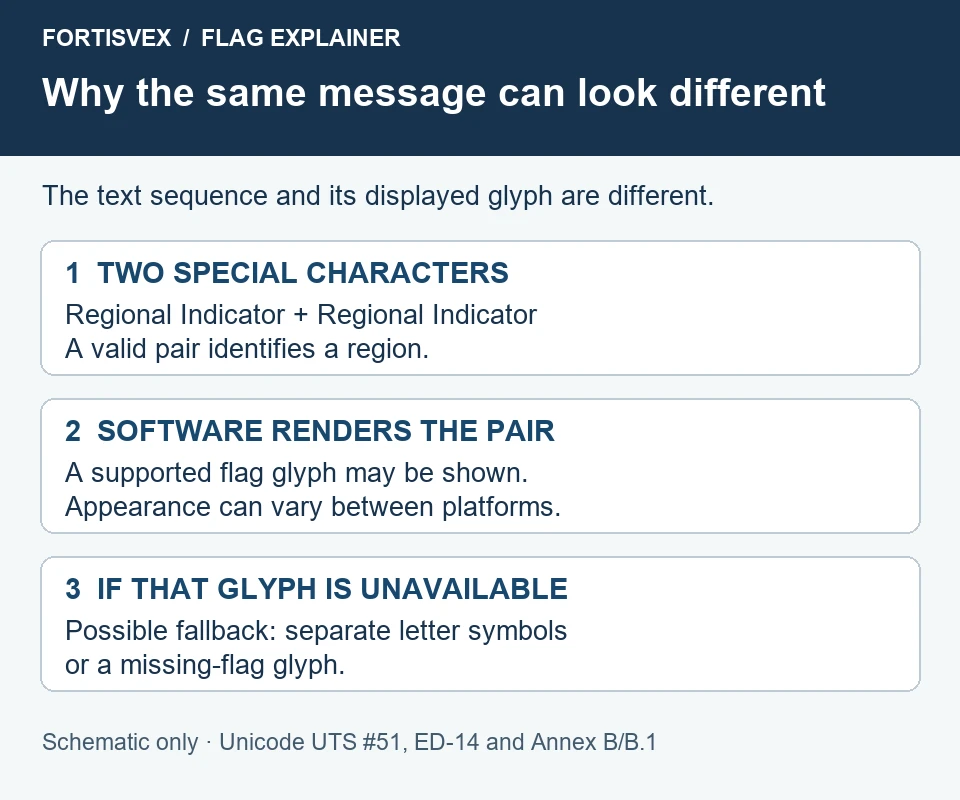
If a message displays unexpectedly, ask the recipient what application they are using and whether they see a picture, letters or a placeholder. Describe the intended country or region in ordinary text as well. That gives the conversation a clear reference without asking the recipient to identify a tiny or missing symbol.
The picture is not fixed by the message
Unicode explicitly distinguishes the region represented by a pair from a specific flag design. The displayed flag can vary between platforms and can change as flags and software change. Its presentation guidance also permits treatments that normalize flag shapes for a compact emoji display. A small icon's apparent proportions therefore should not be used as a dimensional reference for a cloth flag.
For a purchase enquiry, write the country or region name and the intended use instead of sending an emoji alone. If a particular historical or institutional version matters, identify it explicitly. A recipient recognizing the country does not settle which physical design you need. Nor does a colorful icon establish fabric, heading, reverse construction or finished size.
Carry the name into the product search
For example, an American-flag symbol in a message can start a conversation, but it cannot choose among the items in the FORTISVEX American flags collection. Open the actual product listing and compare its stated dimensions, material and attachment with your display. Do not infer these details from the emoji's outline, apparent folds or color.
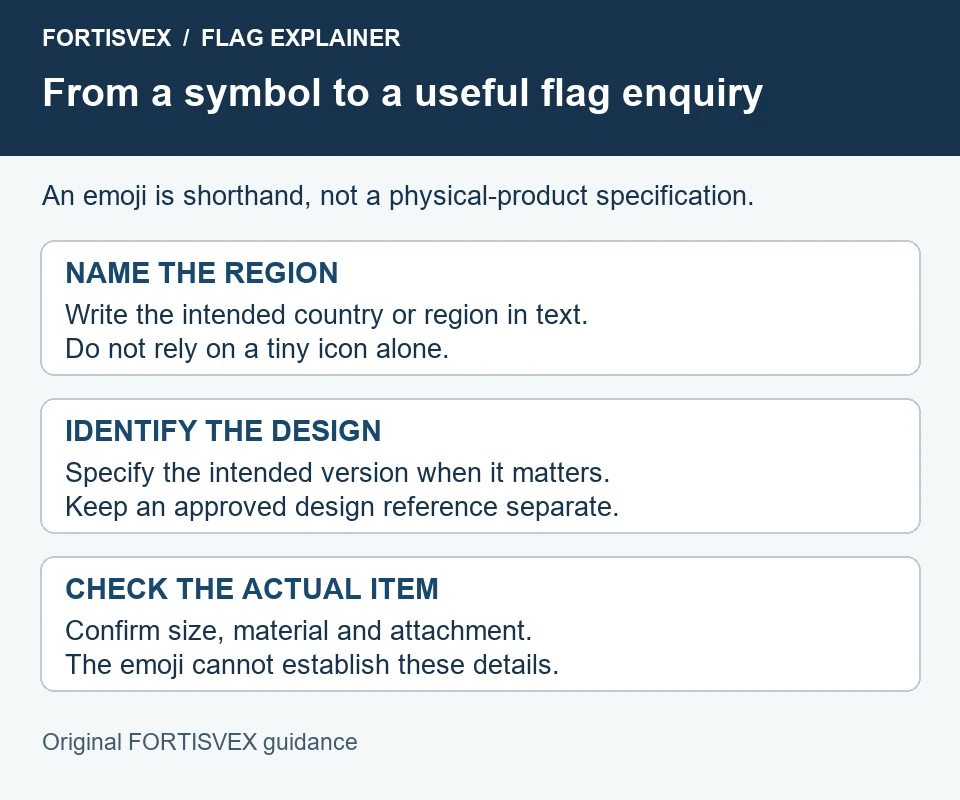
A useful enquiry might say: “I mean the current U.S. flag for an existing outdoor display. I will confirm the required size and attachment from the pole's instructions.” This keeps the identity clear while leaving unresolved equipment details open. It is more useful than asking someone to match the shape of an icon.
Use artwork when the job calls for artwork
If the flag is part of a custom design, an emoji pasted into a document does not settle what the final production artwork should contain. Keep the approved design reference separate from the conversational symbol. Our custom flag proof checklist covers the next stage: checking the actual artwork, orientation and written production details.
A screenshot can record what you saw, but it is still a screenshot of that rendering. It does not establish the underlying flag's official geometry or grant permission to reproduce someone else's artwork. For a newsletter or product explanation, choose a suitable image whose source and rights you can establish. Our guide to useful alternative text for flag photographs addresses describing that image once you have selected it.
What to do when the symbol looks wrong
Keep the intended name in the message, describe the unexpected display, and separate any software question from the physical flag enquiry. Do not promise that an update, another font or a particular application will fix every case. For buying or approving a flag, use the exact product details or approved design reference. The emoji can remain a convenient shorthand; it should not carry the whole specification.
Technical source: Unicode UTS #51, revision 31, definition ED-14 and Annex B/B.1. The explanation concerns regional-indicator flag sequences; it does not describe every kind of flag emoji.
Recent Posts
-
Charcoal Weber Kettle Cauliflower Steaks with Lemon-Caper Dressing
A cauliflower steak needs two things: enough of the central stalk to hold together and enough cooki …Nov 4th 2026 -
Why a Flag Emoji Can Appear as Two Letters
You send a country flag in a message, but another person sees two letters or a missing symbol. Befo …Nov 4th 2026 -
New Meadows, Idaho: The Depot That Kept Finding a Purpose
A railway depot can explain more than a train route. In New Meadows, the Pacific & Idaho Northern de …Nov 4th 2026