
Welcoming International Guests: Plan a Multi-Nation Flag Display
A display for visiting international guests begins with a different question from a display of the American flag beside a state flag: which flags represent sovereign nations? That distinction determines whether an arrangement with a taller center flagstaff is appropriate. A familiar domestic layout can send the wrong message when copied into an international welcome.
This guide explains the relevant U.S. Flag Code provisions and offers practical planning suggestions for a civilian event in the United States. It is not a diplomatic seating chart or a military color-guard manual. A formal delegation's protocol contact should review the final arrangement, including the participating countries and their order.
Start with a flag list, not a floor plan
Write down the identity of every flag before ordering or placing anything. Separate national flags from state, city and organizational flags. A country's flag belongs in the national group even when it is carried by a local cultural association. Conversely, the association's own banner does not become a national flag because its members have international connections.
Next, record what the event is actually doing: welcoming a foreign delegation, displaying the countries represented at a gathering, or presenting an American civic program with a state and organizational flag. These are different display problems. Resolving that purpose first prevents a last-minute decision to squeeze every available banner onto the same flagstaff.
If you need the U.S. member of the national group, compare the dimensions of the American flags at FORTISVEX with the other flags you intend to display. Choose the group as a set of compatible dimensions; do not select a much larger American flag first and assume the remaining flags will look equivalent beside it.
Equal height does not mean a shared flagstaff
Section 7(g) of the U.S. Flag Code calls for separate staffs of equal height when two or more nations' flags are displayed. It also calls for approximately equal flag sizes and states the peacetime international usage against displaying one nation's flag above another's.
Those are three checks, not one. Matching the flagstaff heights does not correct an oversized flag. Matching the fabric dimensions does not correct a taller flagstaff. Hanging two national flags on one halyard does not provide the separate staffs described in the provision.
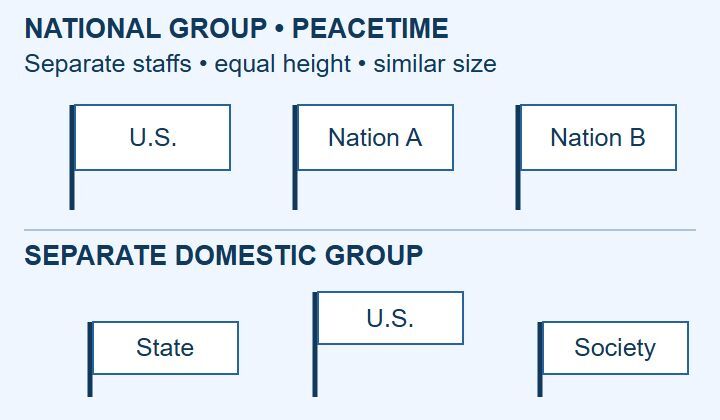
Read the diagram
- National group, in peacetime: the U.S. flag, Nation A and Nation B each have a separate staff of the same height. Their flags are approximately equal in size. The labels illustrate categories, not a prescribed country order.
- Separate domestic group: the U.S. flag is at the center and highest point, with the state flag and society pennant lower on either side. This domestic arrangement does not describe how to rank foreign national flags.
Do not alter a nation's design to make the display look uniform. “Approximately equal size” does not instruct an organizer to stretch artwork or crop a flag into a different shape. Confirm the intended flags and their dimensions before purchase. If the designs have different proportions, give that question to the event's protocol contact rather than inventing a numerical area formula that the cited section does not provide.
Why the domestic diagram is different
Section 7(e) addresses a group of state or locality flags or society pennants displayed from staffs: the U.S. flag is at the center and highest point. Section 7(f) addresses domestic flags on a common halyard or adjacent staffs. On the same halyard, the U.S. flag belongs at the peak; on adjacent staffs, it is raised first and lowered last. Those domestic provisions should not be used as a reason to put a foreign national flag beneath the American flag.
A straightforward planning option is to give the national display its own clearly identified grouping and treat any domestic display as a separate arrangement. That is an editorial planning suggestion, not a statutory requirement to divide a room into zones. The aim is to avoid an ambiguous mixed layout whose designer has applied the domestic hierarchy to visiting nations.
Check position as well as height
Equal-height national flags do not answer every question about precedence. Section 7(c) separately addresses the U.S. flag's position of honor and contains additional language about national and international flags, including a specific United Nations headquarters exception. Read it alongside section 7(g); do not reduce the full text to either “every foreign flag must be lower” or “position never matters.”
This guide does not assign an alphabetical order, a center-out sequence or a country-by-country ranking. Section 7(g) alone does not establish those details. For an official visit, supply the protocol contact with a labeled drawing showing the audience, entrance, speakers and every flag. Ask for approval of the actual arrangement, not merely confirmation that all flagstaffs have the same height.
Turn the plan into an equipment list
Once the arrangement is settled, count the separate supports and check the attachment method for each flag. A flag with grommets and a flag intended for a sleeve-style display may require different equipment. The diagram is not a compatibility specification, and matching color or appearance does not establish that a base and flagstaff fit together.
When reviewing FORTISVEX indoor display and parade accessories, compare the actual listing dimensions, intended use and included components with your plan. Keep flags, flagstaffs, bases and other required accessories as separate checklist items unless the particular listing explicitly includes them.
A final review before guests arrive
- Confirm each country's identity and the intended flag design with the event organizer.
- Check the national group's separate staffs, equal heights and approximately equal flag sizes.
- Verify the approved order from the audience's actual viewpoint.
- Keep domestic and national arrangements unambiguous; do not improvise a shared halyard for national flags.
- Compare the installed arrangement with the approved drawing, including any changes made during setup.
The useful distinction is simple: equal-height national display and domestic hierarchy solve different problems. Identify the flags first, choose the appropriate arrangement, and then buy the equipment that implements it. A deliberate welcome is more effective than a display assembled from whatever happens to be available.
Source: the U.S. Government Publishing Office's HTML edition of 4 U.S.C. §§5 and 7, especially subsections 7(c), (e), (f) and (g). Section 5 identifies the civilian rules-and-customs context; applicable agency regulations and event-specific protocol require their own review.
Recent Posts
-
Rupert, Idaho: Read the History Around the Town Square
Rupert’s historic square rewards a closer look than a quick photograph. Its buildings record change …Oct 29th 2026 -
Reading the Swiss Flag: Shape, Cross and Context
The Swiss flag is easy to recognize, but its simplicity rewards a closer look. Its ordinary national …Oct 29th 2026 -
Why the European Flag Keeps Twelve Stars
Twelve gold stars form a circle on a blue field. The European flag is easy to recognize, but its nu …Oct 29th 2026