
Rathdrum’s changing crossroads: rail connections, county government and a surviving jail
A railway stop and a county seat draw people for different reasons. In Rathdrum, those roles overlapped, then changed. Reading them separately makes the town’s history more interesting than a simple story of growth followed by decline: transportation routes shifted, government moved, buildings survived, and later generations found new uses for them.
A stop on a longer journey
Kootenai County’s history of Rathdrum describes a journey made in several stages. Miners left Northern Pacific trains at Rathdrum, traveled by stage to Coeur d’Alene, continued by steamboat toward the Old Mission, and followed the Mullan Road to the mines. Rathdrum was a transfer point within that network, not the destination of every traveler.
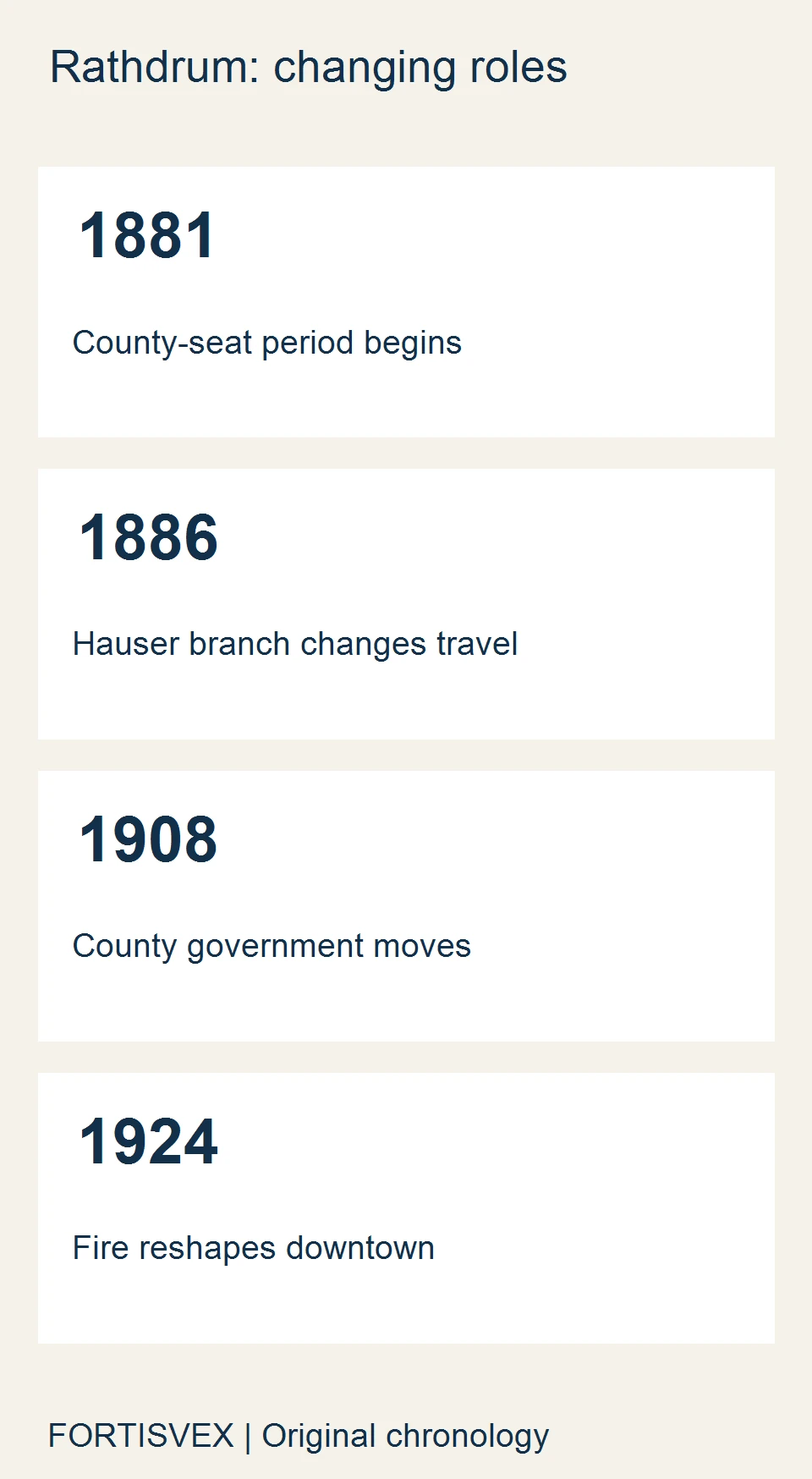
The county account identifies an important change in 1886: a branch railway from Hauser Junction to Coeur d’Alene reduced Rathdrum’s role as a supply point. This is a useful way to read a transportation history. Ask which connection changed and what journey it replaced, rather than assuming that the arrival of any railway benefited every nearby town equally.
County seat, 1881–1908
Both the city’s historical account and the county identify 1881 as the beginning of Rathdrum’s county-seat period and 1908 as the move to Coeur d’Alene. These dates describe the location of county government. They are not incorporation dates and should not be used as shorthand for the beginning or end of the community itself.
Rathdrum’s former jail gives that administrative history a physical focus. The Idaho Heritage Trust’s project record describes a building that combined a sheriff’s office with detention spaces. Its account identifies brick and stone masonry, offices flanking an entrance hall, a tall cage room and cells on an upper level. Those details explain a working arrangement: public business, supervision and confinement occupied the same building.
The Trust records preservation grants across several years, including roof repairs in 2012 and a shake-roof replacement in 2022. This is evidence of continued investment in the structure, not proof that every historic feature remains unchanged. A surviving building has a maintenance history as well as a construction history.
Fire changed the streetscape
The county’s account records major destruction in 1884 and again in August 1924. It connects the later fire with reservoirs that were nearly empty during repairs and describes extensive losses in the business district. This helps explain why looking at downtown today is not the same as looking at an untouched nineteenth-century streetscape.
A useful historic-building visit starts with questions rather than assumptions. Is the structure original to the site? Was its facade altered? Does a photograph show the same building, or a predecessor lost in a fire? The sources inspected here do not answer those questions for every address, so individual properties should not be assigned dates from the town’s general chronology.
If you are planning your own local-history display, distinguish historic objects from items chosen for the event today. The FORTISVEX Idaho nylon flag in 3 by 5 feet is one present-day display option; it should not be labeled as a flag used at the former jail or as a museum-endorsed product. Compare other configurations in the Idaho state flag collection against your display hardware.
Visit the museum as a museum, not a time capsule
The Rathdrum/Westwood Historical Society identifies the surviving site as the Old Kootenai County Jail Museum. When checked on October 30, 2026, its page said it was closed for the season and announced a June 5, 2027 reopening. Treat that as the operator’s posted plan and recheck before traveling; this article does not guarantee admission or a tour.
The museum offers a focused starting point for understanding Rathdrum’s earlier public life. Its value is not that it freezes the town at one moment. It lets a visitor connect a surviving place with changing routes, government responsibilities and the later work of preservation.
Recent Posts
-
South Korea’s Taegeukgi: Check the Four Trigrams and Artwork Orientation
The South Korea flag, known as the Taegeukgi, is a good example of why artwork review should go beyo …Nov 2nd 2026 -
Brazil Flag Artwork: Check the Star Map Before Approving the Proof
The blue globe on a Brazil flag rewards a closer look. When buying a flag or reviewing a production …Nov 2nd 2026 -
Mexico Flag: The Eagle Is Part of the Design, Not an Optional Logo
A Mexico flag can look familiar at a glance while still needing a closer artwork check. When compari …Nov 2nd 2026