
Fire Prevention Week, 2016: Historical Half-Staff Archive
Fire Prevention Week, 2016: Historical Half-Staff Archive
Historical record — not a current half-staff notice. FORTISVEX is an independent publisher, not a government agency. The explanation below is separate from the President's official text.
A week of prevention, a day of remembrance
Fire Prevention Week, 2016, brings two purposes into one proclamation: reducing the harm caused by fire and honoring the firefighters who respond to it. President Barack Obama designated October 9 through October 15 as the week-long observance. Within that week, he identified Sunday, October 9, for half-staff display at all Federal office buildings in honor of the National Fallen Firefighters Memorial Service.
Those intervals should not be merged. The proclamation does not direct a full week of half-staff display. Its flag provision names one Sunday, while its invitation to prevention programs and activities covers the broader observance. That distinction is particularly useful when an archive headline mentions a week but a facilities calendar needs the date of the flag action.
How the 2016 text connects prevention and service
The opening paragraphs move from residential fires to wildfire risk and the work of first responders. They discuss smoke alarms, evacuation plans, communication strategies, and the difficulty of fighting fires where development meets wildland. The closing appeal honors firefighters whose service included losing their lives while trying to save others. Prevention and remembrance are presented as related responsibilities: protecting communities also means recognizing the people who face danger on their behalf.
The numerical claims and safety recommendations in the official text belong to the 2016 proclamation. They are reproduced as historical statements, not presented as a freshly updated statistical report or a substitute for current emergency guidance. Its reference to “last year,” for example, refers to the year preceding this October 2016 instrument.
Reading the dates and scope precisely
The proclamation is dated October 7; the designated week began October 9; Federal Register publication followed on October 13. Publication did not move the October 9 flag observance to a later date. The half-staff clause cites Public Law 107–51 and specifies all Federal office buildings. This article does not expand that language into an express overseas-facilities list or a compulsory order for private households.
No numbered start or end time, sunset clause, or named time zone appears in this proclamation's half-staff sentence. The archive therefore records October 9 as the specified day without manufacturing a clock-time interval. The complete language below lets readers distinguish the flag provision from the broader invitation to take part in appropriate programs and activities.
Source for the proclamation's dates, language, and scope: Federal Register record for Proclamation 9517 of October 7, 2016. The original published pages are available below. These historical dates are separate from the website publication date of this article.
Full official proclamation text
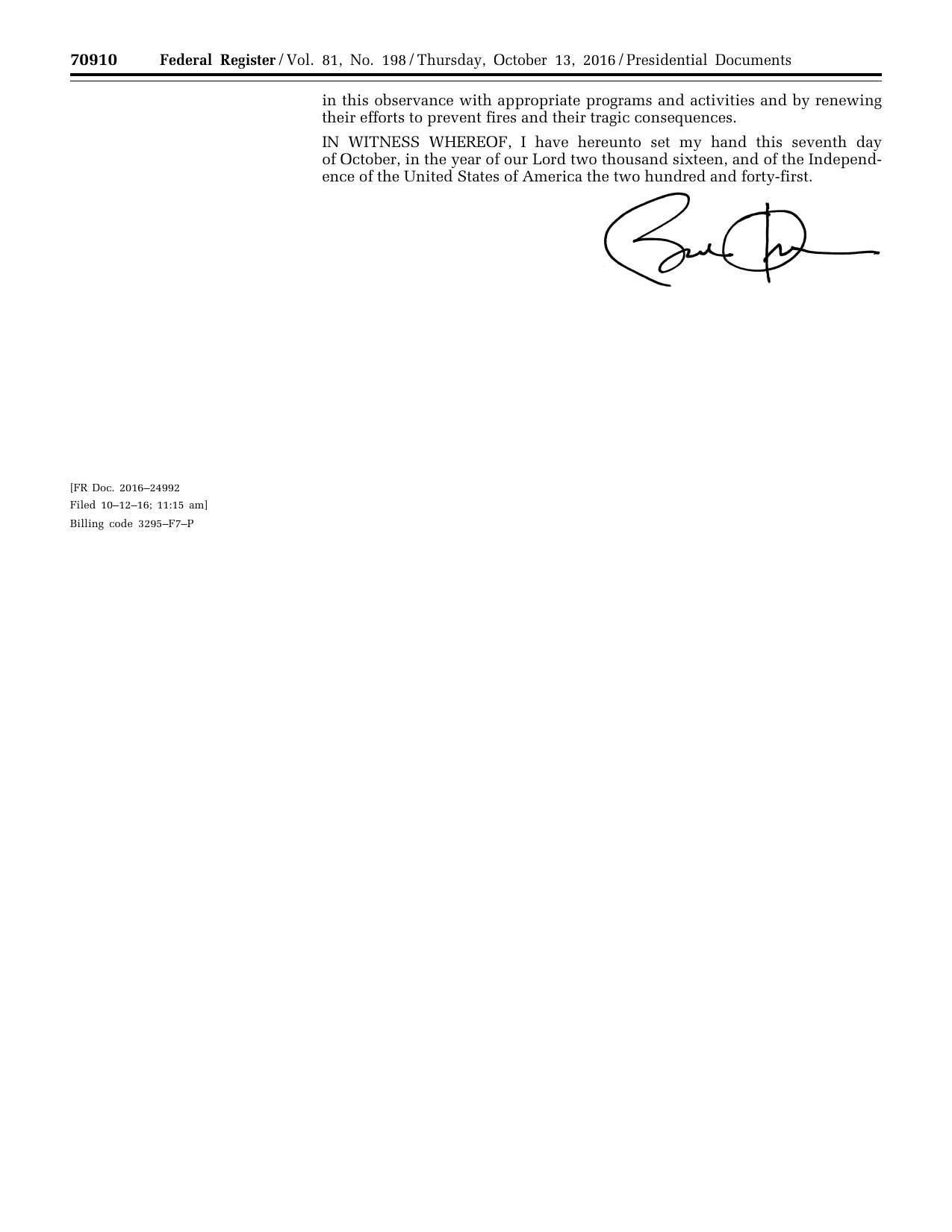
Federal government text. Line wrapping and page-break hyphenation are normalized; page furniture is omitted. The reproduced signature is shown below.
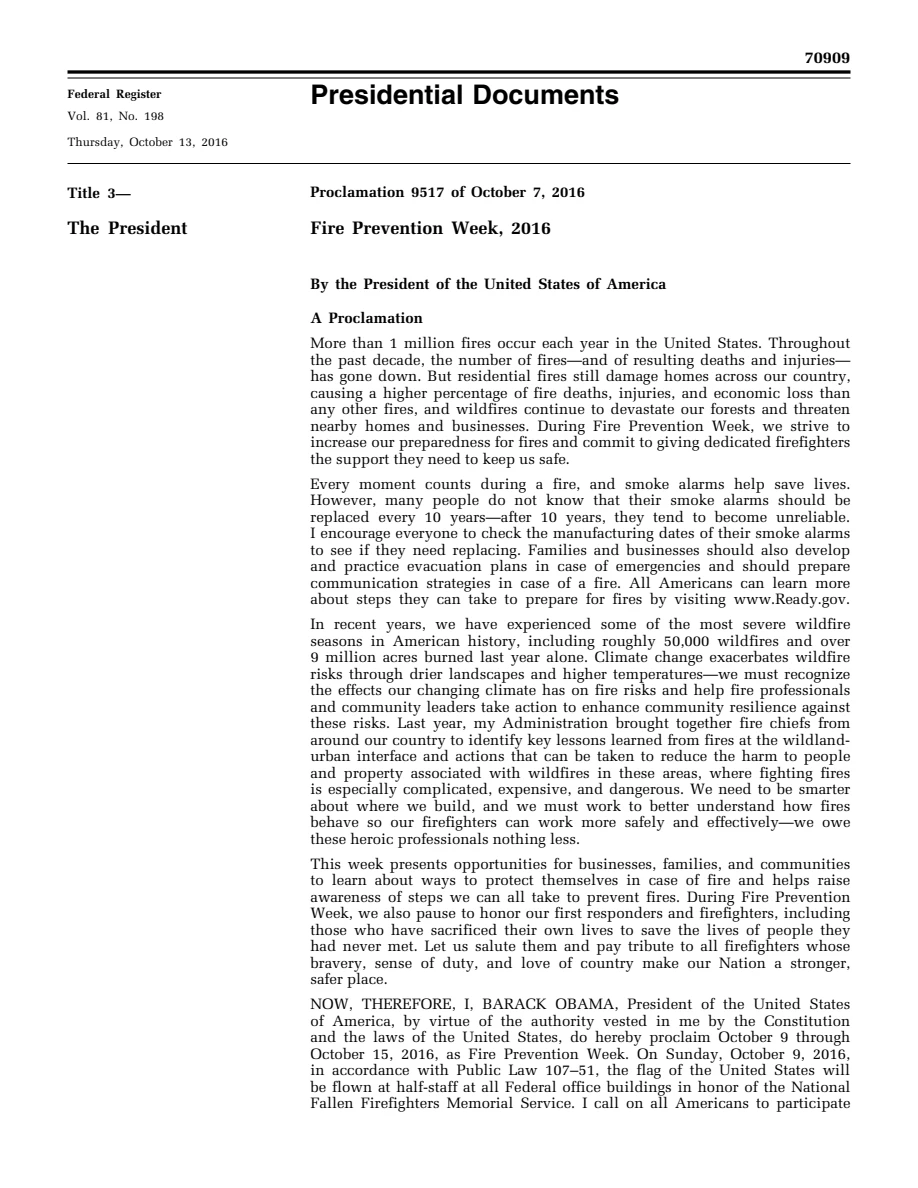
Proclamation 9517 of October 7, 2016 Fire Prevention Week, 2016 By the President of the United States of America A Proclamation
More than 1 million fires occur each year in the United States. Throughout the past decade, the number of fires—and of resulting deaths and injuries— has gone down. But residential fires still damage homes across our country, causing a higher percentage of fire deaths, injuries, and economic loss than any other fires, and wildfires continue to devastate our forests and threaten nearby homes and businesses. During Fire Prevention Week, we strive to increase our preparedness for fires and commit to giving dedicated firefighters the support they need to keep us safe.
Every moment counts during a fire, and smoke alarms help save lives. However, many people do not know that their smoke alarms should be replaced every 10 years—after 10 years, they tend to become unreliable. I encourage everyone to check the manufacturing dates of their smoke alarms to see if they need replacing. Families and businesses should also develop and practice evacuation plans in case of emergencies and should prepare communication strategies in case of a fire. All Americans can learn more about steps they can take to prepare for fires by visiting www.Ready.gov.
In recent years, we have experienced some of the most severe wildfire seasons in American history, including roughly 50,000 wildfires and over 9 million acres burned last year alone. Climate change exacerbates wildfire risks through drier landscapes and higher temperatures—we must recognize the effects our changing climate has on fire risks and help fire professionals and community leaders take action to enhance community resilience against these risks. Last year, my Administration brought together fire chiefs from around our country to identify key lessons learned from fires at the wildland-urban interface and actions that can be taken to reduce the harm to people and property associated with wildfires in these areas, where fighting fires is especially complicated, expensive, and dangerous. We need to be smarter about where we build, and we must work to better understand how fires behave so our firefighters can work more safely and effectively—we owe these heroic professionals nothing less.
This week presents opportunities for businesses, families, and communities to learn about ways to protect themselves in case of fire and helps raise awareness of steps we can all take to prevent fires. During Fire Prevention Week, we also pause to honor our first responders and firefighters, including those who have sacrificed their own lives to save the lives of people they had never met. Let us salute them and pay tribute to all firefighters whose bravery, sense of duty, and love of country make our Nation a stronger, safer place.
NOW, THEREFORE, I, BARACK OBAMA, President of the United States of America, by virtue of the authority vested in me by the Constitution and the laws of the United States, do hereby proclaim October 9 through October 15, 2016, as Fire Prevention Week. On Sunday, October 9, 2016, in accordance with Public Law 107–51, the flag of the United States will be flown at half-staff at all Federal office buildings in honor of the National Fallen Firefighters Memorial Service. I call on all Americans to participate in this observance with appropriate programs and activities and by renewing their efforts to prevent fires and their tragic consequences.
IN WITNESS WHEREOF, I have hereunto set my hand this seventh day of October, in the year of our Lord two thousand sixteen, and of the Independence of the United States of America the two hundred and forty-first.
Read the original published document
Read the original published pages
Historical document reproduced from the Federal Register. FORTISVEX is an independent publisher, not a government agency. Select an enlarge link to inspect a page at its full image size. The complete selectable proclamation text remains in the article above.
Open the original official PDF or download the source PDF. Your browser may open the PDF before offering a download control.
To read the original PDF file, open the official PDF or download the source document. Your browser may open the file before offering its download control.
These full-page images reproduce the official published document. They are not a native PDF viewer. Use the original PDF links to open or download the PDF file; the complete transcription supplies selectable text.
Recent Posts
-
Bovill, Idaho: Reading a Town’s History Through Family, Main Street and Celebration
Bovill, Idaho: Reading a Town’s History Through Family, Main Street and Celebration A family standi …Nov 4th 2026 -
Troy, Idaho: A Town Remembered Through Names, Rails And Main Street
Troy, Idaho: A Town Remembered Through Names, Rails And Main Street Troy sits in Latah County on the …Nov 4th 2026 -
Georgetown, Idaho: Twin Creeks, Stringtown and a Community Remembered
Georgetown, Idaho: Twin Creeks, Stringtown and a Community Remembered Georgetown's history has more …Nov 4th 2026