
McCall beyond the lake view: timber, fire protection and the records that connect them
McCall’s history is easier to understand when the town’s buildings and photographs are read alongside the work of protecting surrounding forests. An early street photograph, a fire warden’s house and the smokejumper program offer three different perspectives. They show a community taking shape, a permanent base for forestry work and a way to reach fires across difficult country.
This is a historical reading guide, not a promise of current building access or a complete account of McCall. The city’s official website provides the municipal starting point; the evidence below comes from local archival records, the museum that cares for historic buildings and the Forest Service.
Start with a photograph, not a founding legend
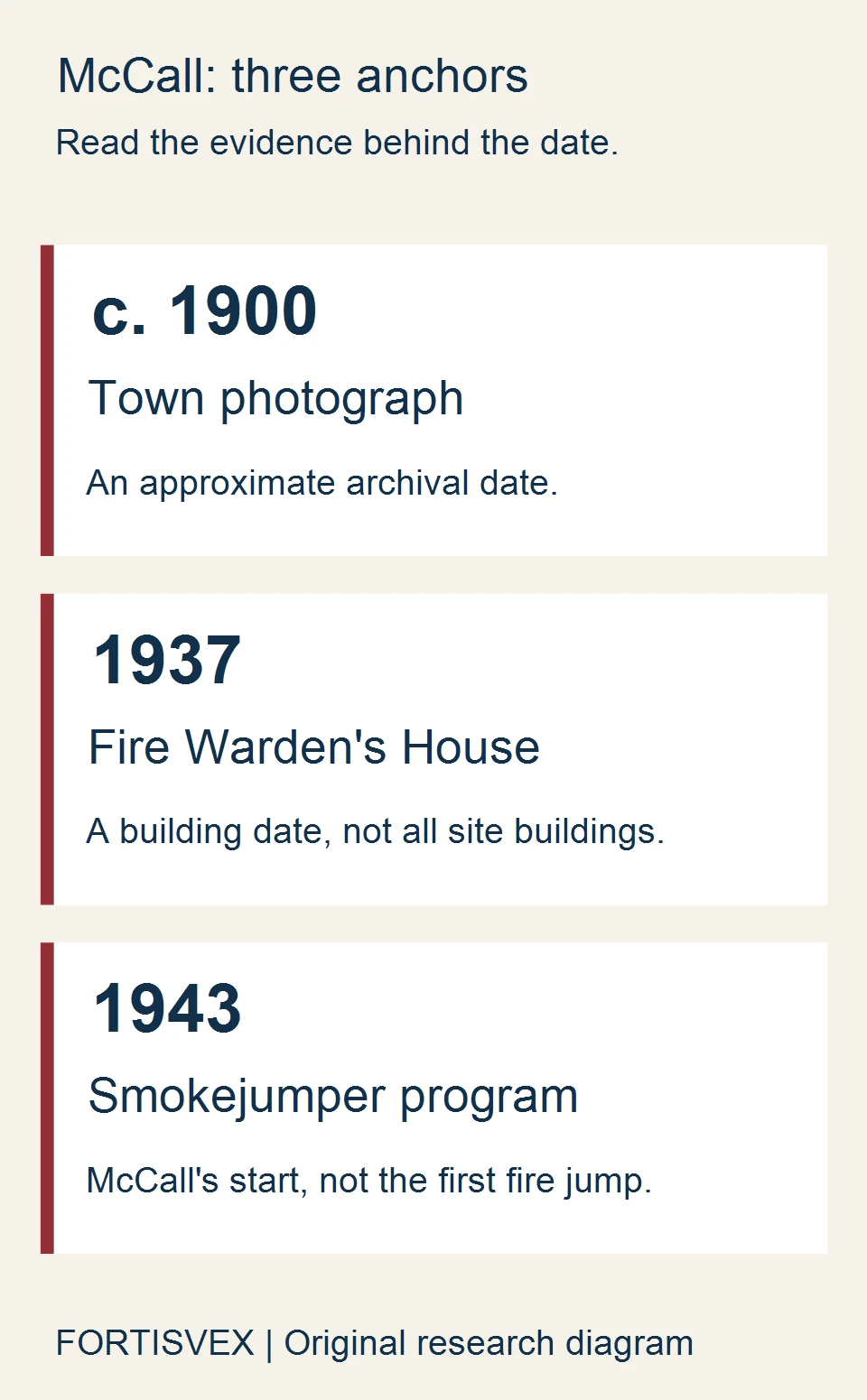
The McCall Public Library Collection includes “McCall with Lake Saloon,” dated approximately 1900. Its catalog description identifies buildings under construction, a fallen tree and the saloon in the background. Those details make the record useful for asking how a town developed: what was being built, what occupied the street and what the photographer chose to include.
The approximate date matters. A catalog label of circa 1900 is not evidence that every structure pictured was erected in that year. Nor does the photograph by itself establish an incorporation date. The source identifier, 1.24, is a better starting point for further research than an attractive but undocumented caption copied from elsewhere.
A fire warden’s house makes forestry history tangible
The Central Idaho Historical Museum’s own history identifies the Fire Warden’s House as a three-story log building constructed in 1937. It describes American Rustic architecture with Finnish influence. That gives the reader a concrete subject to investigate: a building associated with forest protection, rather than simply a picturesque old house.
The state tourism office’s museum listing connects the site’s exhibits with logging, the McCall Mill, fire lookouts and forestry. Read together, the building and exhibit descriptions make the museum a place to explore how timber work and fire protection overlapped. They do not establish the operating dates of every mill or the details of every exhibit.
The museum also identifies a continuing preservation role: collecting photographs and oral histories, maintaining the site and sharing its history. For readers, that is a reminder that a historic place has both an earlier working life and a later life as something a community chooses to care for.
1943: reaching the fire from the air
The Forest Service’s smokejumping history places McCall within a larger sequence. It dates a proposal for parachuting firefighters to 1934, an experimental program in the Pacific Northwest to 1939 and the first fire jump to 1940 on the Nez Perce National Forest. McCall’s program began in 1943. These are separate milestones; McCall’s establishment should not be described as the first fire jump.
The agency explains the operational idea: self-sufficient firefighters could reach difficult terrain quickly and arrive ready to work. This gives the 1943 date meaning beyond a timeline entry. The local program belongs to a story about how people reached fires, supplied crews and organized a response. A historical account does not, however, establish today’s aircraft roster, staffing or visitor arrangements.
For a community-history exhibit that also includes a present-day flag display, compare the FORTISVEX 3 by 5 foot Idaho nylon flag with the mounting arrangement you plan to use. Keep that modern display separate from archival photographs: the flag is not evidence of what appeared in an early McCall street scene.
Use the history without turning it into a promise
For a visit, check the museum’s current information before planning around an interior tour. Its homepage displayed a closure for the 2026 season when checked on October 30, 2026. That is a dated observation, not a permanent opening-hours statement. The historical sources likewise do not establish public access to an operational firefighting base.
For a local exhibit, keep a short source label beside each image or object: what it is, who holds it, the date or date range and what remains uncertain. That approach preserves the distinction between an early-town photograph, a surviving building and an agency’s program history. It also lets McCall’s specific evidence carry the story, without reducing the town to a generic resort narrative.
Recent Posts
-
South Korea’s Taegeukgi: Check the Four Trigrams and Artwork Orientation
The South Korea flag, known as the Taegeukgi, is a good example of why artwork review should go beyo …Nov 2nd 2026 -
Brazil Flag Artwork: Check the Star Map Before Approving the Proof
The blue globe on a Brazil flag rewards a closer look. When buying a flag or reviewing a production …Nov 2nd 2026 -
Mexico Flag: The Eagle Is Part of the Design, Not an Optional Logo
A Mexico flag can look familiar at a glance while still needing a closer artwork check. When compari …Nov 2nd 2026