
Two Flag Raisings at Iwo Jima: Read the Photographs in Sequence
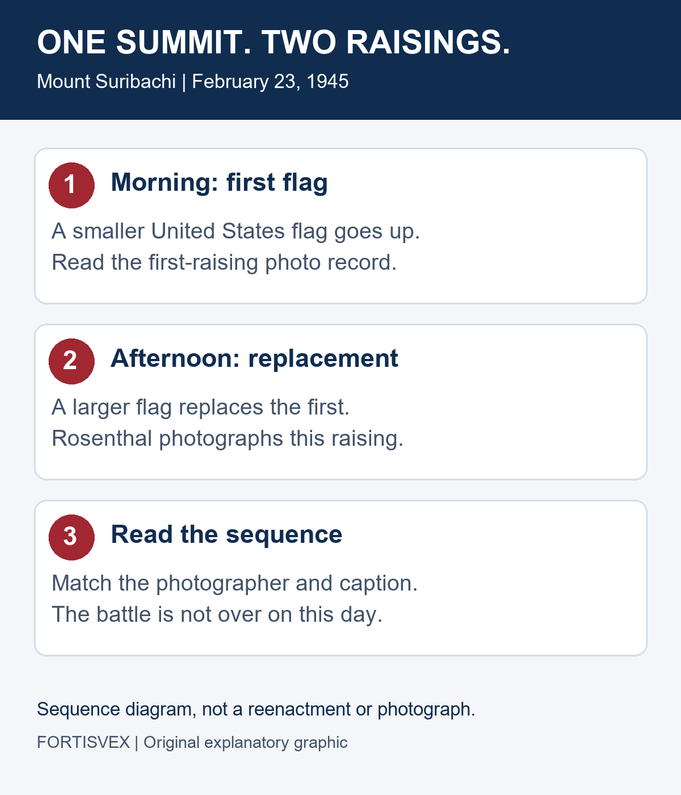
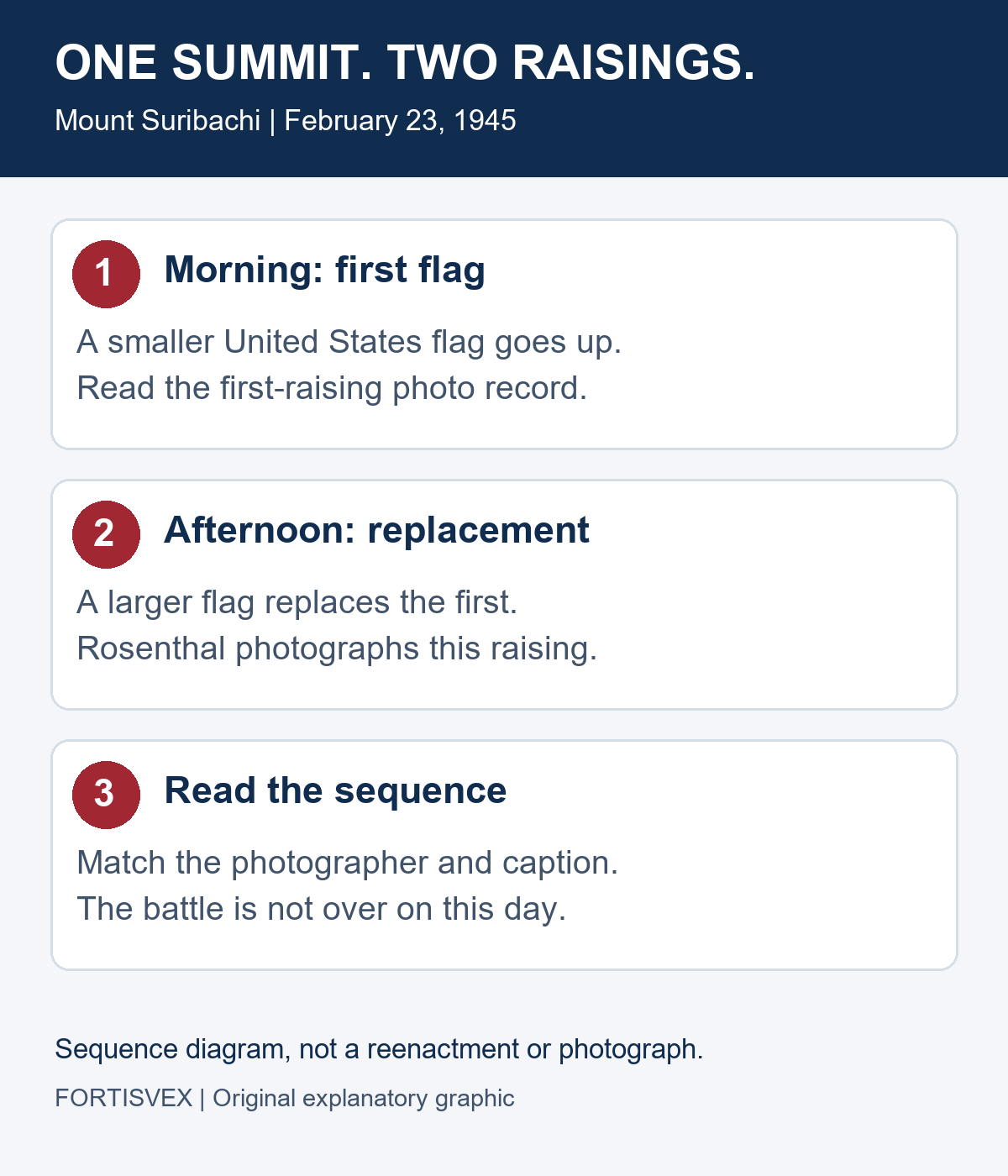
A familiar photograph can make a complicated day look like a single event. On February 23, 1945, Americans raised two United States flags on Mount Suribachi, Iwo Jima. The first flag announced that Marines had reached the summit. A larger replacement went up later that day. Joe Rosenthal's famous photograph shows that second raising.
Keeping those events separate changes how you read the pictures. A photograph of the first flag is not an unsuccessful version of the famous image, and the second flag is not evidence that the first event never happened. Each belongs to a different point in the same day's record.
The sequence before the symbolism
The National Museum of the Marine Corps account places the two raisings on February 23. Marines first raised a small flag on the summit. Later, other troops raised a larger one as the original was lowered. The museum also makes a crucial point that a cropped photograph cannot: the battle for Iwo Jima lasted 36 days. The summit scene was a milestone within the battle, not its ending.
The National Park Service interpretation of the two raisings explains the practical visibility issue. The first flag was difficult to see from distant fighting positions; the replacement was larger. That distinction helps explain why two flags appear in the record without turning either into a mere prop.
First, read a photograph of the first flag
The USMC Archives first-raising photograph is identified as an official Marine Corps photograph from the Louis R. Lowery Collection. Open the archival record and read its title and collection credit before examining the scene. These details connect the image to the first event rather than to Rosenthal's later photograph.
Now separate what you can see from what the catalog tells you. A visible flag, the people around it and the terrain are visual evidence. The event's identity, photographer and date need the accompanying record. Do not assume that every person visible near a flag was one of the people who lifted its flagpole, or that a photograph necessarily catches the precise instant the flag first became upright.
Then examine Rosenthal's second-raising image
The National Archives record of Rosenthal’s photograph identifies the image as National Archives Identifier 520748, local identifier 80-G-413988. It credits Joe Rosenthal, who was working for the Associated Press, and dates the photograph February 23, 1945. The archive also traces its later significance as the model for the Marine Corps War Memorial.
Use that identified image for the second step of the comparison. Notice the collective effort around the angled flagpole and the way the action fills the frame. Those are observations about a composition. They do not, by themselves, establish the names of the men, the exact time of day or what happened elsewhere on the island.
The NPS history of the Marine Corps War Memorial supplies the broader sequence: the small flag was visible in the morning, and the larger replacement was raised that afternoon. The memorial was dedicated on November 10, 1954. Although its form follows the second raising, its dedication reaches beyond that one day to Marines who died in service since 1775.
A practical method for comparing historical photographs
- Keep each image attached to its own record. Copy the institution, item identifier, photographer credit and caption into your classroom notes or display plan. A detached image loses the evidence that makes the comparison useful.
- Arrange by event, not by fame. Put the first-raising record before the second-raising record. Do not let the picture you recognize best become the beginning of the story automatically.
- Describe before interpreting. Start with visible actions and objects. Then add the historical facts supplied by the source. This keeps an observation such as “the flagpole is angled” separate from a claim about why it was being raised.
- Distinguish a photograph, a flag and a monument. A photograph records a viewpoint; a surviving flag is an artifact; a later sculpture commemorates. They can illuminate one another without being interchangeable evidence.
- Check the caption's research history. An older printed label can preserve an identification that an institution later corrected.
Build a display that tells the whole story
For a classroom, veterans' program or family history display, a short paired caption is more useful than a grand claim. Label one record “first flag on the summit” and the other “larger replacement flag,” then give February 23, 1945, the photographer or collection credit, and a source link. Add a sentence that the battle continued. That gives viewers a chronology they can follow and evidence they can revisit.
If you include a newly made flag, describe it as a modern display item. It is not either surviving Iwo Jima flag simply because it resembles a period design. Our guide to choosing a historical flag reproduction explains why a star count alone cannot establish an exact artifact match.
History and remembrance also answer different questions. To plan a specific annual observance, use our Pearl Harbor history and December 7 flag guide; the Iwo Jima photographs do not themselves prescribe today's flag-display schedule.
Choose a flag for your present-day display
For a current U.S. flag, explore the FORTISVEX American flag collection and compare the listed size, material and attachment details with your flagpole. Keep a modern purchase separate from the historical identity of the two flags discussed here.
Source and image notes
This guide uses the official HTML records linked beside the relevant discussion. The graphic is original FORTISVEX explanatory artwork. Historical photographs remain linked to their institutional records; the AP photograph is not reproduced here under an assumed government-image license.
Recent Posts
-
South Korea’s Taegeukgi: Check the Four Trigrams and Artwork Orientation
The South Korea flag, known as the Taegeukgi, is a good example of why artwork review should go beyo …Nov 2nd 2026 -
Brazil Flag Artwork: Check the Star Map Before Approving the Proof
The blue globe on a Brazil flag rewards a closer look. When buying a flag or reviewing a production …Nov 2nd 2026 -
Mexico Flag: The Eagle Is Part of the Design, Not an Optional Logo
A Mexico flag can look familiar at a glance while still needing a closer artwork check. When compari …Nov 2nd 2026