
One Proclamation, Several Dates: Reading a Historical Presidential Document
The day a document was issued, the day it appeared in the Federal Register and the period it describes can all differ. A careful reading keeps them separate.
The Federal Register is a publication, not the event itself
The National Archives describes the Federal Register as the federal government’s official journal, containing presidential documents alongside rules and notices. The Office of the Federal Register prepares it with the Government Publishing Office. A date attached to an issue identifies that publication. It does not automatically mean every event described inside happened that day. Think of the issue date as one part of the document’s publication record. It is valuable for finding and citing the text, but it must be read alongside the heading and the body rather than substituted for them.
A historical example with three separate dates
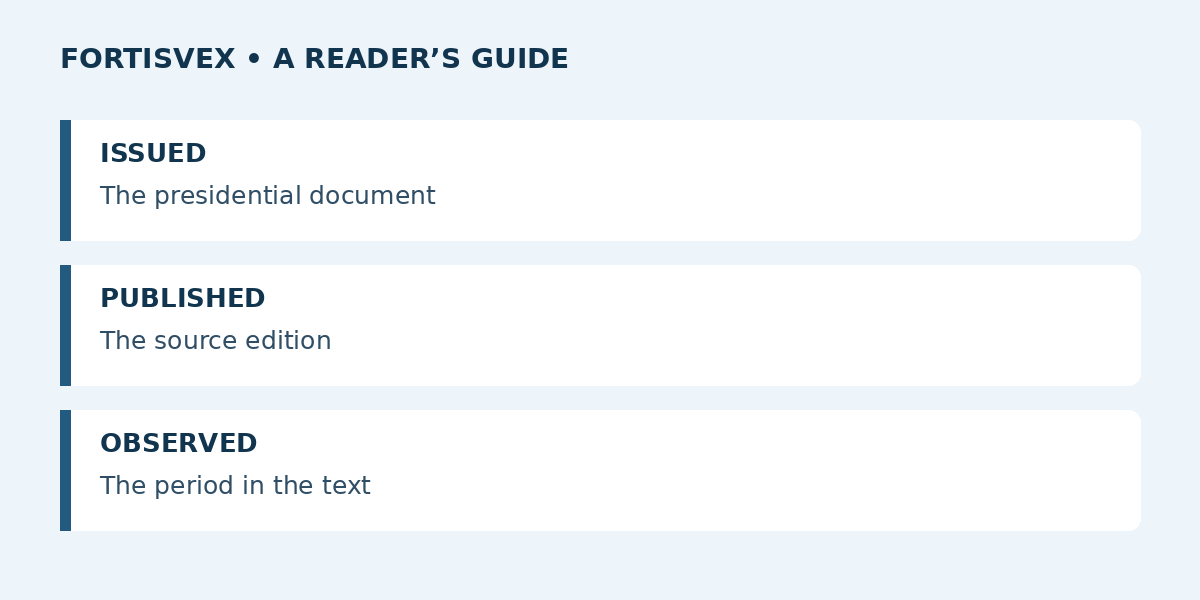
Peace Officers Memorial Day and Police Week, 2014, provides a straightforward example. Its formal heading identifies Proclamation 9123 of May 9, 2014. The Federal Register publication is dated May 14. The observance described in the proclamation includes Peace Officers Memorial Day on May 15. These dates answer three different questions. A timeline of issuance should not quietly use May 14 in place of May 9; a caption about the observance should not call May 9 the memorial day. The Federal Register’s historical record lets readers inspect those distinctions directly.
Look for the sentence that actually gives the instruction
A title can identify the occasion without stating the complete schedule or scope. Read the operative paragraph and note who is addressed, what action is requested or directed, and what beginning or ending language appears. A week-long observance can contain a single-day flag instruction. A document may refer to noon, sunset or a condition instead of a simple date range. Preserve that language in your notes. Do not convert a conditional endpoint into a fixed calendar date unless another reliable source establishes the condition. This is a method for historical reading, not a determination that any old instruction applies today.
Keep website dates in their own lane
An archive article may be created years after the original document. Its website date belongs to the later editorial presentation unless the site clearly explains a different convention. Likewise, an updated date may identify a change to the page rather than a new presidential action. When sharing a historical link, include the original document year in your sentence so that the preview card cannot make the record look like a fresh notice. Our presidential half-staff archive is a historical reference collection; historical dates do not imply that FORTISVEX published an article when the original proclamation was issued.
Record identifiers before shortening a citation
Save the title, proclamation number if present, formal date, publication date, document number and source URL. Those fields provide several routes back to the same record. The National Archives’ Federal Register tutorial explains that published corrections can identify documents by headings, document numbers, page numbers and publication dates. A title alone can be a weak search key when similar observances recur every year. Your public caption can remain concise, but the working citation should be precise enough for another reader to reproduce your research.
Know which collection you are searching
The Federal Register and the Compilation of Presidential Documents are related sources with different roles. The Archives identifies the compilation as an official publication of presidential materials, and its Federal Register tutorial points researchers toward broader presidential collections for a more comprehensive record of statements and directives. A search that finds no match in one collection is therefore not permission to declare that nothing happened. Record where you searched, which terms you used and what dates the search covered. That turns an unsuccessful search into a useful research note instead of an unsupported historical conclusion.
Use a small date table when the distinction matters
For a classroom handout or a research notebook, make a row for each date and give it a plain-language label: “document issued,” “published in the Federal Register,” “observance or instruction,” and “web article posted.” Leave a row blank if the source does not establish it. Then read the table against the original record. If a date appears only in your notes and cannot be found in the cited source, investigate before sharing. This approach also makes corrections easier: a later discovery can change one field without rewriting the entire chronology.
Sources and further reading
Recent Posts
-
South Korea’s Taegeukgi: Check the Four Trigrams and Artwork Orientation
The South Korea flag, known as the Taegeukgi, is a good example of why artwork review should go beyo …Nov 2nd 2026 -
Brazil Flag Artwork: Check the Star Map Before Approving the Proof
The blue globe on a Brazil flag rewards a closer look. When buying a flag or reviewing a production …Nov 2nd 2026 -
Mexico Flag: The Eagle Is Part of the Design, Not an Optional Logo
A Mexico flag can look familiar at a glance while still needing a closer artwork check. When compari …Nov 2nd 2026