
How a Community Flag Library Can Handle Reservations, Renewals and Late Returns
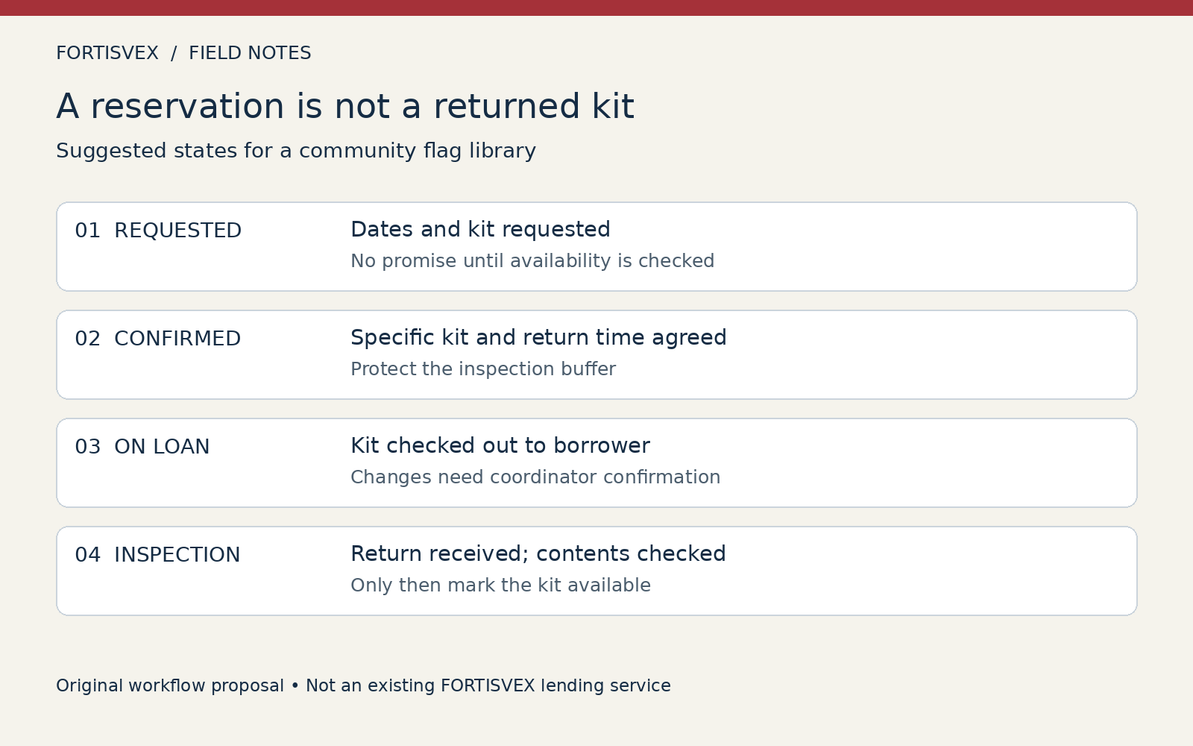
A community flag library needs more than a calendar with names on it. A request for a flag is not yet a confirmed loan, and a returned bag is not yet a kit ready for the next borrower. Separating those states makes reservations easier to explain and prevents one late return from silently disrupting several events.
The following is a proposed operating model for a volunteer-run flag collection, not a description of a FORTISVEX lending service. Adopt it only after your organization chooses its own borrowing, privacy and replacement-cost policies.
Borrow the idea, not another library’s entire policy
Published Library of Things policies offer useful contrasts. Indianapolis Public Library’s posted pilot FAQ uses reservations and does not allow renewals; it also requires returns to the checkout branch. Its page describes a pilot ending September 15, 2026, so treat it as a documented policy example, not a statement that the pilot is still available. See the published Indianapolis FAQ.
In Ashburnham, Massachusetts, the Stevens Memorial Library policy generally allows three-week loans and up to two renewals unless someone is waiting, while certain special items have shorter, nonrenewable loans. Things go through the circulation desk, not the book drop. The lesson is not that flags should have either loan period. It is that renewal rules and item exceptions should be stated before a borrower makes plans.
Read the source policy
If the PDF does not display, open the policy PDF in a new tab or use your browser’s download control to save it.
Give each kit an identity and a buffer
Assign a stable kit number to each lendable unit, such as CL-012. Keep its contents and condition record separate from the reservation list. For a collection of American flags, a flag, carry bag and specified accessories can travel as one kit; two similar flags should not share an identity simply because they have the same design.
Reserve time for checking and drying a returned kit before promising it again. For example, a Friday-to-Sunday event might have Thursday pickup and Monday return, with Tuesday reserved for inspection. That is an illustrative schedule, not a required minimum. Choose a buffer your volunteers can actually cover.
Confirm a particular kit, not a vague promise
Collect the event date, pickup and return windows, kit requested, and one contact route. For state flags, record the specific state and design on the kit record rather than only “state flag.” Avoid putting private contact details in a publicly shared calendar. A public view can show kit numbers and unavailable dates; borrower records can remain with the authorized coordinator.
A confirmation should name the kit number, pickup window, exact return deadline, return location and the way to report a delay. State what happens if the pickup window is missed. If the borrower only needs the flag for Saturday, do not reserve an entire week by default unless your staffing makes that necessary.
Make renewals a decision, not an assumption
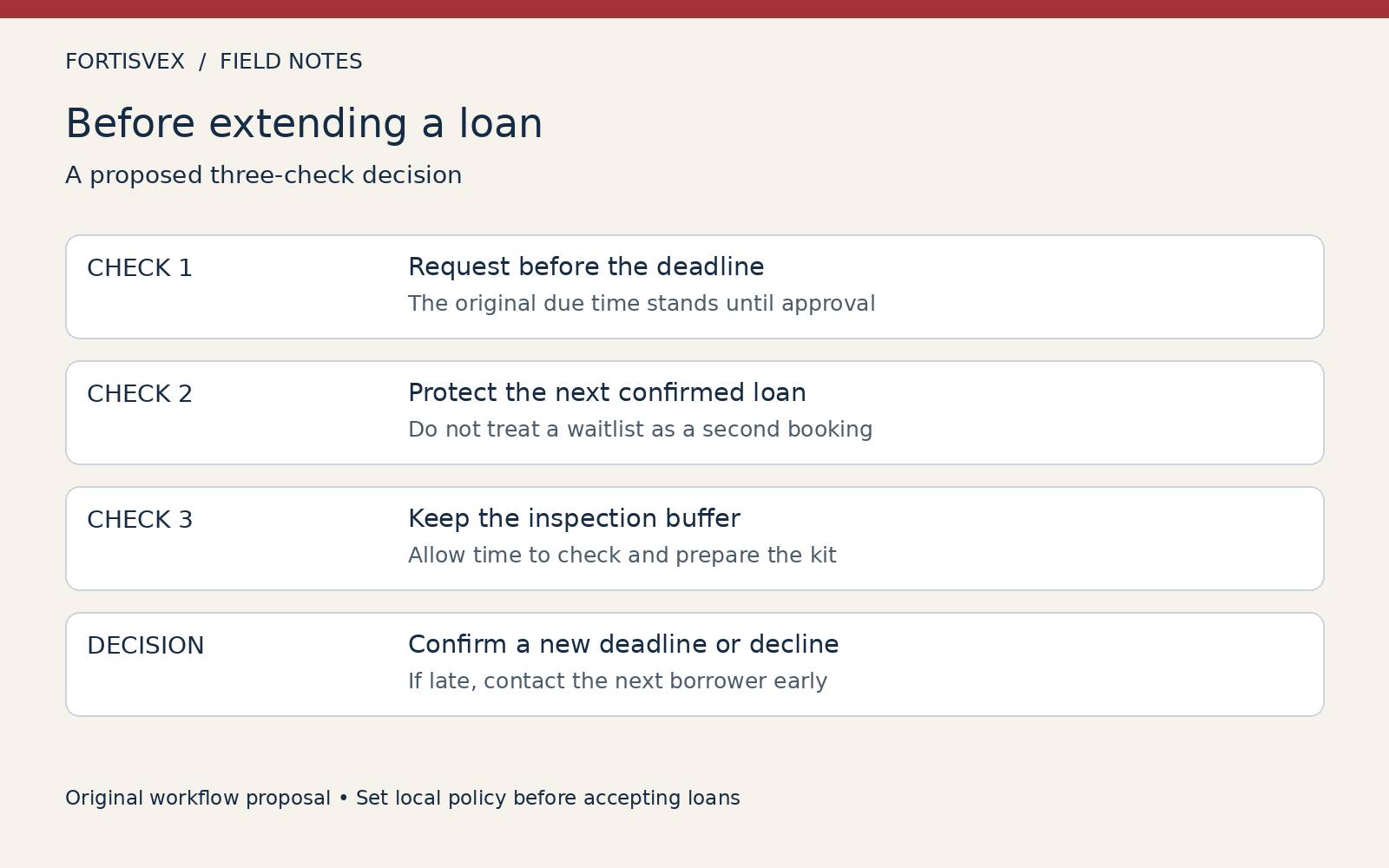
Ask borrowers to request an extension before the due time. The coordinator checks the next confirmed loan, the inspection buffer and any planned program use. If all three remain protected, record a new deadline and send it to the borrower. Until that confirmation arrives, the original deadline still applies.
A waitlist is not a second reservation. Record the requested dates and contact sequence, then make a fresh offer when a suitable kit is actually available. Give that offer an expiry time so volunteers do not leave a kit indefinitely on hold for someone who has already found another solution.
Handle a late return without losing the next booking
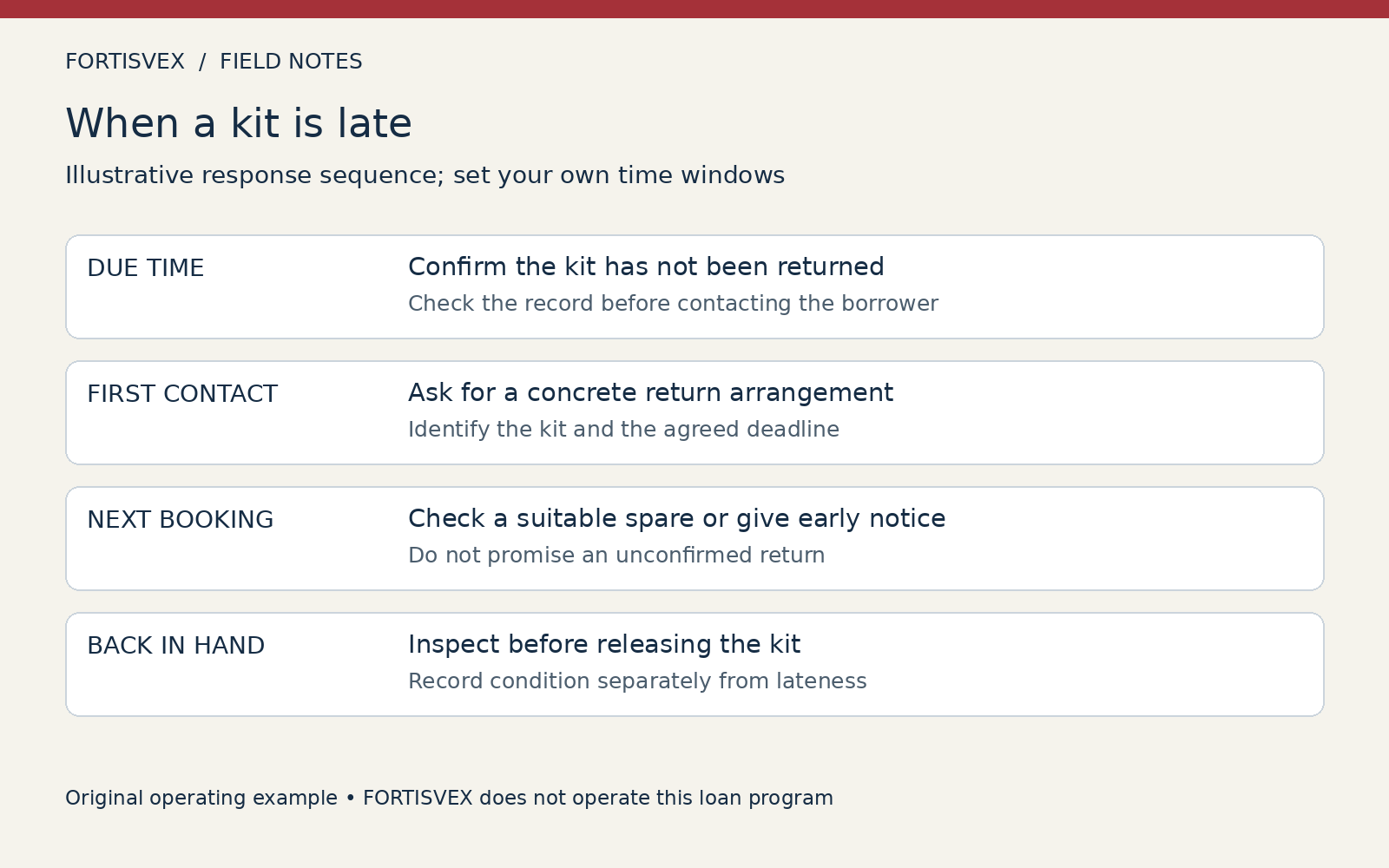
Start with a factual message: which kit is overdue, when it was due, and how to arrange its return. Do not promise the waiting borrower that it will arrive shortly until you have confirmation. Check for a genuinely equivalent spare; if none exists, contact the next borrower early enough to make another plan.
When the kit comes back, move it to inspection rather than straight to available. Record missing pieces or damage against the kit record. Apply only the replacement or repair process your organization disclosed, with a way to correct a mistaken assessment. A late return is a scheduling problem; a damage charge is a separate decision.
Keep a small collection dependable
Review missed pickups, late returns and turnaround time after the first few events. A recurring delay may mean the return window is impractical, not that the policy needs harsher language. Adjust future bookings rather than rewriting a promise already made.
Keep educational reading separate from the loan agreement; the history and reference section is a starting point for that background. The best reservation system is one a substitute volunteer can follow without guessing what the last person promised.
Recent Posts
-

Poland and Indonesia: Check the Top Band Before the Size
Poland and Indonesia both use red and white in two equal horizontal bands. The quickest distinction …Nov 18th 2026 -

Sweden and Finland: Compare the Crosses at the Same Height
Sweden’s yellow cross on blue and Finland’s blue cross on white share a familiar arrangement: the up …Nov 18th 2026 -

Charcoal-Kettle Savoy Cabbage Wedges with Mustard Vinaigrette
Savoy cabbage’s crinkled leaves catch a little oil and brown at their edges, while the thicker base …Nov 18th 2026