
FORTISVEX
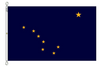
Alaska 12x18 Feet Nylon State Flag Made in USA

- MPN:
- FPAMSTAKNYL12x18D
- Availability:
- Free Shipping*
- Shipping:
- Calculated at Checkout




Description
Two hundred and sixteen square feet puts a 12x18 foot flag in major-installation territory — civic sites, memorial grounds, highway locations, anywhere the flag has to read from a long way off.
This is the Alaska state flag at 12x18 Feet (216 square feet) in nylon, made in the United States and finished with a sewn rope and plated steel thimbles.
Built to the Alaska flag specification
The Alaska flag is set out in the Alaska Statutes on state emblems, which specify the gold as the color of natural yellow gold and the blue as matching the United States flag. It is eight gold stars on a dark blue field, seven forming the Big Dipper and the eighth, larger and set upper right, being Polaris.
Designed by thirteen-year-old Benny Benson through an American Legion territorial contest in 1926 and 1927 that drew 142 entries, unanimously adopted by the territorial legislature May 2, 1927, first flown July 9, 1927, and retained at statehood in 1959.
The statute for this flag describes the design, the colors and the seal or emblem, but it does not fix an overall size that a modern outdoor flag has to match. That is the normal position across most of the country, and it is why every manufacturer builds state flags in the same standard sizes.
The reproduction here is faithful to the design, in the standard outdoor sizes used industry wide and bought by the states themselves. On an outdoor flag, correct colors, seal and emblems are what counts, and that is what you get.
The law that defines it, in its own words
Alaska Statutes Section 44.09.020 reads:
The design of the official flag is eight gold stars in a field of blue, so selected for its simplicity, its originality, and its symbolism. The blue, one of the national colors, typifies the evening sky, the blue of the sea and of mountain lakes, and of wild flowers that grow in Alaskan soil, the gold being significant of the wealth that lies hidden in Alaska's hills and streams. The stars, seven of which form the constellation Ursa Major, the Great Bear, the most conspicuous constellation in the northern sky, contains the stars which form the "Dipper," including the "Pointers" which point toward the eighth star in the flag, Polaris, the North Star, the ever constant star for the mariner, the explorer, hunter, trapper, prospector, woodsman, and the surveyor. For Alaska the northernmost star in the galaxy of stars represents Alaska, the forty-ninth star in the national emblem. The flag of the Territory of Alaska is the official flag of the state. The standard proportions and size graphically delineated herein shall be used in the manufacture of the official flag of Alaska. The stars shall be the color of natural yellow gold and the field of blue shall be of the same shade of blue used in the official manufacture of the national emblem of the United States.
The proportions continue in a graphic sheet, by reference.
You do not have to take our word for any of that. Read Alaska Statutes Section 44.09.020 in full at Justia, and check what we sell against it.
This is what we actually make, not a stand-in for it.
What is on it and what it means
Benson wrote the meaning himself. The blue field is for the Alaska sky and the forget-me-not. The North Star is for the future of the state. The dipper is for the Great Bear, symbolizing strength.
What most listings get wrong
Seven stars make the Dipper and the eighth is Polaris, not an eighth Dipper star. Benson was of Aleut, Russian and Swedish descent and was living at the Jesse Lee Home in Seward when he drew it.
It was designed by a child and adopted without a single dissenting vote.
Where the Alaska flag flies
The original Alaska flag, dark blue silk with hand sewn gold stars, designed by thirteen year old John Ben Benson of the Jesse Lee Home in Seward, winner of a 1927 American Legion territorial contest that drew a hundred and forty two entries. The Alaska State Museum in Juneau holds the flag itself, Benson's original drawing, and the commemorative watch he was awarded, donated in 1963. The territorial legislature adopted it in May 1927 and it became the state flag at statehood in 1959.
Fly it on Alaska’s birthday
Alaska became the 49th state on January 3, 1959. Under the United States Flag Code as amended July 7, 1976, a state flag flown on the state’s birthday takes its place beneath the United States flag, and that day is the one date every year the Alaska flag has an official reason to go up.
Alaska Day on October 18 is an official state holiday, though it marks the 1867 transfer from Russia rather than admission. Statehood itself was January 3, 1959.
Order it ahead of the date and it is ready to fly that day. Every state’s birthday is listed on our state birthdays page.
Nylon or polyester in Alaska
Nylon in the sheltered interior and Southcentral at Anchorage, Fairbanks and Juneau. Polyester in the Aleutians and coastal Southwest for very high wind and salt.
For scale, the National Weather Service ultraviolet index forecast for Anchorage on July 23, 2026 was 4 at solar noon. That is the sun this flag has to survive.
This is installation-flag territory at two hundred and sixteen square feet. The exposed sites above that need polyester need it unconditionally, with a flagpole engineered for the load.
This listing is the nylon. It is the right choice for the sheltered and moderate wind sites named above, on any house bracket, and anywhere the flag comes down in storms. Two things decide that. Nylon is light, so it flies on the breeze most yards actually get instead of hanging limp, and it dries fast, which is what fights mildew in a humid climate. What it gives up is ultraviolet life: nylon’s amide bonds absorb ultraviolet and break, so under hard sun it loses strength and color faster than polyester, and it loses roughly a tenth of its strength while it is wet. If your site is one of the exposed ones above, look at the polyester version of this flag instead.
Here is the part usually learned the hard way, after a second purchase: nylon catches wind on days polyester simply will not move. When the flag needs to be visibly flying — a quiet morning, a holiday, a funeral, a ceremony — that argues for nylon even on a site where polyester would technically last longer. A flag that just hangs there is not doing its job either.
The figure most institutions use is from the American Legion, citing the United States government's expectation of about ninety days for a flag flown daily from sunrise to sunset, and roughly a quarter of that around the clock. Retailers see three to six months in practice for nylon flown daily, four to eight for polyester, and one to three years when flown occasionally. These are practical figures, not a guarantee, and real-world exposure shifts them considerably.
How the 12x18 Feet is built
Six rows of lock stitching on the fly end and zig zag stitched corners. Everything about the construction at this size exists to manage a load that would destroy a house flag in an afternoon.
Work the numbers and you get 216 square feet of nylon at roughly two ounces a square yard. At thirty miles an hour, the fly end actually outpaces the wind, because the wave running to the tip accelerates along the way — the reason the tip fails first, and the reason fly-end stitching count is the number that matters.
Treat this as a scheduled operation rather than a quick task. Two hundred and sixteen square feet goes up and down with the site in mind, and never when the wind is already blowing.
Each lock stitch knots into the one beside it, so a broken thread stays broken right where it snapped instead of unraveling the whole seam. 6 rows is not 6 times the strength — it is 5 backups. Rather than concentrate the load, the heading spreads it across the entire hoist through a full-length sewn nylon rope ending in two plated steel thimbles.
Commercial grade nylon is the material in this flag. Light enough to catch a gentle breeze, it sheds water rather than holding onto it and dries fast, which keeps a flag from staying heavy and stressing its seams. The ink is UV resistant and field tested, since sun exposure is what determines how long the color lasts.
A design that reproduces cleanly
Two colors and eight stars. Nothing here degrades badly, which is part of why it is one of the highest rated flag designs in the country.
For what it is worth, the North American Vexillological Association surveyed 72 state, provincial and territorial flags in 2001 and rated them from zero to ten. The Alaska flag placed 5, at 7.96 out of 10.
Will it fit my flagpole?
Sixty to eighty feet of in-ground flagpole, with hardware rated for it, is the right fit for this size.
Questions about the 12x18 Feet
What size flagpole for a 12x18 foot flag? Sixty to eighty feet with hardware engineered for two hundred and sixteen square feet of load.
Who buys a 12x18 foot state flag? Civic sites, memorial grounds, highway frontages and campuses, anywhere the flag is meant to be seen from a long way off.
Does a flag this size need special care? It needs a rotation, hardware checks, and taking down in severe weather. Flown properly it lasts. Flown carelessly it does not last a season.
This size is a commitment
Put this size on a maintenance schedule rather than forgetting about it. It needs a rotation plan, regular hardware checks, and removal ahead of severe weather. Handled properly it lasts; handled carelessly it will not survive a season.
Specifications
- Size: 12x18 Feet
- Area: 216 square feet
- Material: 100 percent nylon
- Fly end: 6 rows of lock stitching
- Heading: heavy duty white, reinforced, 2 inch
- Finish: Rope and Thimbles
- Ink: UV resistant, field tested
- Made in the United States by FORTISVEX
Which size do I need?
Both tables follow the same logic. A flagpole reads best with a flag whose length falls between a quarter and a third of its height. Where a size could go either way, smaller means more flying days and a longer life, bigger means more visibility at range.
If you know your flagpole height, start here.
- 6 Feet house bracket: 2x3 Feet or 3x5 Feet
- 15 to 20 Feet flagpole: 3x5 Feet or 4x6 Feet
- 20 to 25 Feet flagpole: 4x6 Feet or 5x8 Feet
- 25 to 35 Feet flagpole: 5x8 Feet or 6x10 Feet
- 35 to 45 Feet flagpole: 6x10 Feet or 8x12 Feet
- 45 to 60 Feet flagpole: 8x12 Feet or 10x15 Feet
- 60 to 80 Feet flagpole: 10x15 Feet or 12x18 Feet
- 80 to 100 Feet flagpole: 12x18 Feet or 15x25 Feet
- 100 to 120 Feet flagpole: 15x25 Feet or 20x30 Feet
- 120 to 150 Feet flagpole: 20x30 Feet or 20x38 Feet
- 150 to 200 Feet flagpole: 20x38 Feet or 30x50 Feet
- 200 to 240 Feet flagpole: 30x50 Feet or 30x60 Feet
- 240 Feet and above: 30x60 Feet or 50x80 Feet, engineered to the flagpole
If you know your flag size, start here.
- 2x3 Feet: 4 to 8 Feet bracket or garden flagpole
- 3x5 Feet: 6 Feet bracket, or 15 to 20 Feet in-ground flagpole
- 4x6 Feet: 18 to 25 Feet in-ground flagpole
- 5x8 Feet: 25 to 35 Feet flagpole
- 6x10 Feet: 30 to 40 Feet flagpole
- 8x12 Feet: 40 to 50 Feet flagpole
- 10x15 Feet: 50 to 60 Feet flagpole
- 12x18 Feet: 60 to 80 Feet flagpole
- 15x25 Feet: 80 to 100 Feet flagpole
- 20x30 Feet: 100 to 120 Feet flagpole
- 20x38 Feet: 120 to 150 Feet flagpole. This is the garrison size under Executive Order 10834, at a one to one point nine ratio rather than the two to three of the commercial sizes, and it is the size flown at the White House and the Capitol
- 30x50 Feet: 150 to 200 Feet flagpole
- 30x60 Feet: 200 to 240 Feet flagpole. This is the largest standard commercial size
- 50x80 Feet: 240 Feet and above, engineered to the flagpole
That same ratio keeps working past a hundred feet, but at that point the flag and the flagpole are no longer separate purchases — the truck, the halyard, the foundation and the wind load all have to be sized together, and a flag chosen without checking the flagpole first damages the pole rather than itself. A handful of well known installations deliberately run past the rule of thumb, and every one of them did it with an engineer, not a chart.
We supply the whole range shown above, whether or not a given size currently has its own listing on the site. Ask if you do not see it.
About the back of the flag
The back of a printed flag shows the design reversed, not missing. That is true of almost every flag in the country, and it is normal rather than a flaw. Getting both sides to read correctly means sewing two flags together with a liner between them, which roughly doubles the cost and the weight. Single sided is standard practice, and the right choice unless a particular state’s law says otherwise.
Flying it with the United States flag
Section 7 of Title 4, the United States Flag Code, addresses this directly: the United States flag is never outranked in position, staying above every other flag and to the right at the same level, which reads as the viewer’s left. Same-height flagpoles put the United States flag on the viewer’s left with matching flag sizes; different heights put it on the taller pole; one flagpole with two flags puts it at the top. There is no legal penalty for civilians under the Flag Code, but it is what every institution follows anyway.
Buy two and they both last longer
Keep two flags and swap them monthly. That single habit will outlast three flags run to destruction, since resting fabric recovers and the fly end is spared the repeated wear of constant flying. Take the flag down ahead of severe weather, since one bad storm night can outdo six calm months. Watch the fly end rather than the center; a little stitching early saves a whole season.
For cities, counties, schools and agencies
State flags go out to municipalities, school districts, fire and police departments, courthouses and state agencies as a matter of course. Tax exempt purchasing runs through the tax exempt page, and anything involving quantity, a replacement schedule or a size we do not list goes through the contact page.
Why buy it from us
We are a small American company and we stock what we sell. Every flag here is made in the United States, printed in UV resistant ink, and finished to the construction described above rather than to a price point. We would rather sell you one flag that lasts than three that do not. Free shipping on orders over twenty five dollars.
Videos
View AllClose
Additional Information
Material Type: |
Commercial Nylon |
Flag Size: |
12x18 Feet |
Made in: |
USA |
Finish: |
D-Rings |
Related Products
Related Products


Connecticut 12x18 Feet Nylon State Flag Made in USA
FORTISVEX

Colorado 12x18 Feet Nylon State Flag Made in USA
FORTISVEX


Virginia 12x18 Feet Nylon State Flag Made in USA
FORTISVEX


Texas 12x18 Feet Nylon State Flag Made in USA
FORTISVEX


Delaware 12x18 Feet Nylon State Flag Made in USA
FORTISVEX