
FORTISVEX
FORTISVEX Rhode Island State Flag 4x6 Feet Nylon - Made in USA with Brass Grommets

- MPN:
- FPAMSTRINYL4x6G
- Availability:
- Free Shipping* https://fortisvex.com/shipping-returns-terms/
- Shipping:
- Calculated at Checkout

Description
A 4x6 foot flag is the first size that really needs a flagpole in the ground. It is too large for a standard house bracket, and that is the honest reason to step up to it rather than any question of appearance.
This is the Rhode Island state flag at 4x6 Feet (24 square feet) in nylon, made in the United States and finished with brass grommets.
Built to the Rhode Island flag specification
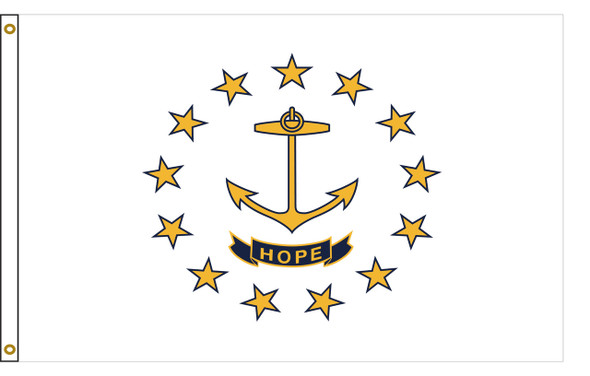
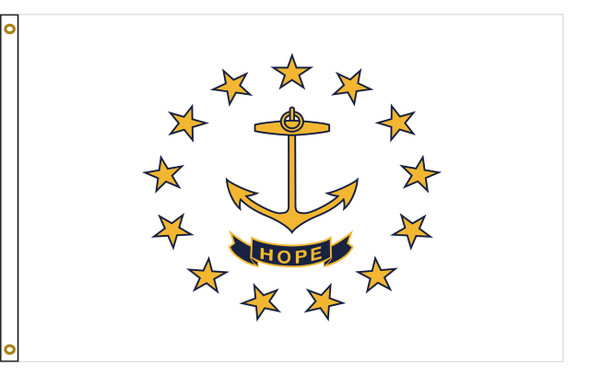
The Rhode Island flag is set out in the Rhode Island General Laws provisions on the state flag. It is a white field with a gold anchor encircled by thirteen gold stars and a blue ribbon carrying the motto Hope.
The current design was adopted in 1897.
Rhode Island General Laws Section 42-4-3 gives five feet six inches by four feet ten inches and then adds the words, or in these proportions. The statute authorizes scaling in as many words.
Faithfully reproduced, that is the standard we hold this design to, at the outdoor sizes the whole industry uses and states themselves order. What an outdoor flag needs right is the color, the seal and the emblems, and this one has them right.
The law that defines it, in its own words
Rhode Island General Laws Section 42-4-3 reads:
The flag of the state shall be white, five feet and six inches fly and four feet and ten inches deep on the pike, bearing on each side in the center a gold anchor, twenty-two inches high, and underneath it a blue ribbon twenty-four inches long and five inches wide, or in these proportions, with the motto "Hope" in golden letters thereon, the whole surrounded by thirteen (13) golden stars in a circle. The flag shall be edged with yellow fringe. The pike shall be surmounted by a spearhead and the length of the pike shall be nine feet, not including the spearhead.
The statute writes the measurements with foot and inch marks in parentheses; they are spelled out here.
You do not have to take our word for any of that. Read Rhode Island General Laws Section 42-4-3 in full at Justia, and check what we sell against it.
This is what we actually make, not a stand-in for it.
What is on it and what it means
The anchor is hope, a colonial symbol used since the seventeenth century. The thirteen stars are the original states and Rhode Island as one of them.
Worth knowing about this flag
It is one of only a handful of state flags on a white field, and it is normally made with gold fringe, which is part of the specification rather than an optional extra.
Where the Rhode Island flag flies
No citizen state capitol program was confirmed. the white state flag flies over one of the world's largest self supported marble domes. On Rhode Island Independence Day, the fourth of May, commemorating the 1776 Act of Renunciation in which Rhode Island was the first colony to renounce allegiance to King George the Third, the Department of State opens the State House on a special Saturday, encourages residents to display the state flag, and sells large Rhode Island flags at the State House Visitor's Center. The original Act of Renunciation is held by the Department of State and viewable at the State Archives.
Fly it on Rhode Island’s birthday
Rhode Island became the 13th state on May 29, 1790. Under the United States Flag Code as amended July 7, 1976, a state flag flown on the state’s birthday takes its place beneath the United States flag, and that day is the one date every year the Rhode Island flag has an official reason to go up.
Buy it in time and it goes up on the day it matters. Every state’s date is on our state birthdays page.
Nylon or polyester in Rhode Island
Polyester leans favorable given near total coastal and Narragansett Bay salt exposure and wind at Providence. Nylon only well inland.
At this size, twenty four square feet, wind load starts to count, and the material verdict above applies with more force than at house flag size.
You are looking at the nylon here, the right pick for the sheltered and moderate wind sites named above, for any house bracket, and for anywhere the flag gets brought in during storms. Two things make that case. It is light enough to move on the breeze most yards actually get rather than hang limp, and it dries fast, which keeps mildew away in a humid climate. What it trades away is ultraviolet durability — nylon’s amide bonds break down under ultraviolet light, losing strength and color faster than polyester, and it loses roughly a tenth of its strength while wet. For one of the exposed sites named above, the polyester version is the better fit.
Here is the part usually learned the hard way, after a second purchase: nylon catches wind on days polyester simply will not move. When the flag needs to be visibly flying — a quiet morning, a holiday, a funeral, a ceremony — that argues for nylon even on a site where polyester would technically last longer. A flag that just hangs there is not doing its job either.
Institutions commonly cite the American Legion’s figure: the federal government expects about ninety days from a flag flown daily sunrise to sunset, and roughly a quarter of that flown around the clock. On the ground, retailers report three to six months for nylon flown daily, four to eight for polyester, and one to three years for occasional flying. Take these as working estimates, not warranties — exposure can move them a long way in either direction.
How the 4x6 Feet is built
A 4x6 foot flag's larger area, over half again a 3x5 Feet's, catches more wind and stresses the fly end harder. That is why it carries four rows of lock stitching rather than fewer.
Here is the arithmetic: 24 square feet of nylon at roughly two ounces a square yard. A thirty mile an hour wind sends the fly end moving faster than the wind itself, since the wave traveling toward the tip picks up speed as it goes — which is why the tip wears out first, and why the fly end's stitching count is the figure to check on any listing.
This remains a one person task, but a windy afternoon spent taking it down alone will show you the difference from a 3x5 Feet. Handle it before weather arrives.
Each lock stitch knots into the one beside it, so a broken thread stays broken right where it snapped instead of unraveling the whole seam. 4 rows is not 4 times the strength — it is 3 backups. An inch and a half of reinforced heavy duty white heading holds two solid brass grommets and tooth washers, carrying real load at twenty four square feet.
This is commercial grade nylon: light enough to fly in a light wind, quick to shed water instead of holding it, and fast to dry, which matters because a waterlogged flag is a heavier flag putting more strain on its seams. UV resistant, field tested ink is what fights the sun, which is the real driver of color loss over time.
A design that reproduces cleanly
An anchor, thirteen stars and a short motto. No seal, which keeps it well clear of the expensive end, though the white ground shows soiling.
For what it is worth, the North American Vexillological Association surveyed 72 state, provincial and territorial flags in 2001 and rated them from zero to ten. The Rhode Island flag placed 28, at 6.12 out of 10.
Will it fit my flagpole?
This size wants an in-ground flagpole of eighteen to twenty five feet — on a six foot bracket, expect it to drag and wrap around the pole.
Questions about the 4x6 Feet
What flagpole does a 4x6 foot flag need? An in-ground flagpole of eighteen to twenty five feet. It is too large for a standard house bracket, which is the honest reason to choose it.
Is a 4x6 foot flag worth it over a 3x5 foot flag? Only if the flagpole is tall enough. On a twenty foot flagpole a 3x5 foot flag looks lost and a 4x6 foot flag fills it. On a six foot bracket the 4x6 foot flag will wrap.
Can I fly a 4x6 foot state flag with a 4x6 foot United States flag? Yes, and on two flagpoles of equal height that is the correct pairing, with the United States flag to the viewer’s left.
Where the step up starts to cost you
Buying cheap gets expensive right at the 3x5 Feet-to-4x6 Feet step up. The added area puts more force on the fly end and more load on the grommets, so a budget-built 4x6 Feet fails sooner than a budget 3x5 Feet would. Construction is no longer a nicety at this size.
Specifications
- Size: 4x6 Feet
- Area: 24 square feet
- Material: 100 percent nylon
- Fly end: 4 rows of lock stitching
- Heading: heavy duty white, reinforced, 1-1/2 inch
- Finish: Brass Grommets
- Ink: UV resistant, field tested
- Made in the United States by FORTISVEX
Which size do I need?
The proportion that makes both tables work is simple: length equal to roughly a quarter to a third of the flagpole’s height. Sitting between two sizes is common, and the choice there is really a trade between a flag that flies often and one that is seen from a distance.
If you know your flagpole height, start here.
- 6 Feet house bracket: 2x3 Feet or 3x5 Feet
- 15 to 20 Feet flagpole: 3x5 Feet or 4x6 Feet
- 20 to 25 Feet flagpole: 4x6 Feet or 5x8 Feet
- 25 to 35 Feet flagpole: 5x8 Feet or 6x10 Feet
- 35 to 45 Feet flagpole: 6x10 Feet or 8x12 Feet
- 45 to 60 Feet flagpole: 8x12 Feet or 10x15 Feet
- 60 to 80 Feet flagpole: 10x15 Feet or 12x18 Feet
- 80 to 100 Feet flagpole: 12x18 Feet or 15x25 Feet
- 100 to 120 Feet flagpole: 15x25 Feet or 20x30 Feet
- 120 to 150 Feet flagpole: 20x30 Feet or 20x38 Feet
- 150 to 200 Feet flagpole: 20x38 Feet or 30x50 Feet
- 200 to 240 Feet flagpole: 30x50 Feet or 30x60 Feet
- 240 Feet and above: 30x60 Feet or 50x80 Feet, engineered to the flagpole
If you know your flag size, start here.
- 2x3 Feet: 4 to 8 Feet bracket or garden flagpole
- 3x5 Feet: 6 Feet bracket, or 15 to 20 Feet in-ground flagpole
- 4x6 Feet: 18 to 25 Feet in-ground flagpole
- 5x8 Feet: 25 to 35 Feet flagpole
- 6x10 Feet: 30 to 40 Feet flagpole
- 8x12 Feet: 40 to 50 Feet flagpole
- 10x15 Feet: 50 to 60 Feet flagpole
- 12x18 Feet: 60 to 80 Feet flagpole
- 15x25 Feet: 80 to 100 Feet flagpole
- 20x30 Feet: 100 to 120 Feet flagpole
- 20x38 Feet: 120 to 150 Feet flagpole. This is the garrison size under Executive Order 10834, at a one to one point nine ratio rather than the two to three of the commercial sizes, and it is the size flown at the White House and the Capitol
- 30x50 Feet: 150 to 200 Feet flagpole
- 30x60 Feet: 200 to 240 Feet flagpole. This is the largest standard commercial size
- 50x80 Feet: 240 Feet and above, engineered to the flagpole
The quarter to a third rule holds all the way up, but above about a hundred feet the flag and the flagpole stop being two purchases and become one engineered system: the truck, the halyard, the foundation and the wind load all have to be specified together, and a flag bought without checking the flagpole rating damages the flagpole first. Several famous installations deliberately fly longer than the rule, which is a choice made with an engineer rather than from a chart.
We supply the whole range shown above, whether or not a given size currently has its own listing on the site. Ask if you do not see it.
About the back of the flag
Hold a printed flag up to the light and the reverse side shows the design in mirror image. That is not a defect — it is how nearly every flag flown in America is made. A flag correct on both sides is a double sided flag, two flags sewn together around a liner, and it runs roughly double the price and double the weight. Unless a state’s own statute calls for it, single sided is standard and it is the right call.
Flying it with the United States flag
Governing this is Title 4, Section 7 of the United States Flag Code, which keeps the United States flag in the position of honor: never below another flag, never to the right of one at the same level, meaning never right of the viewer’s left. Two flagpoles at equal height put the United States flag at the viewer’s left with equal-sized flags; unequal heights put it on the taller pole; a single flagpole with two flags carries it at the top. No penalty attaches for private citizens under the Code, but it is what institutions follow as standard practice.
Buy two and they both last longer
Two flags, alternated month to month, beat three flags flown until they fall apart, because the material recovers on its days off and the fly end is not worked in the same place every day. Severe weather is the one time to take it down; a real windstorm can cost more in one night than six ordinary months of flying. Fraying starts at the fly end, not the middle, and a few minutes with a needle there adds a season.
For cities, counties, schools and agencies
Fire and police departments, school districts, courthouses, municipalities and state agencies are all regular buyers of our state flags. Tax exempt purchasing is set up through the tax exempt page, and quantities, replacement schedules or an unlisted size are handled through the contact page.
Why buy it from us
Small and American describes this company, and we stock what we list. Every flag is made in the United States, printed with UV resistant ink, and finished to the construction described above rather than to a price target. We’d rather sell one flag that holds up than three that don’t. Free shipping on orders over twenty five dollars.
Additional Information
Material Type: |
Commercial Nylon |
Flag Size: |
4x6 Feet |
Made in: |
USA |
Finish: |
Brass Grommets |
Related Products
Related Products
FORTISVEX Rhode Island State Flag 3x5 Feet Nylon - Made in USA with Brass Grommets
FORTISVEX
FORTISVEX Rhode Island State Flag 5x8 Feet Nylon - Made in USA with Brass Grommets
FORTISVEX

FORTISVEX Rhode Island State Flag 6x10 Feet Nylon - Made in USA with Brass Grommets
FORTISVEX

FORTISVEX Kentucky State Flag 4x6 Feet Nylon - Made in USA with Brass Grommets
FORTISVEX

FORTISVEX Hawaii State Flag 4x6 Feet Nylon - Made in USA with Brass Grommets
FORTISVEX