
FORTISVEX
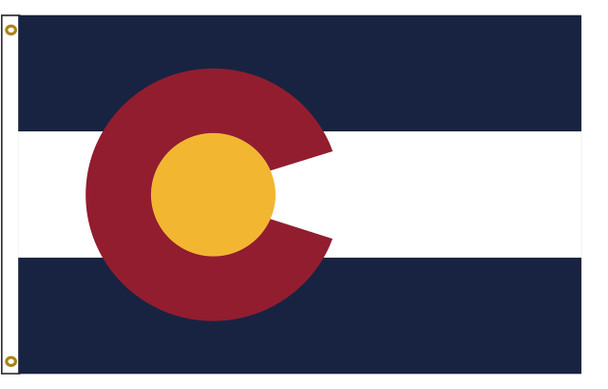
FORTISVEX Colorado State Flag 4x6 Feet Nylon - Made in USA with Brass Grommets
- MPN:
- FPAMSTCONYL4x6G
- Availability:
- Free Shipping* https://fortisvex.com/shipping-returns-terms/
- Shipping:
- Calculated at Checkout

Description
The 4x6 foot flag is where a house bracket stops being enough. It needs an in-ground flagpole, and that is the real reason people move up to it — not appearance, just size.
This is the Colorado state flag at 4x6 Feet (24 square feet) in nylon, made in the United States and finished with brass grommets.
Built to the Colorado flag specification
The Colorado flag is set out in the Colorado Revised Statutes provisions on the state flag. It is three horizontal stripes, blue over white over blue, with a red circular letter C filled with a gold disk.
Designed by Andrew Carlisle Carson and adopted June 5, 1911, replacing an unused 1907 banner; colors were standardized to match the United States flag on February 28, 1929 and the letter size and position fixed March 31, 1964.
The law governing this flag addresses design, colors and the seal or emblem, but leaves overall size unspecified for a modern outdoor flag. That is typical across most states, which is why the industry has converged on the same standard sizes.
The design here is reproduced faithfully, at the standard outdoor sizes the whole industry works in and that states buy for themselves. What actually matters on a flag flown outdoors is that the colors, the seal and the emblems are correct, and they are.
The law that defines it, in its own words
Colorado Revised Statutes Section 24-80-904 reads:
A state flag is hereby adopted to be used on all occasions when the state is officially and publicly represented, with the privilege of use by all citizens upon such occasions as they may deem fitting and appropriate. The flag shall consist of three alternate stripes to be of equal width and at right angles to the staff, the two outer stripes to be blue of the same color as in the blue field of the national flag and the middle stripe to be white, the proportion of the flag being a width of two-thirds of its length. At a distance from the staff end of the flag of one-fifth of the total length of the flag there shall be a circular red C, of the same color as the red in the national flag of the United States. The diameter of the letter shall be two-thirds of the width of the flag. The inner line of the opening of the letter C shall be three-fourths of the width of its body or bar, and the outer line of the opening shall be double the length of the inner line thereof. Completely filling the open space inside the letter C shall be a golden disk; attached to the flag shall be a cord of gold and silver intertwined, with tassels one of gold and one of silver.
You do not have to take our word for any of that. Read Colorado Revised Statutes Section 24-80-904 in full at Justia, and check what we sell against it.
It is the real flag we produce, not a simplified version.
What is on it and what it means
Blue is the sky. Gold is sunshine and mining. White is the snow-capped Rockies and silver. Red is the ruddy earth. The letter C carries three meanings at once, Colorado, Centennial and Columbine.
What most listings get wrong
The designer is routinely named Andrew Carlisle Johnson. His surname was Carson. And the exact shade of gold is not fixed by statute, which is why the disk legally differs between manufacturers.
Where the Colorado flag flies
The Department of Personnel and Administration runs the Ceremonial Flag Request Program. The flag is flown at the State Capitol in Denver, folded in the traditional thirteen fold style, and returned with a certificate of authenticity carrying the date. Colorado residents only. State flags are offered in nylon and bunting, United States flags the same.
Time Plumbing, Heating and Electric in Denver near Sixth Avenue and Interstate 25, a flagpole reported at about a hundred and fifty four feet. There is a source conflict on the flag size. Denverite reported forty by eighty feet, the owner's own site says thirty by sixty, likely different flags over time. Denverite also reported that the town of Swink subsequently built a taller pole, so the record may be superseded.
Fly it on Colorado’s birthday
Colorado became the 38th state on August 1, 1876. Under the United States Flag Code as amended July 7, 1976, a state flag flown on the state’s birthday takes its place beneath the United States flag, and that day is the one date every year the Colorado flag has an official reason to go up.
Colorado Day is August 1, a state observance on which the state parks offer free admission.
Buy it in time and it goes up on the day it matters. Every state’s date is on our state birthdays page.
Nylon or polyester in Colorado
Polyester on the Front Range and plains at Denver, Colorado Springs, Fort Collins and Pueblo, for chinook and downslope windstorms and high altitude ultraviolet. Nylon only in sheltered mountain valleys.
Twenty four square feet is where wind load starts to matter in earnest, and the verdict above carries more weight here than on a standard house flag.
You are looking at the nylon here, the right pick for the sheltered and moderate wind sites named above, for any house bracket, and for anywhere the flag gets brought in during storms. Two things make that case. It is light enough to move on the breeze most yards actually get rather than hang limp, and it dries fast, which keeps mildew away in a humid climate. What it trades away is ultraviolet durability — nylon’s amide bonds break down under ultraviolet light, losing strength and color faster than polyester, and it loses roughly a tenth of its strength while wet. For one of the exposed sites named above, the polyester version is the better fit.
This is the detail people usually only figure out after buying twice: nylon will fly on a day too calm for polyester to move at all. If flying on a still morning, a holiday, at a funeral, or at a ceremony matters to you, that is reason enough to choose nylon even where polyester would survive longer. A motionless flag fails at its purpose regardless of how durable it is.
The number most institutions rely on traces to the American Legion, which reports a roughly ninety-day expectation from the federal government for a flag flown daily sunrise to sunset, and about a quarter of that flown around the clock. Retailer experience puts nylon at three to six months daily, polyester at four to eight, and an occasionally flown flag at one to three years. These figures are practical guidance, not a warranty, and exposure will move them considerably.
How the 4x6 Feet is built
A 4x6 foot flag's larger area, over half again a 3x5 Feet's, catches more wind and stresses the fly end harder. That is why it carries four rows of lock stitching rather than fewer.
Work the numbers and you get 24 square feet of nylon at roughly two ounces a square yard. At thirty miles an hour, the fly end actually outpaces the wind, because the wave running to the tip accelerates along the way — the reason the tip fails first, and the reason fly-end stitching count is the number that matters.
This remains a one person task, but a windy afternoon spent taking it down alone will show you the difference from a 3x5 Feet. Handle it before weather arrives.
A lock stitch ties into the stitch next to it, so one broken thread does not unzip the whole seam — it just stops. 4 rows is not 4 times the strength; it is 3 backups. An inch and a half of reinforced heavy duty white heading holds two solid brass grommets and tooth washers, carrying real load at twenty four square feet.
Nylon, commercial grade, is what this flag is made from. It is light enough to move in a gentle breeze, sheds rather than soaks up water, and dries quickly — a wet flag is a heavier flag, harder on its own seams. The ink is UV resistant and field tested, because sun exposure is what actually fades a flag.
A design that reproduces cleanly
Four colors and one letter. The only real variable is the gold, which the statute leaves open.
For what it is worth, the North American Vexillological Association surveyed 72 state, provincial and territorial flags in 2001 and rated them from zero to ten. The Colorado flag placed 16, at 6.83 out of 10.
Will it fit my flagpole?
This size wants an in-ground flagpole of eighteen to twenty five feet — on a six foot bracket, expect it to drag and wrap around the pole.
Questions about the 4x6 Feet
What flagpole does a 4x6 foot flag need? An in-ground flagpole of eighteen to twenty five feet. It is too large for a standard house bracket, which is the honest reason to choose it.
Is a 4x6 foot flag worth it over a 3x5 foot flag? Only if the flagpole is tall enough. On a twenty foot flagpole a 3x5 foot flag looks lost and a 4x6 foot flag fills it. On a six foot bracket the 4x6 foot flag will wrap.
Can I fly a 4x6 foot state flag with a 4x6 foot United States flag? Yes, and on two flagpoles of equal height that is the correct pairing, with the United States flag to the viewer’s left.
Where the step up starts to cost you
Buying cheap gets expensive right at the 3x5 Feet-to-4x6 Feet step up. The added area puts more force on the fly end and more load on the grommets, so a budget-built 4x6 Feet fails sooner than a budget 3x5 Feet would. Construction is no longer a nicety at this size.
Specifications
- Size: 4x6 Feet
- Area: 24 square feet
- Material: 100 percent nylon
- Fly end: 4 rows of lock stitching
- Heading: heavy duty white, reinforced, 1-1/2 inch
- Finish: Brass Grommets
- Ink: UV resistant, field tested
- Made in the United States by FORTISVEX
Which size do I need?
Both tables follow the same logic. A flagpole reads best with a flag whose length falls between a quarter and a third of its height. Where a size could go either way, smaller means more flying days and a longer life, bigger means more visibility at range.
If you know your flagpole height, start here.
- 6 Feet house bracket: 2x3 Feet or 3x5 Feet
- 15 to 20 Feet flagpole: 3x5 Feet or 4x6 Feet
- 20 to 25 Feet flagpole: 4x6 Feet or 5x8 Feet
- 25 to 35 Feet flagpole: 5x8 Feet or 6x10 Feet
- 35 to 45 Feet flagpole: 6x10 Feet or 8x12 Feet
- 45 to 60 Feet flagpole: 8x12 Feet or 10x15 Feet
- 60 to 80 Feet flagpole: 10x15 Feet or 12x18 Feet
- 80 to 100 Feet flagpole: 12x18 Feet or 15x25 Feet
- 100 to 120 Feet flagpole: 15x25 Feet or 20x30 Feet
- 120 to 150 Feet flagpole: 20x30 Feet or 20x38 Feet
- 150 to 200 Feet flagpole: 20x38 Feet or 30x50 Feet
- 200 to 240 Feet flagpole: 30x50 Feet or 30x60 Feet
- 240 Feet and above: 30x60 Feet or 50x80 Feet, engineered to the flagpole
If you know your flag size, start here.
- 2x3 Feet: 4 to 8 Feet bracket or garden flagpole
- 3x5 Feet: 6 Feet bracket, or 15 to 20 Feet in-ground flagpole
- 4x6 Feet: 18 to 25 Feet in-ground flagpole
- 5x8 Feet: 25 to 35 Feet flagpole
- 6x10 Feet: 30 to 40 Feet flagpole
- 8x12 Feet: 40 to 50 Feet flagpole
- 10x15 Feet: 50 to 60 Feet flagpole
- 12x18 Feet: 60 to 80 Feet flagpole
- 15x25 Feet: 80 to 100 Feet flagpole
- 20x30 Feet: 100 to 120 Feet flagpole
- 20x38 Feet: 120 to 150 Feet flagpole. This is the garrison size under Executive Order 10834, at a one to one point nine ratio rather than the two to three of the commercial sizes, and it is the size flown at the White House and the Capitol
- 30x50 Feet: 150 to 200 Feet flagpole
- 30x60 Feet: 200 to 240 Feet flagpole. This is the largest standard commercial size
- 50x80 Feet: 240 Feet and above, engineered to the flagpole
Above roughly a hundred feet of flagpole, the quarter to a third guide keeps its accuracy but loses its simplicity: the flag now has to be specified alongside the truck, the halyard, the foundation and the wind load as a single system, and skipping that step is how a flagpole gets damaged rather than the flag. Several famous installations fly flags larger than the rule on purpose, with an engineer deciding it rather than a table.
If a size in either table is missing from the website, it does not mean we do not carry it. The full range is available to order regardless of what is currently listed.
About the back of the flag
A printed flag reads correctly from the front and reversed from the back. That is normal and it is true of almost every flag flown in the country. A flag that reads correctly from both sides is a double sided flag, built as two flags sewn together with a liner between them, and it costs roughly twice as much and weighs roughly twice as much. Unless the statute for a particular state requires it, single sided is the standard and the right choice.
Flying it with the United States flag
Section 7 of Title 4, the United States Flag Code, addresses this directly: the United States flag is never outranked in position, staying above every other flag and to the right at the same level, which reads as the viewer’s left. Same-height flagpoles put the United States flag on the viewer’s left with matching flag sizes; different heights put it on the taller pole; one flagpole with two flags puts it at the top. There is no legal penalty for civilians under the Flag Code, but it is what every institution follows anyway.
Buy two and they both last longer
Two flags, alternated month to month, beat three flags flown until they fall apart, because the material recovers on its days off and the fly end is not worked in the same place every day. Severe weather is the one time to take it down; a real windstorm can cost more in one night than six ordinary months of flying. Fraying starts at the fly end, not the middle, and a few minutes with a needle there adds a season.
For cities, counties, schools and agencies
Municipalities, school districts, fire and police departments, courthouses and state agencies all buy state flags from us regularly. The tax exempt page handles tax exempt accounts, and the contact page is the route for quantity orders, replacement schedules or a size not shown here.
Why buy it from us
We run a small American company and stock the flags we sell. Each one is made in the United States, printed in UV resistant ink, and built to the construction described above instead of built to hit a lower price. One durable flag beats three that fail, in our view. Free shipping applies to orders over twenty five dollars.
Additional Information
Material Type: |
Commercial Nylon |
Flag Size: |
4x6 Feet |
Made in: |
USA |
Finish: |
Brass Grommets |
Related Products
Related Products

FORTISVEX Kentucky State Flag 4x6 Feet Nylon - Made in USA with Brass Grommets
FORTISVEX

FORTISVEX Hawaii State Flag 4x6 Feet Nylon - Made in USA with Brass Grommets
FORTISVEX

FORTISVEX Arkansas State Flag 4x6 Feet Nylon - Made in USA with Brass Grommets
FORTISVEX


FORTISVEX Maryland State Flag 4x6 Feet Nylon - Made in USA with Brass Grommets
FORTISVEX

FORTISVEX Iowa State Flag 4x6 Feet Nylon - Made in USA with Brass Grommets
FORTISVEX