
FORTISVEX
FORTISVEX California State Flag 12x18 Feet Nylon - Made in USA Bear Flag with Rope and Thimbles

- MPN:
- FPAMSTCANYL12x18D
- Availability:
- Free Shipping*
- Shipping:
- Calculated at Checkout




Description
Large civic sites, memorial grounds and highway locations fly the 12x18 foot flag for the same reason: two hundred and sixteen square feet is visible from a long way off, which is the point of it.
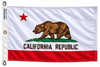
This is the California state flag at 12x18 Feet (216 square feet) in nylon, made in the United States and finished with a sewn rope and plated steel thimbles.
Built to the California flag specification
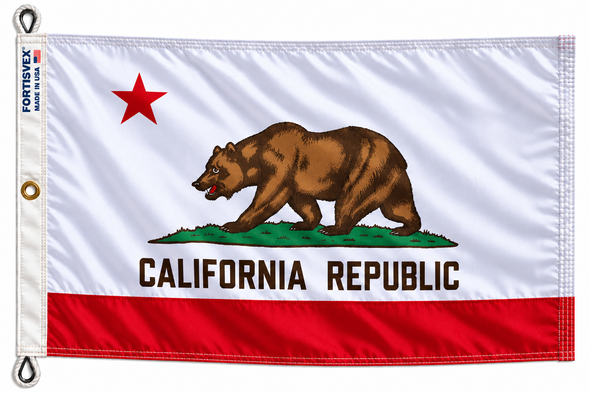
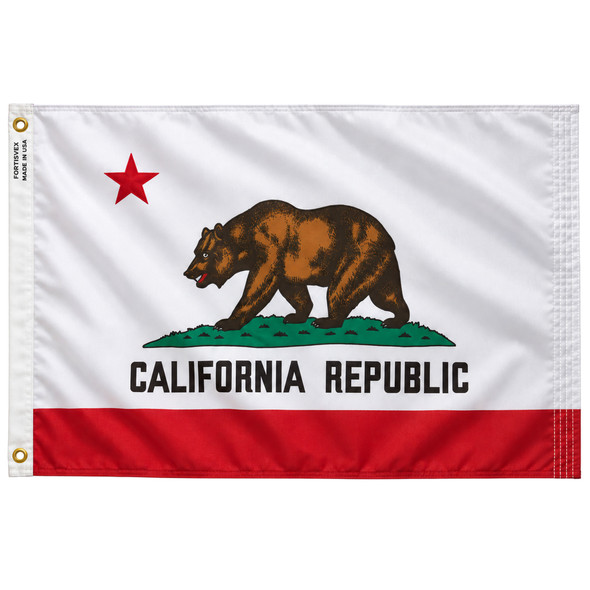
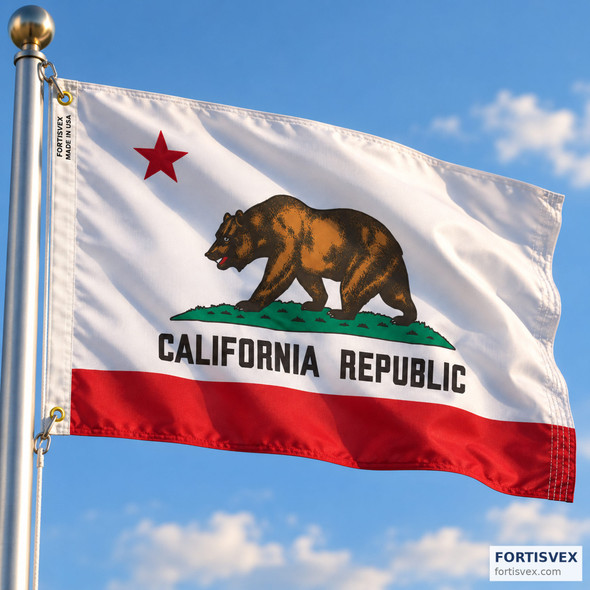
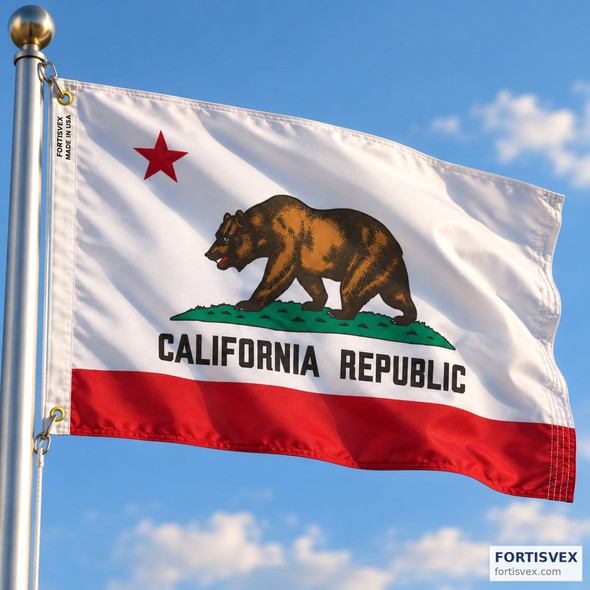
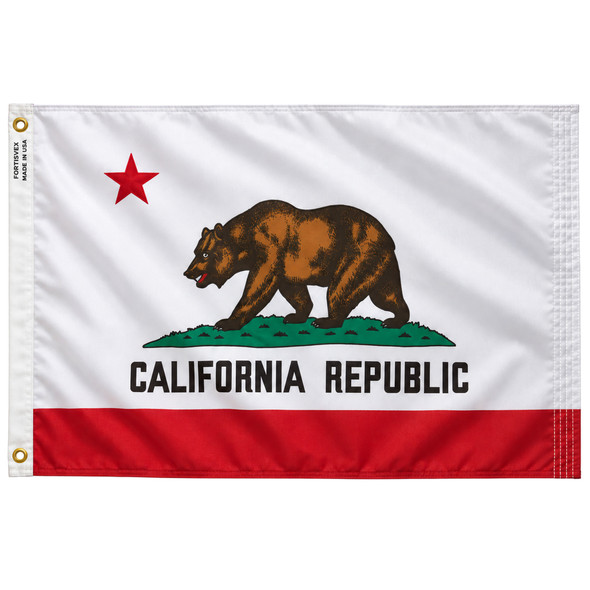
The California flag is set out in California Government Code Section 420, one of the most precise flag statutes in the country. It is two thirds as tall as it is long, with a red stripe along the bottom exactly one sixth of the height, a grizzly bear walking left across a green grass plot of twelve tufts and measuring two thirds of the flag’s height from nose to hind paw, one red five-pointed star in the upper hoist corner, and the words California Republic in condensed gothic capitals between the grass and the stripe.
Adopted in 1911 and standardized to its current form in 1953; it derives from the original Bear Flag raised at Sonoma during the Bear Flag Revolt of 1846, when a short-lived republic declared independence from Mexico and lasted twenty five days; the design is credited to William Todd, a nephew of Mary Todd Lincoln, who painted the original at Sonoma.
California is precise about proportion. Government Code Section 420 makes the flag two thirds as tall as it is long, which is two to three, and a 4x6 foot flag, an 8x12 foot flag, a 10x15 foot flag and a 12x18 foot flag all match it exactly. A 3x5 foot flag is a three to five ratio and is therefore slightly deeper than the statute describes, which is true of almost every 3x5 foot state flag sold in the country.
The reproduction here is faithful to the design, in the standard outdoor sizes used industry wide and bought by the states themselves. On an outdoor flag, correct colors, seal and emblems are what counts, and that is what you get.
The law that defines it, in its own words
California Government Code Section 420 reads:
The Bear Flag is the State Flag of California. As viewed with the hoist end of the flag to the left of the observer there appears in the upper left-hand corner of a white field a five-pointed red star with one point vertically upward and in the middle of the white field a brown grizzly bear walking toward the left with all four paws on a green grass plot, with head and eye turned slightly toward the observer; a red stripe forms the length of the flag at the bottom, and between the grass plot and the red stripe appear the words CALIFORNIA REPUBLIC. Dimensions, excluding heading and unfinished flag ends: The hoist or flag width is two-thirds of the fly or flag length; the red stripe width is one-sixth of the hoist width. The state official flag hoist widths shall be two, three, four, five, six and eight feet.
The section continues with the proportions of the star, bear, grass plot and lettering, then the Textile Color Card Association references: White cable 70001, Old Glory red 70180, Irish Green 70168, Maple Sugar brown 70129, Seal dark brown 70108. The bear illustration itself appears only in the printed Statutes of 1953, chapter 1140.
You do not have to take our word for any of that. Read California Government Code Section 420 in full at Justia, and check what we sell against it.
This is what we actually make, not a stand-in for it.
What is on it and what it means
The bear is a California grizzly, a subspecies now extinct. The last one held in captivity, a bear named Monarch, was the model used when the flag was standardized. The star recalls the lone star of the 1836 California revolt. The original 1846 flag was destroyed in the San Francisco fire of 1906.
What most listings get wrong
Three errors are repeated constantly by other retailers and by general reference sites. The bear walks on all fours; it does not stand upright. The words California Republic sit below the bear, not above it. And the word Eureka belongs to the state seal, not to the flag, so any California flag carrying it is wrong.
Where the California flag flies
The Superflag, five hundred and five by two hundred and twenty five feet and about three thousand pounds, was made for Thomas Demski of Long Beach and was recognized by Guinness as the world's largest flag in the 1994 and 1995 editions. Its 1996 unfurling at Hoover Dam made it the largest flag flown. It no longer holds the world title but is still cited as the largest American flag. Calipatria in Imperial County has a one hundred and eighty four foot municipal flagpole so the flag flies at sea level in a town one hundred and eighty four feet below it. Dorris is documented as having one of the tallest United States flagpoles.
Fly it on California’s birthday
California became the 31st state on September 9, 1850. Under the United States Flag Code as amended July 7, 1976, a state flag flown on the state’s birthday takes its place beneath the United States flag, and that day is the one date every year the California flag has an official reason to go up.
California Admission Day is September 9, a legal observance, and some cities close offices for it.
Order it ahead of the date and it is ready to fly that day. Every state’s birthday is listed on our state birthdays page.
Nylon or polyester in California
Nylon in the mild sheltered coastal valley metros, the Los Angeles basin, San Diego, San Jose and Sacramento. Polyester on the immediate coast for salt, in the high wind passes at San Gorgonio and Altamont, and in the high ultraviolet desert at Palm Springs and the Bakersfield edge.
For scale, the National Weather Service ultraviolet index forecast for Los Angeles on July 23, 2026 was 11 at solar noon, in the extreme band. That is the sun this flag has to survive.
At two hundred and sixteen square feet this is an installation flag. The sites above that call for polyester call for it absolutely, and the flagpole has to be engineered for the load.
You are looking at the nylon here, the right pick for the sheltered and moderate wind sites named above, for any house bracket, and for anywhere the flag gets brought in during storms. Two things make that case. It is light enough to move on the breeze most yards actually get rather than hang limp, and it dries fast, which keeps mildew away in a humid climate. What it trades away is ultraviolet durability — nylon’s amide bonds break down under ultraviolet light, losing strength and color faster than polyester, and it loses roughly a tenth of its strength while wet. For one of the exposed sites named above, the polyester version is the better fit.
This is the detail people usually only figure out after buying twice: nylon will fly on a day too calm for polyester to move at all. If flying on a still morning, a holiday, at a funeral, or at a ceremony matters to you, that is reason enough to choose nylon even where polyester would survive longer. A motionless flag fails at its purpose regardless of how durable it is.
Most institutions work from the same benchmark, reported by the American Legion: the United States government's expectation is roughly ninety days for a flag flown daily sunrise to sunset, and about a quarter of that for one flown around the clock. In practice, retailers report three to six months for nylon flown daily, four to eight for polyester, and one to three years for a flag flown only on occasions. These are working numbers, not a guarantee, and exposure can move them substantially either way.
How the 12x18 Feet is built
Six rows of lock stitching on the fly end and zig zag stitched corners. Everything about the construction at this size exists to manage a load that would destroy a house flag in an afternoon.
The arithmetic behind that: 216 square feet of nylon at roughly two ounces a square yard. In a thirty mile an hour wind the fly end of a flag this size travels faster than the wind itself, because the wave running out to the tip accelerates as it goes. That is why the tip wears out first and why the stitching count at that end is the number worth reading on any listing.
Two hundred and sixteen square feet is not an errand you fit in casually. Schedule it, account for the site, and never attempt it on a day the wind is already up.
With lock stitching, every stitch knots into its neighbor, so damage stays contained at the break instead of running down the seam. Read 6 rows not as 6 times the strength but as 5 backups. Rather than concentrate the load, the heading spreads it across the entire hoist through a full-length sewn nylon rope ending in two plated steel thimbles.
The flag material is commercial grade nylon. It is light enough to fly in a gentle breeze, it sheds water rather than holding it, and it dries fast, which matters because a flag that stays wet stays heavy and works its seams harder. The ink is UV resistant and field tested; sun is what takes a flag’s color, and the ink decides how long it holds.
Why this flag is harder to make than most
A detailed bear silhouette, a twelve-tuft grass plot, lettering and a star, and a statute that fixes proportions precisely enough that a sloppy reproduction is visibly wrong.
For what it is worth, the North American Vexillological Association surveyed 72 state, provincial and territorial flags in 2001 and rated them from zero to ten. The California flag placed 13, at 7.00 out of 10.
Will it fit my flagpole?
Sixty to eighty feet of in-ground flagpole, with hardware rated for it, is the right fit for this size.
Questions about the 12x18 Feet
What size flagpole for a 12x18 foot flag? Sixty to eighty feet with hardware engineered for two hundred and sixteen square feet of load.
Who buys a 12x18 foot state flag? Civic sites, memorial grounds, highway frontages and campuses, anywhere the flag is meant to be seen from a long way off.
Does a flag this size need special care? It needs a rotation, hardware checks, and taking down in severe weather. Flown properly it lasts. Flown carelessly it does not last a season.
This size is a commitment
A flag of this size belongs on a maintenance schedule, not a set-and-forget flagpole. It needs rotation, hardware checks, and to come down before severe weather. Flown right, it lasts; flown carelessly, it fails inside a season.
Specifications
- Size: 12x18 Feet
- Area: 216 square feet
- Material: 100 percent nylon
- Fly end: 6 rows of lock stitching
- Heading: heavy duty white, reinforced, 2 inch
- Finish: Rope and Thimbles
- Ink: UV resistant, field tested
- Made in the United States by FORTISVEX
Which size do I need?
One rule sits under both tables: the flag should run about a quarter to a third the height of the flagpole. On the border between two rows, the smaller flag flies more and lasts longer; the larger one is the one you can see from the road.
If you know your flagpole height, start here.
- 6 Feet house bracket: 2x3 Feet or 3x5 Feet
- 15 to 20 Feet flagpole: 3x5 Feet or 4x6 Feet
- 20 to 25 Feet flagpole: 4x6 Feet or 5x8 Feet
- 25 to 35 Feet flagpole: 5x8 Feet or 6x10 Feet
- 35 to 45 Feet flagpole: 6x10 Feet or 8x12 Feet
- 45 to 60 Feet flagpole: 8x12 Feet or 10x15 Feet
- 60 to 80 Feet flagpole: 10x15 Feet or 12x18 Feet
- 80 to 100 Feet flagpole: 12x18 Feet or 15x25 Feet
- 100 to 120 Feet flagpole: 15x25 Feet or 20x30 Feet
- 120 to 150 Feet flagpole: 20x30 Feet or 20x38 Feet
- 150 to 200 Feet flagpole: 20x38 Feet or 30x50 Feet
- 200 to 240 Feet flagpole: 30x50 Feet or 30x60 Feet
- 240 Feet and above: 30x60 Feet or 50x80 Feet, engineered to the flagpole
If you know your flag size, start here.
- 2x3 Feet: 4 to 8 Feet bracket or garden flagpole
- 3x5 Feet: 6 Feet bracket, or 15 to 20 Feet in-ground flagpole
- 4x6 Feet: 18 to 25 Feet in-ground flagpole
- 5x8 Feet: 25 to 35 Feet flagpole
- 6x10 Feet: 30 to 40 Feet flagpole
- 8x12 Feet: 40 to 50 Feet flagpole
- 10x15 Feet: 50 to 60 Feet flagpole
- 12x18 Feet: 60 to 80 Feet flagpole
- 15x25 Feet: 80 to 100 Feet flagpole
- 20x30 Feet: 100 to 120 Feet flagpole
- 20x38 Feet: 120 to 150 Feet flagpole. This is the garrison size under Executive Order 10834, at a one to one point nine ratio rather than the two to three of the commercial sizes, and it is the size flown at the White House and the Capitol
- 30x50 Feet: 150 to 200 Feet flagpole
- 30x60 Feet: 200 to 240 Feet flagpole. This is the largest standard commercial size
- 50x80 Feet: 240 Feet and above, engineered to the flagpole
The quarter to a third rule holds all the way up, but above about a hundred feet the flag and the flagpole stop being two purchases and become one engineered system: the truck, the halyard, the foundation and the wind load all have to be specified together, and a flag bought without checking the flagpole rating damages the flagpole first. Several famous installations deliberately fly longer than the rule, which is a choice made with an engineer rather than from a chart.
The full range is available to order even where a size is not shown on the site. If what you need is not listed here, ask and we can still get it made.
About the back of the flag
A single sided printed flag shows its design correctly on one face and reversed on the other. That is expected, and it describes almost every flag flying in the United States. A flag readable on both sides is built as two layers sewn around a liner, roughly double the cost and double the weight of a single sided flag. Unless a state’s law requires double sided, single sided remains the standard choice.
Flying it with the United States flag
The rule comes from Title 4, Section 7 of the United States Flag Code: no flag is displayed above the United States flag, and none is placed to its right at the same level, which from the viewer’s position means the left. Equal-height flagpoles carry the United States flag on the viewer’s left with matching flag sizes; unequal flagpoles put it on the taller one; a single flagpole with two flags carries it at the top. Civilians face no penalty for departing from the Flag Code, but it is the standard institutions hold to.
Buy two and they both last longer
Rotate two flags on a monthly cycle and they will outlast three flags flown until they fail, because the fabric gets a rest and the fly end is not taking the same beating in the same spot every day. Bring it down before severe weather; one real windstorm can do more damage overnight than six ordinary months. Check the fly end, not the middle — a few minutes of stitching at the first sign of fraying buys another season.
For cities, counties, schools and agencies
Our state flags go to municipalities, school districts, fire and police departments, courthouses and state agencies regularly. Tax exempt purchasing is handled on the tax exempt page. For quantity, a replacement schedule, or a size outside this listing, use the contact page.
Why buy it from us
We are a small, American-based company that stocks what it lists. Every flag is made in the United States, uses UV resistant ink, and is finished to the standard described above rather than cut down to hit a price. One flag that lasts is worth more to us than three that do not. Free shipping applies over twenty five dollars.
Videos
View AllClose
Additional Information
Size: |
12x18 Feet |
Dimensions: |
12 Feet Tall x 18 Feet Wide |
Material: |
Commercial Nylon, 100% Nylon |
Material Type: |
Commercial Nylon |
Flag Size: |
12x18 Feet |
Construction: |
Printed, Single Face Reverse |
Back of Flag: |
Ink Penetrates, Image Reads Mirrored |
Heading: |
Heavy Duty White, Reinforced |
Header Construction: |
Rope Heading, Two Steel Thimbles, Triple Crimped Sleeves |
Finish: |
Two Plated Steel Rope Thimbles, One Center Brass Grommet |
Grommet Reinforcement: |
Heavy Duty Sleeve |
Fly End: |
Six Rows of Lock Stitching, Zig Zag Corners |
Corner Patches: |
Two Ply, Each Header Corner |
Ink: |
UV Resistant, Field Tested |
Suits Flagpole: |
60 to 80 foot pole |
Brand: |
FORTISVEX |
Made in: |
USA |
Official Specification: |
California Government Code Section 420 |
Part Number: |
FPAMSTCANYL12x18D |
Related Products
Related Products


FORTISVEX California State Flag 10x15 Feet Nylon - Made in USA Bear Flag with Rope and Thimbles
FORTISVEX

FORTISVEX California State Flag 8x12 Feet Nylon - Made in USA Bear Flag with Rope and Thimbles
FORTISVEX
FORTISVEX California State Flag 6x10 Feet Nylon - Made in USA Bear Flag with Brass Grommets
FORTISVEX

FORTISVEX California State Flag 2x3 Feet Nylon - Made in USA Bear Flag with Brass Grommets
FORTISVEX

FORTISVEX California State Flag 5x8 Feet Nylon - Made in USA Bear Flag with Brass Grommets
FORTISVEX