
FORTISVEX
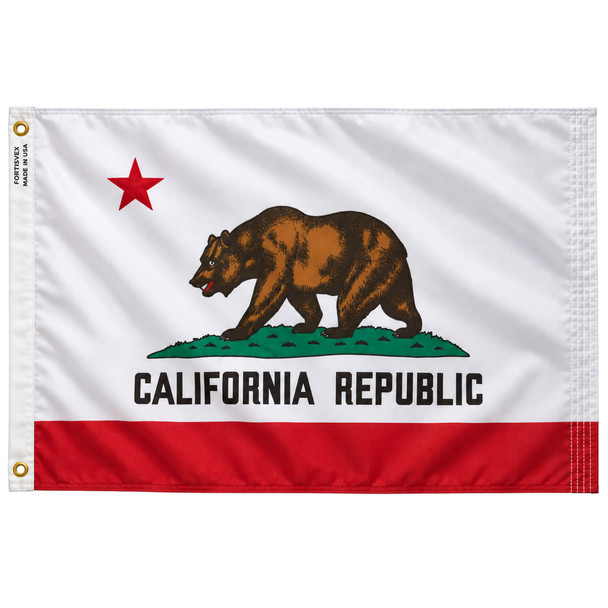
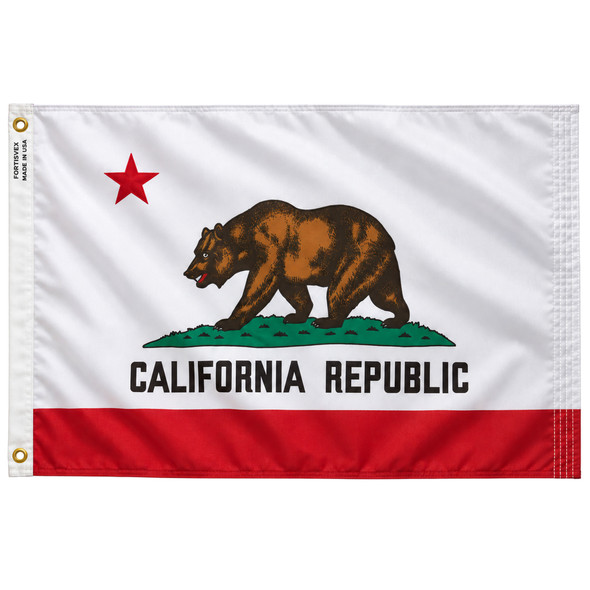
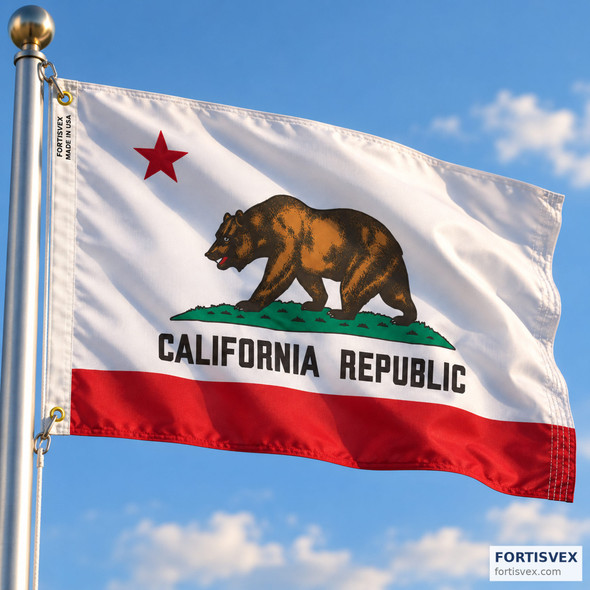
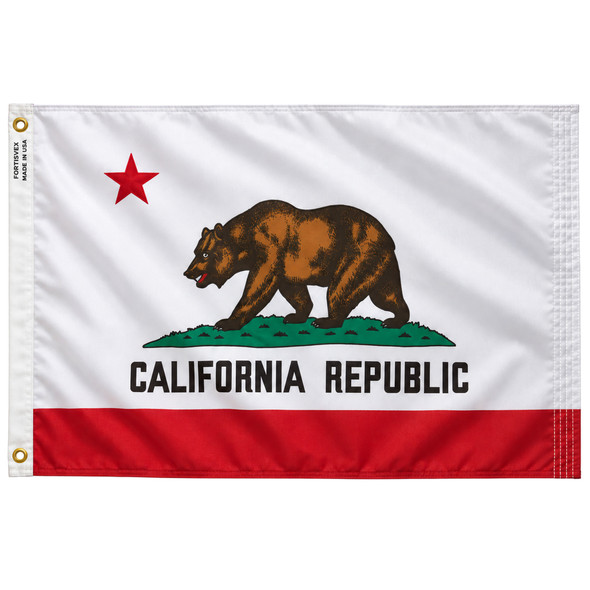
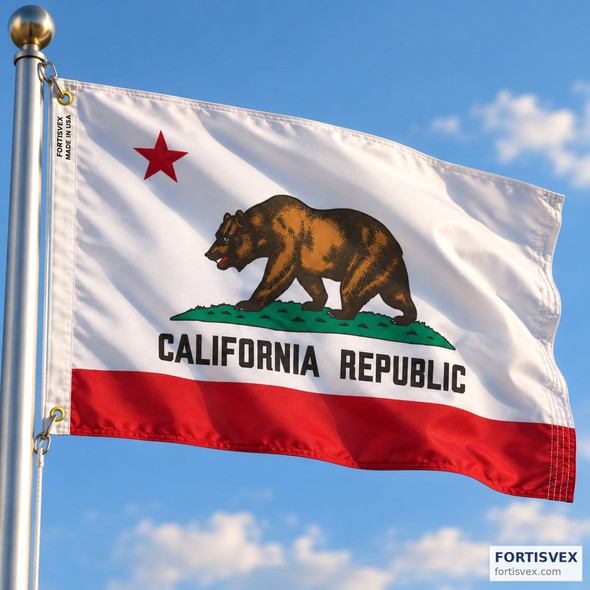
FORTISVEX California State Flag 4x6 Feet Nylon - Made in USA Bear Flag with Brass Grommets
- MPN:
- FPAMSTCANYL4x6G
- Availability:
- Free Shipping*
- Shipping:
- Calculated at Checkout






Description
A 4x6 foot flag is the first California size that really needs a flagpole in the ground. At twenty four square feet it is too much flag for a house bracket — it will foul the eaves and beat itself against the siding. On a twenty five foot flagpole it looks the way a state flag is supposed to look from the street.
This is the size where the step up starts to cost you if the flag is cheap. A 4x6 foot flag carries twice the area of a 3x5 foot flag, so it catches twice the wind, and every weakness in the construction gets found twice as fast.
So it is built for the load. Made in the United States by FORTISVEX. Printed in UV resistant, field tested ink. Four rows of lock stitching on the fly end. Solid brass grommets with tooth washers set into a heavy duty heading. Buy it once and fly it.
Built to the California flag code
California does not leave its flag to interpretation. Government Code section 420 specifies the Bear Flag down to the fraction — the height against the length, the width of the red stripe, where the star sits, how long the bear measures nose to hind paw, the twelve tufts in the grass, the lettering between the grass and the stripe.
This flag is reproduced to that specification. Not close to it. Not a version of it somebody drew. The design the state of California wrote into its own code is the design flying over your house.
It matters more than it sounds. Plenty of what is sold online as a California flag is an approximation — a bear that is the wrong size, a star in the wrong place, lettering in the wrong face. It reads as a California flag from a distance and it is wrong up close. Ours is not.
The fly end is where every flag fails
The fly end is where every flag fails, and on a 4x6 foot flag it goes faster. Double the area of a 3x5 foot flag means roughly double the force arriving at that far edge every time the wind moves, and the whip at the tip travels further and hits harder.
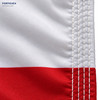
The fly hem carries four rows of lock stitching. Lock stitch means each stitch is knotted into the next, so a cut thread does not unzip the seam — it stops where it started. Four rows means three backups.
This is the size where the difference between four rows and two stops being theoretical. A two row hem on a 3x5 foot flag may last a season. On a 4x6 foot flag it will not.
Color that survives the summer
Sun is the other killer, and it is slower and crueler. A flag does not fail all at once; it just quietly stops looking like a flag. The red turns salmon. The dark colors go grey. One morning you look up and realize it has been embarrassing you for weeks.
Our inks are UV resistant and field tested, chosen to hold their color in direct sun rather than surrender to it. And because we print so the ink penetrates the weave rather than sitting on top of it, the design reads vividly from the back as well as the front. No dull ghost of a flag on the reverse. It looks right from your porch and it looks right from the road.
The part that takes all the load
Two grommets carry twenty four square feet of nylon. That is half again what a 3x5 foot flag puts through the same two points, and it is the reason a heading that was adequate on a smaller flag is not adequate here.
The heading is heavy duty white, reinforced — an inch and a half of it, stiffer and thicker than the flag body, so the load sits in material built for it rather than in the printed cloth.
The grommets are solid brass with tooth washers that bite into the heading and stop the grommet working loose under a load that never stops changing direction. Not brass plated steel, which rusts and streaks.
Our name is printed on that heading.
About the back of the flag
This is a single face reverse flag, and it is worth understanding before it surprises you.
The design is printed on the front, and the ink goes all the way through the weave, so the back shows the same bear, the same star, the same red stripe — mirrored. The bear walks the other way and the lettering reads right to left. That is normal. It is how nearly every outdoor flag in America is made — the flags flying over your state capitol, your city hall, your courthouse, your school, your post office and every other government building are built exactly the same way.
The alternative is a double face flag: two printed flags sewn back to back with a blackout liner between them, so the design reads correctly from both sides. That sounds better until you look at what it costs you.
It is about three times the weight. Three layers instead of one. It needs real wind to fly at all, and on an ordinary day it hangs against the pole while a single face flag is up and moving. A flag that does not fly is not doing its job.
It can run three or four times the price of a single face flag this size, because it is three times the material and a much slower build.
And very few are made in the United States. It is fiddly, labor heavy work, which is exactly the kind that gets sent overseas. If made in America matters to you, ask where the double face flag was made before you pay four times as much for it.
And there is a question of whether it is really your state’s flag at all.
Two states have flags that are genuinely two sided. Oregon’s is written that way into law — Oregon Revised Statutes section 186.010 puts the state escutcheon on one side and a gold beaver on the other, and it is the only state flag in the country with a different design on each face. Washington’s seal is directional, so its flag is commonly built double face to keep the seal reading correctly from both sides.
The other forty eight states, California among them, define one design. Government Code section 420 describes a flag. Singular. It does not describe a front and a back, because California’s flag does not have a front and a back — it has a design.
So when somebody sells you a double face California flag, that is a construction a manufacturer chose. It is not a thing the state of California ever specified. Single face reverse is how a one design flag is made, and it is what flies over the state capitol, your city hall, your courthouse and your school.
We will not pretend otherwise to make a sale. If you specifically need the lettering readable from behind, buy the double face and go in knowing what it costs and what it is. But if you want the flag California actually wrote down, this is it.
Commercial grade nylon
Commercial 100% nylon. At twenty four square feet the weight of the cloth starts to matter to the pole as well as to the flag — a heavy flag on a twenty five foot pole loads the truck and the halyard every time the wind gets up.
Nylon is light for its strength, which is why it is the standard for outdoor flags of this size. It flies in air that would leave polyester hanging, and it sheds water rather than soaking it up, so it is not adding pounds to the halyard after every storm.
The ink is UV resistant and field tested. Sun takes color slowly and unevenly, and the larger the flag the more obvious uneven fading becomes.
Will it fit my flagpole?
This flag is 4 feet tall and 6 feet wide. It suits a 25 foot flagpole.
It is too large for a house bracket. At twenty four square feet it will reach the eaves and beat against the siding, and the bracket takes the whole load with no halyard to absorb it. If you are mounting to the house, drop to a 3x5 foot flag.
The two brass grommets take standard flag snaps. Flying it below a United States flag on the same halyard is fine, provided the US flag is the same size or larger.
Specifications
- Size: 4x6 Feet — 4 feet tall by 6 feet wide
- Material: Commercial grade 100% nylon
- Construction: printed, single face reverse, ink penetrates to the back
- Heading: heavy duty white, reinforced
- Grommets: two commercial solid brass with tooth washers
- Fly end: four rows of lock stitching
- Ink: UV resistant, field tested
- Suits: 25 foot flagpole
- Official specification: California Government Code section 420
- Made in: United States of America
- Brand: FORTISVEX, printed on the heading
- Item number: FPAMSTCANYL4x6 feetG
Which size do I need?
If you know your flag size, start here.
- 2 x 3 feet — a 5 foot flagpole on a house bracket, a garden pole, a boat or RV staff, or an indoor stand
- 3 x 5 feet — a 20 foot in-ground flagpole, or a 6 foot flagpole on a house bracket. The most common residential size.
- 4 x 6 feet — a 25 foot flagpole
- 5 x 8 feet — a 30 foot flagpole
- 6 x 10 feet — a 35 to 40 foot flagpole
- 8 x 12 feet — a 40 to 50 foot flagpole
- 10 x 15 feet — a 50 to 60 foot flagpole
- 12 x 18 feet — a 60 to 80 foot flagpole
- 15 x 25 feet — an 80 to 100 foot flagpole
- 20 x 30 feet — a 100 to 120 foot flagpole
- 20 x 38 feet — a 120 to 150 foot flagpole
- 25 x 40 feet — a 120 to 160 foot flagpole
- 30 x 50 feet — a 150 to 200 foot flagpole
- 30 x 60 feet — a 180 to 240 foot flagpole
- 40 x 70 feet — a 200 to 280 foot flagpole
- 40 x 75 feet — a 225 to 300 foot flagpole
- 50 x 80 feet — a 250 foot flagpole and up
If you know your pole height, start here.
- House bracket, 5 or 6 foot flagpole — 2 x 3 feet, or 3 x 5 feet on a 6 foot flagpole
- 15 foot flagpole — 3 x 5 feet
- 20 foot flagpole — 3 x 5 feet
- 25 foot flagpole — 4 x 6 feet
- 30 foot flagpole — 5 x 8 feet
- 35 foot flagpole — 6 x 10 feet
- 40 foot flagpole — 6 x 10 feet, or 8 x 12 feet if you want it to read from a distance
- 45 to 50 foot flagpole — 8 x 12 feet
- 50 to 60 foot flagpole — 10 x 15 feet
- 60 to 80 foot flagpole — 12 x 18 feet
- 80 to 100 foot flagpole — 15 x 25 feet
- 100 to 120 foot flagpole — 20 x 30 feet
- 120 to 160 foot flagpole — 20 x 38 feet, or 25 x 40 feet
- 150 to 200 foot flagpole — 30 x 50 feet
- 180 to 240 foot flagpole — 30 x 60 feet
- 200 to 300 foot flagpole — 40 x 70 feet, or 40 x 75 feet
- 250 foot flagpole and up — 50 x 80 feet
Both tables come from the same rule: your flag's length should run about a quarter to a third of your pole's height. Where two sizes fit, the smaller one flies more often and lasts longer; the larger one reads from further away.
The Bear Flag
California's flag is not a design somebody chose. It is written into law — Government Code section 420 specifies it down to the fraction. The flag is two thirds as tall as it is long. The red stripe along the bottom is exactly one sixth of the height. The grizzly walks left across a green grass plot of twelve tufts and measures two thirds of the flag's height from nose to hind paw. One red star, five points, in the upper hoist corner. CALIFORNIA REPUBLIC in condensed gothic capitals between the grass and the stripe.
It has flown since 1911 and took its current standardized form in 1953. We reproduce it to the specification, not to an approximation of it. If you are going to fly a state's colors, they should be the state's colors.
For cities, counties, schools and agencies
If you are buying for a public building, three things usually have to be true at once. This flag is all three.
It is the design the state specifies. Reproduced to California Government Code section 420, not to an approximation of it. If somebody asks whether the flag over the building is the correct one, the answer is yes, and you can point at the statute.
It is made in the United States. Manufactured here by FORTISVEX. Federal agencies buying United States flags are now required by the All-American Flag Act, Public Law 118-74, signed 30 July 2024, to buy flags manufactured entirely in America from American materials. Many states, counties and school districts apply the same standard to their own purchasing, whether by policy or by preference. Domestic origin is not an upgrade here; it is how the flag is made.
It is built to survive an institutional pole. A flag over a school or a city building flies longer hours, in a more exposed spot, and gets looked at by more people than one on a house. Four rows of lock stitching on the fly end, solid brass grommets with tooth washers in a heavy duty heading, and UV resistant ink are what keep it presentable rather than embarrassing.
Buying for more than one pole? We supply sizes from 2x3 feet up to 50x80 feet, and everything above 6x10 feet comes finished with rope and thimbles rather than grommets. Tell us the pole heights and how many buildings, and we will tell you what fits each one. Tax exempt accounts are straightforward to set up. Orders are paid at checkout.
Buy two and they both last longer
This is the single best piece of advice we can give you, and it is the one nobody tells you when you buy your first flag.
Fly one flag for a month. Then take it down, wash it, and put the second one up. A month later, swap them back. The flag that has been resting goes up clean, and the one that has been working comes down for a wash and a month off.
Why it works: flag fiber recovers when it is not under load. A flag on a pole is being stretched, whipped and baked every hour of every day, and that damage is cumulative. Give it a month off and the fibers relax instead of failing. Annin, one of the oldest flag makers in America, puts it plainly in their care guide: tests have shown that flag fibers actually benefit from periodic rest.
Washing on the same schedule matters just as much. Dirt is abrasive. Left in the weave, it grinds away at the fibers every time the wind moves the flag, and it causes the microtears that eventually become holes. A flag washed monthly is a flag that is not sanding itself apart.
The result is not two flags lasting as long as one. It is two flags each lasting considerably longer than one would have, and you are never without a flag flying while one is in the wash or being re-hemmed. Buy two of the same flag and rotate them, and you will be surprised how long both of them last.
You might be wondering
How long will it last? That depends on your wind and your sun more than anything we do — a flag on an exposed ridge lives a harder life than one on a sheltered porch. What we can tell you is that the two things that wear a flag out, the fly end and the ink, are the two things we build hardest. No outdoor flag lasts forever, and anyone who tells you otherwise is selling.
Is it really made in America? Yes. Made in the United States by FORTISVEX, and our name is printed on the heading where you can see it.
Why not just buy the fifteen dollar one? Because you will buy it again. And again. Run the arithmetic over five years and the cheap flag is the expensive one — and in the meantime you have had a faded flag flying over your house.
How do I take care of it? Wash it cold on a gentle cycle with a mild detergent, no bleach, and hang it to dry completely before you fold it away. Bring it in ahead of a real storm. Inspect the fly end now and then, and re-hem it at the first sign of fraying rather than waiting for it to shred. And if you can, keep a second flag and rotate them monthly — see above.
Why buy it from us
Flags and flagpole hardware are not a sideline here. They are the whole business. Ask us anything — which truck your pole has, what thread your spindle is, whether the flag you are looking at is right for where you live. Somebody who knows will answer.
Free shipping on orders over $25. Made in the United States. Fly it proud.
Additional Information
Material Type: |
Commercial Nylon |
Flag Size: |
4x6 Feet |
Made in: |
USA |
Finish: |
Grommets |
Size: |
4x6 Feet |
Dimensions: |
4 Feet Tall x 6 Feet Wide |
Material: |
Commercial Nylon, 100% Nylon |
Construction: |
Printed, Single Face Reverse |
Back of Flag: |
Ink Penetrates, Image Reads Mirrored |
Heading: |
Heavy Duty White, Reinforced |
Grommets: |
Two Commercial Solid Brass, Tooth Washers |
Fly End: |
Four Rows of Lock Stitching |
Ink: |
UV Resistant, Field Tested |
Suits Flagpole: |
25 foot pole |
Brand: |
FORTISVEX |
Official Specification: |
California Government Code Section 420 |
Part Number: |
FPAMSTCANYL4x6G |
Related Products
Related Products

FORTISVEX California State Flag 4x6 Feet Polyester - Made in USA Bear Flag with Brass Grommets
FORTISVEX
FORTISVEX California State Flag 6x10 Feet Nylon - Made in USA Bear Flag with Brass Grommets
FORTISVEX

FORTISVEX California State Flag 5x8 Feet Nylon - Made in USA Bear Flag with Brass Grommets
FORTISVEX

FORTISVEX California State Flag 2x3 Feet Nylon - Made in USA Bear Flag with Brass Grommets
FORTISVEX


FORTISVEX California State Flag 3x5 Feet Nylon - Made in USA Bear Flag with Brass Grommets
FORTISVEX