
A Surveyor's Vision and a City's Choices: Reading Public Art in Twin Falls
A small white flag is the starting point of a story Twin Falls tells about its downtown. On the city’s page for John E. Hayes: A Vision of Tomorrow, surveyor John E. Hayes places that marker at what is now Main and Shoshone in April 1904. The sculpture commemorates Hayes and the forward-looking spirit of that work. It offers a focused way to approach local public art: begin with the person or event being remembered, then ask what the artwork adds.
Start with Hayes, Then Look Beyond the Main Figure
The city invites viewers to look for plants and animals in the sculpture’s details and to imagine Main Avenue in both the past and the future. That is a more useful prompt than simply collecting a photograph of a landmark. Try identifying one detail, describing it precisely and explaining how it contributes to the work’s larger subject.
Keep observation and history separate in your notes. “I noticed this detail” is different from “the historical record establishes this event.” The city’s short account supports the April 1904 surveying story; it is not a complete engineering history of the street grid. This article does not assign an unverified artist, installation date or present-day access arrangement to the work.
What the Public Art Commission Adds
Twin Falls records the council vote establishing its Public Art Commission on September 23, 2019. The commission advises the council on public art and related activities and carries out public-art policy. Its stated mission connects art programs with shared spaces and the region’s cultural identity.
The published goals include acquiring, exhibiting and maintaining public art through a transparent process, engaging in arts education and supporting collaboration. Those goals help explain why public art is more than the selection of an attractive object. They also create useful questions for a reader: how is a proposal considered, who maintains a work and how can people learn about it? A goal alone does not prove that any particular project was completed.
A Practical Way to Build a Local-Art Notebook
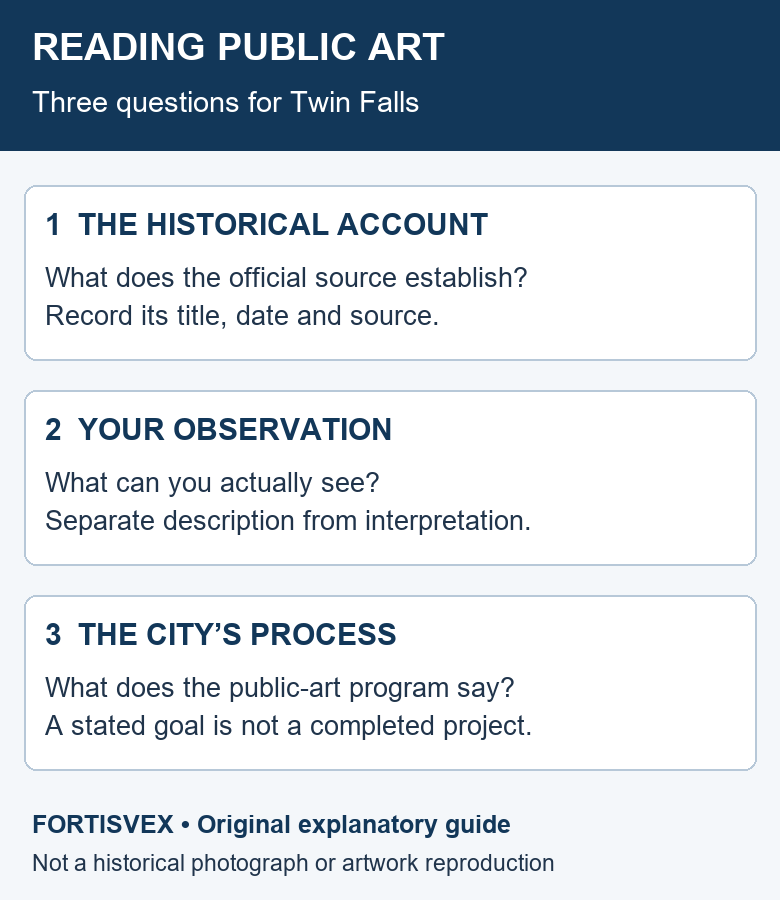
Give each entry three short sections. First, record the title exactly as the official source presents it, followed by the source address and the date you consulted it. Second, describe what you actually observed or what a clearly identified photograph shows. Third, write one question that the source does not answer. This keeps an interesting interpretation from becoming an invented fact.
For a group activity, compare the questions rather than ranking whose interpretation is best. One person may notice an animal, another the surveying subject and another the relationship between the work and its surroundings. Return to the source when someone makes a factual claim. Check current access separately before organizing an outing; this article is a reading guide, not a verified walking route.
Bring the Subject into an Idaho Display
A school or community-history display can place those notes beside an Idaho state flag. Label the flag as a present-day part of the display. The white surveying marker in the city’s Hayes account is not evidence that an Idaho state flag was used for that event, and the two should not be illustrated as the same object.
Choose a display flag by its actual listed dimensions and attachment details, not by the apparent size in a product photograph. Let the history remain the main attraction: a clear title, a concrete observation and an honest source reference can make a modest display useful without suggesting a city endorsement, a local FORTISVEX storefront or a historical connection the evidence does not establish.
Recent Posts
-
Choosing a Historical Flag Reproduction: More Than Counting Stars
Before choosing a historical flag for a classroom or display, finish this sentence: “This flag will …Oct 29th 2026 -
The Flag, the Pledge and the Anthem: A Clear Ceremony Cue Sheet
A flag enters the room, a host invites the Pledge of Allegiance, and a musician begins the national …Oct 29th 2026 -
Welcoming International Guests: Plan a Multi-Nation Flag Display
A display for visiting international guests begins with a different question from a display of the …Oct 29th 2026