
Troy, Idaho: A Town Remembered Through Names, Rails And Main Street
Troy, Idaho: A Town Remembered Through Names, Rails And Main Street
Troy sits in Latah County on the eastern Palouse. Its story is not contained in one founding date: the municipal record describes a settlement with earlier names, a railway connection and institutions that continue to collect its history. The city's location page places farming, ranching and timber within that setting. Those connections offer a better starting point than treating a small town as simply a stop along the road.
From Huff's Gulch To Vollmer And Troy
According to the city's historical account, the settlement was first known as Huff's Gulch. John P. Vollmer helped extend the Spokane and Palouse Railway from Moscow in 1890; the town subsequently took his name and incorporated as Vollmer in 1892. The same account describes a vote favoring the name Troy in 1897. These are retrospective municipal statements, not transcriptions of the original incorporation papers.
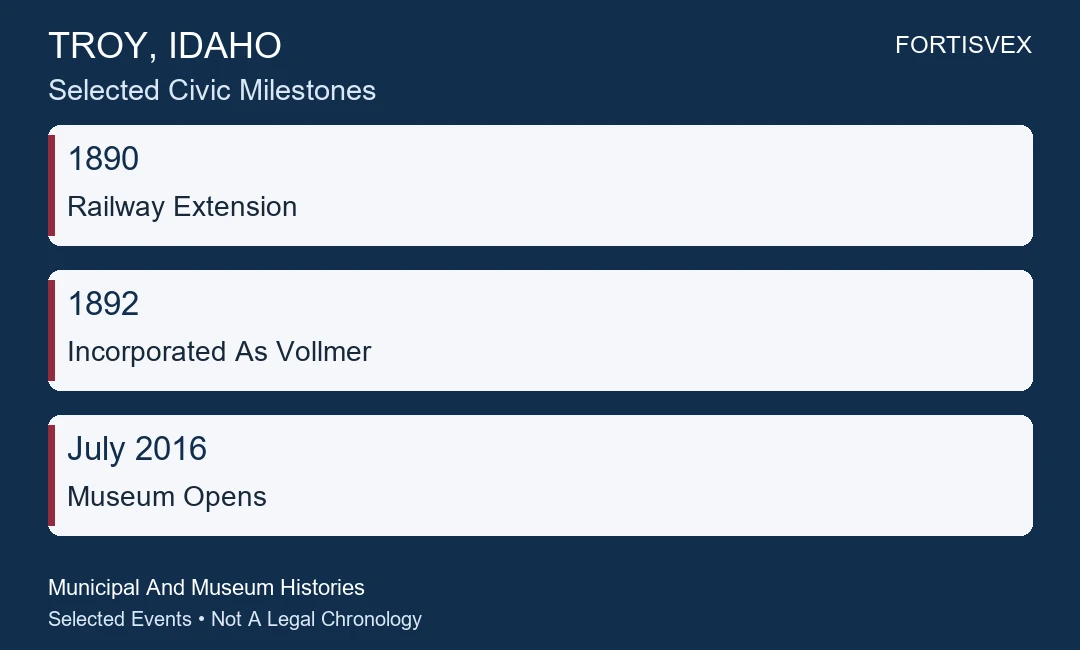
Diagram Text Equivalent: The city's history places the railway extension in 1890 and incorporation as Vollmer in 1892. The museum's own history dates its opening to July 2016.
Main Street Holds More Than Storefronts
The municipal resources page dates the community library's opening to summer 1977. It describes an initial Main Street office location, then a new building made possible through a donated lot, private contributions and Friends of the Troy Library fundraising. The Bohman Building was dedicated in September 1994. This history makes a useful distinction: a library's beginning and the dedication of its later building are different milestones.
The Troy Historical Society Museum describes another sustained community effort. An informal group began in 1992, incorporated in 2006, purchased museum property in 2015 and opened the museum in July 2016. Its collecting interests include photographs, documents, household objects, farms, schools, timber and local military participation. For a family or building research question, the museum offers a concrete place to begin; its website describes research assistance and changing displays. Check its current visiting information before making plans.
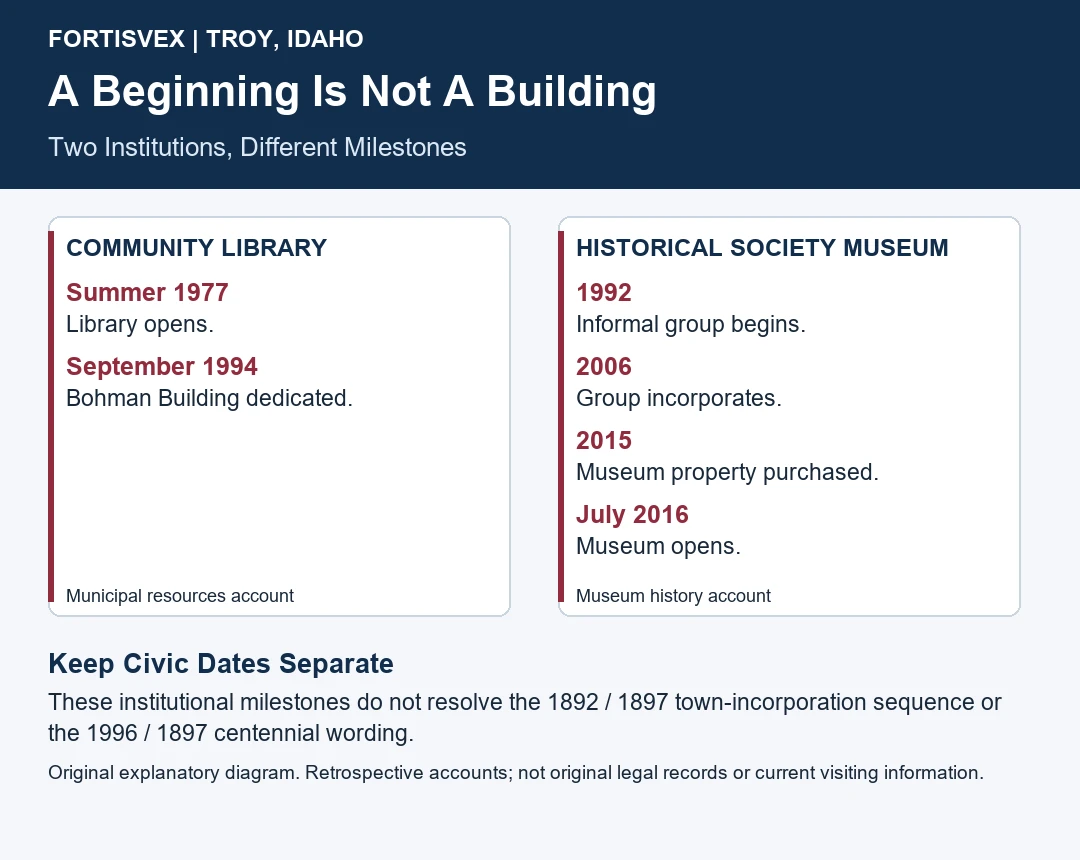
The library began in summer 1977; the Bohman Building was dedicated in September 1994. The museum account records an informal group in 1992, incorporation in 2006, property purchase in 2015 and opening in July 2016. Town-incorporation dates of 1892 and 1897 and the 1996/1897 centennial wording remain qualified and unresolved.
A Railway Corridor Has A Different Use Today
The city's recreation page describes the Latah Trail as a paved connection between Moscow and Troy occupying a former railroad right-of-way. It also identifies Troy City Park and Duthie Park, recording the Duthie family's gift of the latter in 1916. These places connect civic history with present-day recreation without requiring an invented reconstruction of the past.
Use current trail and park guidance for access, conditions and permitted activities. A historical corridor description is not a guarantee that every segment is open or suitable for every visitor.
Follow The Evidence Into The Present
For city business, begin with Troy City Hall and its linked agendas and minutes. For historical questions, compare the municipal narrative with the museum's records and ask which document supports a date. That approach keeps local recollection valuable without making it carry more certainty than the surviving evidence allows.
For a wider perspective on civic milestones and flag history, explore FORTISVEX History And Reference. Local incorporation, a community anniversary and statehood describe different events; keeping their labels clear makes each story more meaningful.
Recent Posts
-
Grace, Idaho: Understanding the Water Behind the Fields and the Powerhouse
Grace, Idaho: Understanding the Water Behind the Fields and the Powerhouse A canal and a hydroelect …Nov 4th 2026 -
Donnelly, Idaho: The Railroad Town and the Records Behind Its Story
Donnelly, Idaho: The Railroad Town and the Records Behind Its Story Donnelly's municipal history pl …Nov 4th 2026 -
Bovill, Idaho: Reading a Town’s History Through Family, Main Street and Celebration
Bovill, Idaho: Reading a Town’s History Through Family, Main Street and Celebration A family standi …Nov 4th 2026