
Washington State History: Statehood, Freedom, and the Green Flag
Washington became the 42nd state on November 11, 1889. The U.S. Senate's state chronology records that admission, but the date is a milestone rather than the beginning of Washington's history. Native homelands, maritime trade, territorial government, farms, forests, industry, and arguments over liberty all came before or continued after it.
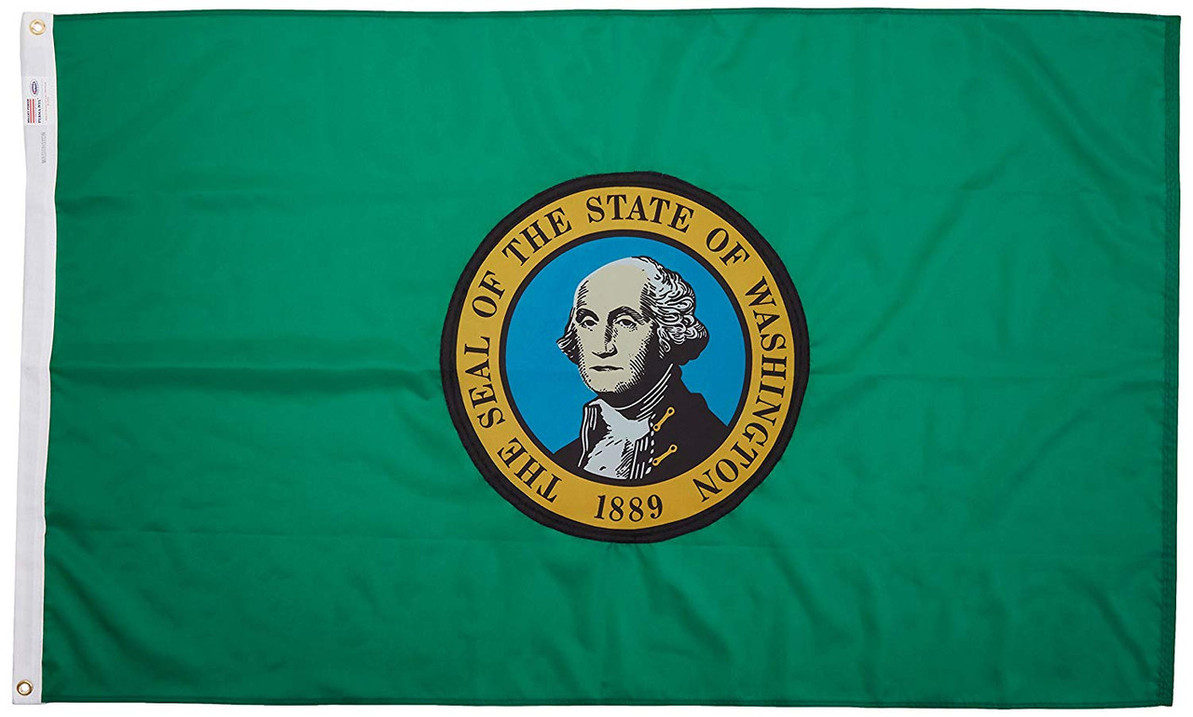
The face on Washington's green flag connects the state to the nation's founding. The history behind that flag also connects Americans to the people who built homes and businesses, served their country, challenged injustice, and wrestled with the responsibilities of self-government. Here is the fuller story, from before statehood to the modern state.
In this guide: Native homelands · Exploration and territory · The road to statehood · The early state · Dams and national defense · Modern Washington · Flag history · Choosing a flag.
Before statehood: a region of distinct Native communities
Long before there was a Washington Territory, people lived along the coast, around Puget Sound, and beside the Columbia River and its tributaries. Their communities were not interchangeable. Differences in language, geography, trade, food, and political relationships shaped distinct ways of life.
At Ozette on the Olympic Peninsula, archaeological work brought extraordinary evidence of Makah village life to light. A mudslide had preserved buildings and wooden objects; excavation beginning in 1970 recovered tens of thousands of artifacts. The Makah Cultural and Research Center's museum account hosted by the University of Washington explains how the findings confirmed Makah oral history about a great slide. The tribe retained the collection and developed a center to preserve and interpret it. This is a story of cultural continuity, not a vanished people discovered by outsiders.
Farther inland, salmon shaped food supplies, trade, and gatherings along the Columbia. Kettle Falls was an important meeting and fishing place for peoples from across the region. The Bureau of Reclamation's cultural history describes its significance to communities including the Sanpoil, Nespelem, Colville, Lakes, and Spokane. Rivers that later powered industries had already sustained societies for generations.
1805–1859: exploration, trade, and changing governments
Lewis and Clark reach the Pacific coast
In November 1805, members of the Corps of Discovery reached the lower Columbia and explored the coast near Cape Disappointment. The National Park Service's account follows Lewis's reconnaissance and Clark's later trip to see more of the ocean. The expedition expanded American geographical knowledge and demonstrated remarkable endurance. It did not arrive in a place without inhabitants, travel routes, or prior maritime contacts. The cape itself already carried a European name.
Fort Vancouver and the Oregon boundary
Established in 1824–1825, Fort Vancouver became the headquarters and supply center for the Hudson's Bay Company's Columbia Department. Its working community included trappers, traders, carpenters, blacksmiths, and families from varied backgrounds. The National Park Service's fort history places this commercial world on Cowlitz and Chinookan homelands.
The Oregon Treaty of 1846 placed the fort on the American side of the new international boundary. The U.S. Army established Vancouver Barracks nearby in 1849, and the Army and the company coexisted for years before the company left in 1860. The transition from fur-trade headquarters to American military presence shows that national borders, local communities, and business networks did not change in a single uncomplicated moment.
1853: Washington becomes a territory, not yet a state
Congress created Washington Territory in 1853. President Millard Fillmore signed its organic act on March 2, establishing a framework for territorial government. The Washington Legislature's territorial history explains that system, which lasted until statehood in 1889. Territorial status brought American institutions, but it was not the same as equal state representation in the Union.
The proposed name was Columbia. During congressional consideration, Representative Richard Stanton of Kentucky offered Washington instead, honoring the first president. The state park history of the Monticello Convention traces the naming decision and petitions for separate government. The name explains the presidential portrait's later place on the state seal and flag; it was not chosen because George Washington had personally governed or explored this western territory.
Treaties and the limits of a simple settlement story
Territorial growth involved more than new towns. The Treaty of 1855 with the Yakama and associated tribes and bands ceded extensive lands while reserving a homeland and specific fishing, hunting, and gathering rights. The Yakama Nation publishes the treaty text, including the June 9 agreement and the later 1859 ratification. Those dates and provisions matter: the creation of a territory or state did not simply erase the promises made to Native nations.
For readers who value the rule of law, this is a central point. Government commitments must be judged by what they promised, not only by what became convenient as settlement increased.
The Pig War: restraint at an unsettled border
The 1846 boundary agreement did not resolve which channel should divide the San Juan Islands. In 1859, the killing of a pig on disputed land helped trigger a confrontation between American and British forces. The situation was serious enough to risk a wider conflict, but commanders and diplomats avoided battle. Joint occupation followed until arbitration resolved the boundary in favor of the United States in 1872. The National Park Service's Pig War history tells a useful patriotic story: disciplined restraint can serve a nation as effectively as force.
1878–1889: building the case for statehood
Washington did not become a state on its first constitutional attempt. In 1878, delegates meeting in Walla Walla drafted a constitution that voters approved, but Congress did not complete the action needed for admission. The University of Washington Law Library's constitutional history distinguishes that document from the constitution adopted in 1889. The earlier effort helped prepare the way without itself creating a state.
Economic development strengthened the territory's case. Transcontinental rail connections in the 1880s brought people and investment while opening distant markets for timber and other products. Rail transport also changed how logging operated. The University of Washington's regional history describes the acceleration from a relatively isolated economy to one connected more closely with the rest of the country. That growth depended on workers and infrastructure as well as natural resources.
Opportunity was not offered equally. On November 3, 1885, a mob forced Chinese residents out of Tacoma, despite Chinese workers' contributions to regional development. The city's Prairie Line Trail interpretive history documents the expulsion. A history that honors enterprise must also acknowledge when people were denied the security of their homes and livelihoods because of their ancestry.
A constitution, disputed questions, and a proclamation
The 1889 enabling legislation opened the way for Washington, Montana, and the Dakotas to form state governments. Seventy-five Washington delegates convened in Olympia on July 4 and completed their work in August. John P. Hoyt served as convention president. The Legislature's convention record identifies the delegates and the resulting vote.
Not every important issue was settled inside the convention. Voters faced separate questions concerning prohibition, women's suffrage, and the seat of government. They rejected prohibition and women's suffrage in 1889. Olympia led the capital vote without securing a majority, requiring another contest in 1890. The Senate-published History of the Washington Legislature describes those debates. Statehood involved choices about public power and political participation, not merely a celebration.
On October 1, 1889, voters approved the constitution by 40,152 to 11,879. President Benjamin Harrison proclaimed Washington's admission on November 11. The constitution's official preface records the sequence. November 11 is therefore Washington's statehood birthday; July 4 marks the convention's opening, not admission.
The year of statehood also demanded rebuilding
Seattle's Great Fire on June 6, 1889, destroyed much of its business district and waterfront. Businesses reopened in tents while rebuilding and improvements to fire protection and water supply began. The Seattle Municipal Archives' documents show both individual losses and public responses. The new state's future was being constructed quite literally by merchants, tradespeople, workers, and neighbors recovering from disaster.
1890s–1920s: enterprise, service, and broader citizenship
The Klondike gold rush brought Seattle another opportunity. When news of northern gold discoveries reached the city in 1897, outfitters, hotels, shipping businesses, and suppliers served people heading to the goldfields. The gold was in northwestern Canada, not underneath Seattle. The National Park Service's Klondike history explains how a city could prosper by supplying an economic rush elsewhere. It is a classic example of opportunity found through useful services, not only through striking a rich claim.
National defense also became part of the state's industrial foundation. The Navy established its Puget Sound station in 1891. It built vessels during World War I and later repaired battle-damaged ships during World War II. The Navy's shipyard history connects generations of Washington workers to the readiness of the American fleet. Their contribution included skilled civilian work as well as uniformed service.
Mount Rainier National Park, created in 1899, represented another decision about the region's future. Scientists, conservationists, businesses, and railroad interests supported protecting the mountain for different reasons. The park's official history explains how preservation and tourism developed together. Washington's scenery became both a shared inheritance and a source of livelihoods, raising questions about access and stewardship that continue today.
Votes for women and a contentious labor era
Washington women secured statewide voting rights in 1910 after sustained organizing. Emma Smith DeVoe and May Arkwright Hutton were among the campaign's leaders. The National Park Service's western suffrage history describes public meetings, advertising, parades, and alliances that helped win support. The achievement came before the federal Nineteenth Amendment, but it should not be confused with an immediate end to every racial or citizenship barrier to voting.
Industrial expansion also brought conflicts over wages and authority. In February 1919, a shipyard wage dispute widened into the Seattle General Strike, with workers in other trades joining the stoppage. The University of Washington's General Strike Project preserves contemporary documents and competing accounts. The episode belongs in a history of American freedom because it involved workers' organization, employers' interests, public order, and fears about political radicalism. It is better understood through evidence than through either a heroic legend or a single hostile label.
1930s–1940s: dams, aviation, and the national war effort
Grand Coulee Dam brought major construction employment during the Depression and a new scale of hydroelectric power. Its early-1940s generating capacity supported wartime aluminum production and the industries that depended on it. The National Park Service's engineering history explains the links among federal investment, private contractors, skilled labor, and the defense economy.
The benefits had costs. The dam blocked salmon from reaching the upper Columbia, and the reservoir inundated Kettle Falls and other places important to tribal communities. The Bureau of Reclamation's account acknowledges those changes. Celebrating engineering achievement need not mean overlooking the families and resources affected by it.
Boeing, founded in 1916, grew from a small aircraft enterprise into a major wartime manufacturer. After World War II, commercial jet production became another powerful source of industrial work around Puget Sound, including the 707 and later aircraft programs. Boeing's historical account of its Washington facilities follows the connection from early workshops through wartime production and the jet age. The story includes engineering initiative, investment, manufacturing skill, and the risks of a cyclical industry.
Wartime power also tested constitutional principles
On March 30, 1942, Japanese American residents of Bainbridge Island were forcibly removed from their community under wartime exclusion orders. Families were incarcerated away from their homes, including at Manzanar and later Minidoka. The National Park Service's memorial account preserves their experience and the support some neighbors offered. The defense of America and the protection of civil liberties must not be treated as unrelated subjects. This history shows why constitutional limits on government matter especially during fear and crisis.
At Hanford, construction of B Reactor began in 1943, and the reactor became operational in 1944. It produced plutonium used for the Trinity test and the atomic bomb dropped on Nagasaki. The National Park Service's B Reactor interpretation explains the facility's place in the Manhattan Project. Hanford later expanded during the Cold War. Its history combines scientific and industrial achievement, national defense, the terrible human consequences of nuclear warfare, and an enduring responsibility for radioactive waste.
Seattle’s Space Needle was built for the 1962 World’s Fair. Its official history connects the landmark with the fair’s vision of the space age, another chapter in the state’s relationship with technology and public imagination.
1970s to the present: technology, treaty rights, and stewardship
Treaty fishing rights remain consequential
Native leaders and fishing families challenged state restrictions during the Fish Wars of the 1960s and 1970s. In 1974, Judge George Boldt's decision in United States v. Washington affirmed treaty fishing rights and recognized tribes' share of the harvestable fish covered by those treaties. It also helped establish a stronger tribal role in fisheries management. The Northwest Indian Fisheries Commission's history connects the decision to earlier treaty promises and the work of advocates such as Billy Frank Jr. The lesson is not that promises expire when they become inconvenient.
1980: Mount St. Helens changes the landscape
The eruption of Mount St. Helens on May 18, 1980, devastated the surrounding area and killed 57 people, including USGS volcanologist David Johnston. The U.S. Geological Survey's account describes the collapse of the volcano's north flank and the eruption that followed. The event became a defining reminder that Washington's landscape is active, powerful, and not fully controllable. Scientific observation, preparedness, and respect for natural hazards belong alongside appreciation of its beauty.
Software joins the state's industrial story
Microsoft moved from Albuquerque to Bellevue in 1979 and to its Redmond campus in 1986. The company's official historical timeline records those transitions. Software became a major part of the state's identity alongside aerospace, ports, farms, and forests. This was not a simple replacement of manual work by office work: growing technology businesses also depended on construction, electricity, transport, education, and services supplied by other people and industries.
Long-term responsibilities outlast the original projects
At Hanford, the 1989 agreement among the Department of Energy, Environmental Protection Agency, and Washington's Department of Ecology marked the shift toward a major cleanup mission. The Department of Energy's historical overview explains that transition. Wartime service and cleanup accountability are not opposing values. A country can honor the people who served while insisting that hazardous legacies be addressed.
On the Elwha River, a different restoration effort removed two dams between 2011 and 2014. The National Park Service's research overview describes renewed access for fish, sediment movement, and the continuing study of ecosystem recovery. Dam removal did not make restoration instantly complete. It created a long-term opportunity to observe how a river and its living communities respond.
On March 22, 2014, the Oso landslide killed 43 people and devastated the community of Steelhead Haven. The U.S. Geological Survey's ten-year retrospective describes the disaster's effects on families, responders, scientific research, and public awareness. It also cautions that better scientific understanding does not automatically eliminate the risks faced by established communities. Washington's recent history includes this continuing work of learning from loss without promising that every danger can be engineered away.
Washington also remains an agricultural state. USDA's 2025 overview, checked October 23, 2026, lists 31,500 farm operations and 13.7 million acres operated. Apples, potatoes, wheat, cherries, hops, and dairy products appear among its major agricultural outputs. These dated figures help correct a city-centered picture that overlooks the farms, ranches, and smaller communities beyond the best-known technology centers.
Constitutional freedom is part of the inheritance
Washington's Declaration of Rights locates political authority in the people and protects individual rights, private affairs, and the home. Article I, section 24 protects an individual citizen's right to bear arms in defense of self or state, while also stating that the provision does not authorize private armed bodies. The official constitutional text supplies that distinction. Support for the Second Amendment fits with responsible ownership, lawful conduct, and respect for neighbors. This history is not a current carry-law guide.
Why George Washington appears on the state flag
1889: the Talcott brothers create the seal
The state seal came before the official state flag. In 1889, Olympia jeweler Charles Talcott proposed a simpler alternative to an elaborate design containing scenery and industry. He drew circles using an ink bottle and a silver dollar, then placed a Washington postage-stamp portrait in the center. Grant Talcott did the lettering, and George Talcott cut the die after finding a clearer portrait for the finished work. The Secretary of State's seal history preserves this practical, inventive origin.
The original concept was not the last word in its appearance. Many versions circulated before designer Richard Nelms produced a standardized insignia in 1967 using a Gilbert Stuart portrait of Washington. That development explains why a modern seal is not simply an enlarged copy of the original postage stamp.
1923: Washington adopts its official flag
Before official adoption, communities used several banners, including a gold Washington profile on blue and seal-centered designs on purple or green. In 1923, lawmakers adopted the dark-green flag with the state seal in its center. The Secretary of State's flag history distinguishes those earlier banners from the official design.
The dates should stay separate: 1889 for statehood and the seal's original design, 1923 for the official state flag, and 1967 for the standardized seal. The documented record does not support substituting a supposed 1914 flag-design contest for that chronology.
Reading the modern design accurately
The current flag statute specifies dark green with a reproduction of the state seal. Fringe is optional; when used, it is gold or yellow matching the seal. The gold ring, blue portrait background, black lettering, and presidential likeness make the design recognizable. The date beneath the portrait is 1889, not the year the flag was adopted.
Green can naturally remind viewers of Washington's forests and landscape. That is a reasonable personal association, but it should not be presented as a detailed official symbolism statement that the adoption law does not make. Likewise, the portrait honors the state's namesake; it does not mean George Washington visited the state or designed the flag.
Choosing and displaying a Washington flag
Washington's birthday shares November 11 with Veterans Day, but the two observances have different origins. Statehood in 1889 preceded the 1918 armistice that inspired the later federal observance; Congress changed Armistice Day to Veterans Day in 1954. The Department of Veterans Affairs' holiday history explains that development. A November 11 display can honor both occasions while keeping their meanings distinct.
- Choose the right period. A modern green flag is appropriate for a present-day display. A historical exhibit about 1889 should not silently present the 1923 official flag as if it already existed.
- Use an accurate label. “Washington: admitted November 11, 1889; official state flag adopted 1923” separates the two milestones clearly.
- Inspect the portrait and lettering. The seal's detail should be clear. A modern catalog illustration is not an original nineteenth-century artifact or proof of a particular procurement certification.
- Match the product to the setting. Compare actual dimensions, fabric, attachment method, and stated indoor or outdoor use. Follow the flagpole and hardware manufacturer's requirements for your installation.
- Maintain the display. Inspect outdoor fabric and attachments, follow care instructions, and replace worn items. A well-kept flag communicates respect more effectively than a neglected one.
Explore Washington state flags at FORTISVEX and compare the selected product's specifications. For the rest of the Union, use our U.S. state birthday calendar.
Washington's flag can express pride in state and nation at the same time. Its fullest meaning comes from knowing the history: enterprise and service, constitutional freedom, the discipline of self-government, and the responsibility to tell the American story honestly.
Recent Posts
-
Choosing Standard or Deluxe Flag Arrangements
If you are replacing the hardware that connects a flag to an internal-halyard cable system, start wi …Oct 24th 2026 -
Custom Flag Artwork: What to Check Before Approving a Proof
A custom flag proof should answer the questions that are expensive to discover after printing: Is th …Oct 24th 2026 -
Why Does a Flag Look Backward on the Reverse Side?
You turn a flag over and its lettering reads backward. That does not automatically mean the flag was …Oct 24th 2026