
Statehood Dates: Why Ratification and Admission Are Different Milestones
A state birthday can mark a constitutional decision, a congressional admission or another defining event. Naming the milestone makes a history display more accurate.
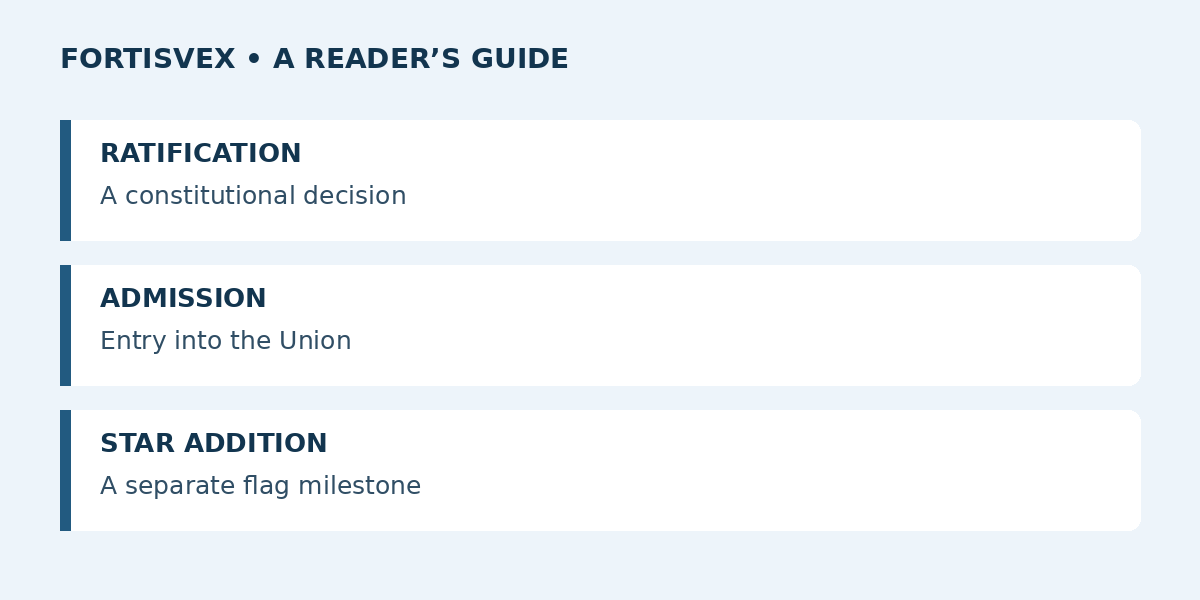
The original states ratified a new Constitution
The National Archives explains that the Constitution went to state ratifying conventions after the Philadelphia convention. Article VII required nine ratifications for the Constitution to take effect among ratifying states. State conventions, rather than Congress, performed that ratification. The familiar ordering of the original thirteen therefore records their decisions about the new Constitution. It does not mean those communities first appeared, first developed governments or first declared independence on their ratification dates. The Archives’ Constitution questions and answers gives the sequence, beginning with Delaware and ending with North Carolina and Rhode Island after Washington’s inauguration. These are constitutional milestones within a longer history.
Admission describes a different question
For states added after the original thirteen, an admission date identifies their entrance into the Union. Vermont offers a clear comparison: the National Archives dates its statehood to March 4, 1791. Its census guidance even explains why Vermont’s enumeration associated with the first federal census took place in 1791. The example shows why a generic heading such as “founded” would be misleading. A community can have an extensive history before state admission. A state can also have earlier constitutions, political arrangements or territorial experiences that deserve their own entries. Keep those events separate rather than asking a single anniversary date to stand for all of them.
Build a three-column display label
Use three columns in your working notes: date, event and source. A fourth column for “what this does not establish” can be surprisingly useful. For a ratification entry, that last column might say “not the date the state’s first community was founded.” For an admission entry, it might say “not the first settlement date.” You do not need to put every qualification on the public label. The working note helps you choose a precise short sentence. “Ratified the U.S. Constitution” and “admitted to the Union” tell the reader more than a bare birthday, while still fitting on a small display card.
The flag adds another date to check
A state’s admission date and the addition of its star to the national flag need not be identical. The federal rule in 4 U.S.C. § 2 places the added star on the next July 4 after admission. That is a separate milestone, not an error in the statehood date. When a display combines a state flag with an earlier national star count, record both dates before choosing the design. Our historical U.S. flags collection is a useful starting point for comparing periods; the individual product’s material, dimensions and mounting details remain separate purchasing questions.
A simple example of better wording
Imagine a school preparing two cards for a chronological display. One card says “Delaware: first state.” The other says “Vermont: fourteenth state.” Those ordinal labels can be retained, but adding the kind of event prevents confusion: Delaware’s place in the original-state sequence concerns constitutional ratification; Vermont’s March 4, 1791 milestone concerns admission. A visitor can then understand that the numbers belong to a national ordering without assuming that every state followed the same process. This is an editorial example, not a suggestion that two short cards tell the complete history of either place.
Keep the state flag’s own history separate
A statehood anniversary does not prove that today’s state flag design existed on that date. For a historically specific scene, investigate the flag itself: what design is documented, what source describes it and what period the evidence supports. For a modern anniversary celebration, a present-day state flag may serve a different purpose. Make that purpose clear in the caption. “A modern display celebrating statehood” is a more careful description than “the flag flown at statehood” unless you have evidence for the latter. The same distinction applies to costumes, seals and other objects used to make an anniversary presentation more engaging.
A practical review before the display goes up
Read every caption aloud without its photograph. Does the sentence still identify the event? Does “this date” have an obvious referent? Check that the source supports the wording rather than merely mentioning the state. Then examine the display as a whole: a modern flag, a historical flag and an archival document may each answer a different question. Give each its own label. If you are choosing a current national flag to accompany the display, compare the specifications in our American flags collection rather than treating a historical illustration as a modern product specification.
Sources and further reading
Recent Posts
-
South Korea’s Taegeukgi: Check the Four Trigrams and Artwork Orientation
The South Korea flag, known as the Taegeukgi, is a good example of why artwork review should go beyo …Nov 2nd 2026 -
Brazil Flag Artwork: Check the Star Map Before Approving the Proof
The blue globe on a Brazil flag rewards a closer look. When buying a flag or reviewing a production …Nov 2nd 2026 -
Mexico Flag: The Eagle Is Part of the Design, Not an Optional Logo
A Mexico flag can look familiar at a glance while still needing a closer artwork check. When compari …Nov 2nd 2026