
How Semaphore Makes Letters: The Sender, the Receiver and the Viewpoint
In a photograph of semaphore, the small flags are only part of the story. The positions in which a person holds them carry the information. Looking carefully at the arms changes the scene from a sailor holding two pieces of cloth into a person communicating across a distance.
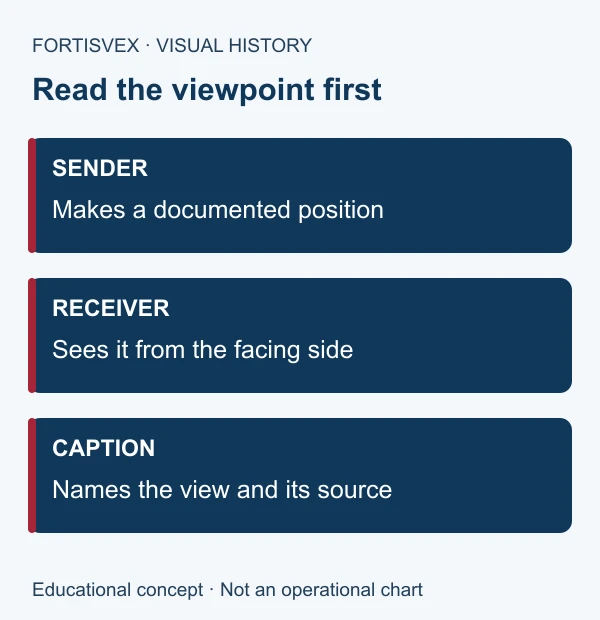
A visual alphabet, not a collection of letter flags
NATO’s explanation of signaling describes semaphore as communication with hand-held flags whose positions represent letters or numbers. The person changes the arrangement to change the character. This differs from identifying a patterned flag in a flaghoist. Understanding that distinction is enough to begin reading a museum display without pretending to know the message. Read NATO’s explanation of semaphore and other signaling methods.
For a visitor, the first useful question is therefore not “Which letter is printed on that flag?” It is “What position is the sender making, and which chart is being used to interpret it?” That question keeps the attention on the system instead of the decoration.
A wartime teaching tool explains the viewpoint
The Canadian War Museum’s naval-history exhibition presents a Second World War semaphore training tool from the Naval Museum of Quebec’s Bouchard Collection, catalog number 1999.20.87. Two disks helped learners associate letters with flag positions. The example shown is the letter C. The museum explicitly distinguishes a receiving view on the left from a sending view on the right. Examine the museum’s semaphore training tool.
That distinction solves a familiar difficulty with illustrated movement. When two people face each other, an arm on one side of the sender appears on the opposite side of the receiver’s view. An unlabeled drawing can leave a learner unsure whether to imitate the picture as though looking in a mirror or to interpret it as the person across the space would see it.
A good educational graphic answers that question in its caption. It should say whether the viewer is facing the sender or seeing the sender’s perspective. Cropping away the label can remove an essential part of the lesson even when the figure remains perfectly sharp.
Communication still depended on people
The museum notes that semaphore remained important during the Second World War even with widespread radio use. That is a useful corrective to a simple story in which each new invention instantly replaces everything before it. The training object records an investment in a human skill: seeing a position, recognizing it and coordinating with another person.
A later naval photograph also places semaphore outside a purely nineteenth-century setting. NHHC’s catalog entry L09-01.01.01 identifies a semaphore scene aboard USS Enterprise in March 1962. The date and ship are documented; the catalog does not give a decoded message. A responsible caption can explain the communication method without claiming to recover words that the record does not supply. Read the Enterprise photograph’s catalog description.
What one still photograph can tell you
A still image preserves a moment. It may show the sender, the flags, the surroundings and a recognizable pose, but it does not preserve an entire exchange. Before translating a position, establish that the picture shows a completed character rather than movement between characters. Where that cannot be established, identifying the activity is more defensible than guessing a letter.
For a school or museum project, keep three labels beside any example: the source, the viewpoint and the limit of the interpretation. A useful caption might identify a documented training chart and explain what its two views demonstrate. It need not manufacture a dramatic secret message to make the object interesting.
FORTISVEX’s introduction to nautical signal-flag sets explains a different visual system. Reading the two subjects together helps distinguish the pattern of a flag from the position of a hand-held flag. Both reward careful observation; neither can be reliably interpreted by color alone.
This article explains historical visual communication. It is not a signaling procedure, qualification course or maritime safety reference.
Recent Posts
-
South Korea’s Taegeukgi: Check the Four Trigrams and Artwork Orientation
The South Korea flag, known as the Taegeukgi, is a good example of why artwork review should go beyo …Nov 2nd 2026 -
Brazil Flag Artwork: Check the Star Map Before Approving the Proof
The blue globe on a Brazil flag rewards a closer look. When buying a flag or reviewing a production …Nov 2nd 2026 -
Mexico Flag: The Eagle Is Part of the Design, Not an Optional Logo
A Mexico flag can look familiar at a glance while still needing a closer artwork check. When compari …Nov 2nd 2026